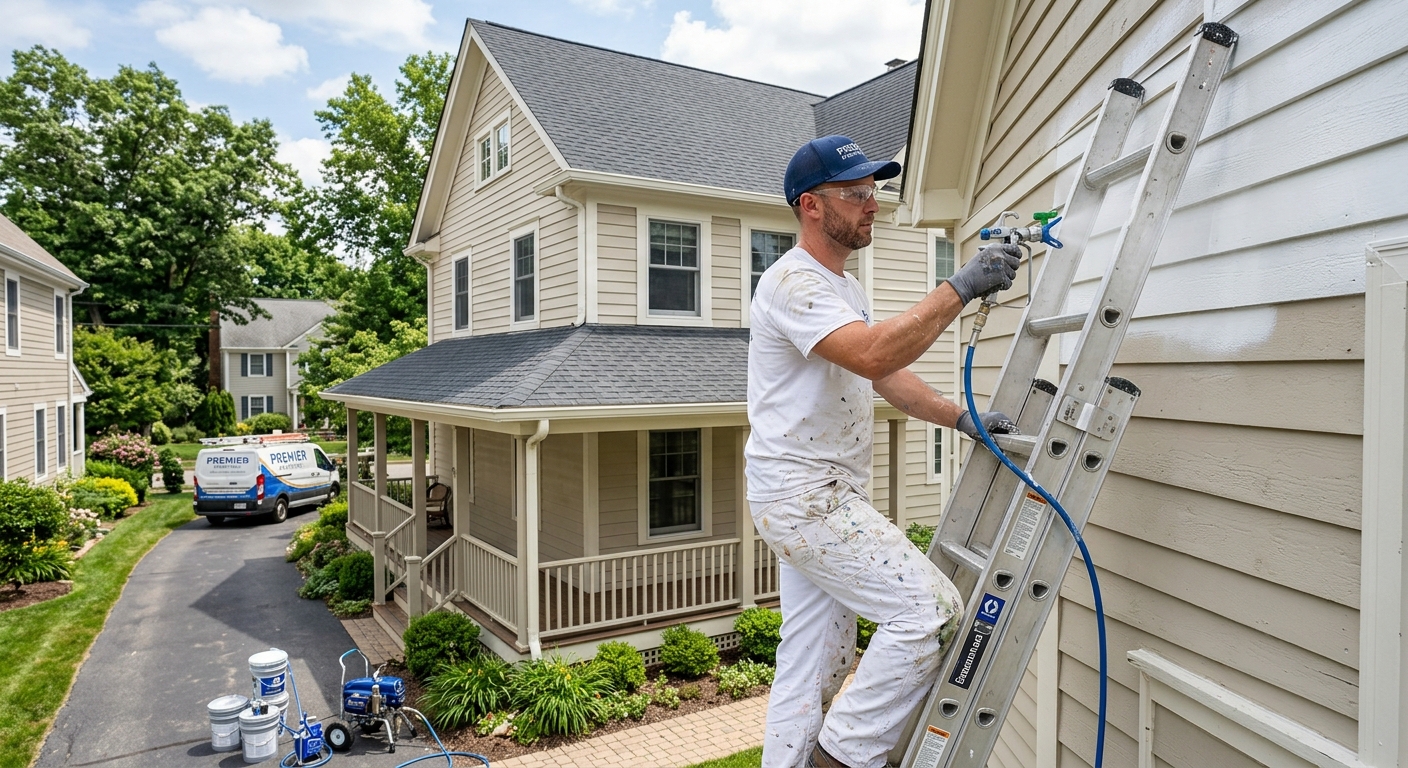
Painting options and costs in Markham
Painting in Markham can look straightforward on paper, but the final cost depends on how much prep your house needs and how the Toronto-area season lines up with your schedule. In Markham, about 18.5% of homes were built before 1981, which usually means more surface work—scraping loose paint, sanding blistered areas, caulking gaps, and priming to lock down older layers. Those extra steps are labour-heavy, and in pre-1978 properties contractors commonly use lead-safe methods even when permits aren’t required for painting itself.
On top of prep, our climate directly affects timing and pricing. In the Greater Toronto Area, exterior crews typically work from late May through June and again from September to mid-October, when temperatures stay above roughly 10°C for proper application and curing. Summer demand can spike in June–August, and that’s when it’s common to see exterior pricing run about 10–15% higher due to limited “ideal” weather windows.
Interior work is less weather-dependent, so you’ll often get more flexible starts and better scheduling for occupied homes around Unionville and parts of Markham Village—particularly when you want a same-week finish before moving in or before spring events. For most homeowners, choosing between interior refreshes and full exterior repaints comes down to budget, but also to how long you want the finish to last.
Below is a realistic snapshot of typical options so you can compare quotes line-by-line, then we’ll explain what drives the biggest differences between them.
| Service |
What's Included |
Typical Duration |
Price Range |
| Interior — whole home (walls, ceilings, trim) |
Move/cover protection, patching as needed, sanding, priming selected surfaces, 2-coat finish on walls/ceilings, caulking trim, brush/roll paint, standard trim touch-ups |
5–10 business days |
$2,200–$6,000 |
| Interior — per room (standard bedroom or living room) |
Prep and patching, spot-priming, 2-coat walls, ceiling coat (per scope), masking and basic trim paint touch-up |
2–4 business days |
$400–$1,600 |
| Exterior — full house (siding, trim, soffits) |
Pressure wash (where appropriate), scrape/sand loose areas, caulking, spot-priming, 2-coat system, paint to siding/trim/soffits, protection/masking, cleanup |
7–16 business days |
$3,500–$8,000 |
| Exterior — trim and accent colours only |
Targeted prep on trim, caulking, priming as required, 2-coat paint on accent areas, masking and cleanup |
3–8 business days |
$1,500–$4,200 |
| Kitchen cabinet painting (doors, frames, spray finish) |
Degrease, degloss/light sanding, dust control, bonding primer, sprayed doors/drawers, brushed frames (per plan), hardware handling, 2-coat finish system |
7–15 business days |
$1,900–$4,000 |
| Specialty / faux finish (accent wall, texture) |
Surface build-out or priming, texture/application design, multiple thin coats (as needed), sealant if required, protection and cleanup |
2–6 business days |
$600–$3,800 |
Prices are estimates only and vary by project scope, site access and material selection.
What affects the price of painting in Markham
It’s normal to see quote differences of 30–50% for the “same” project across the Toronto region. In practice, contractors price for different levels of prep, different paint systems, and different access challenges (scaffolding/lifts, tight driveways, tall front elevations, and how much masking protection is required). Even paint brand can change labour indirectly—better systems can improve coverage and adhesion, but they still require the correct prep to actually perform.
For exteriors, the main scheduling driver is the tightly climate-bound season in this region. In Ontario, exterior work usually runs late May to early October, with temperatures staying above about 10°C for application and for curing for at least a full day or two. GTA summers also come with humidity spikes and frequent rain events, so crews must plan around weather windows. That differs from coastal BC, where persistent dampness increases mildew risk and product choice often shifts toward high-quality mildew-resistant systems. In Markham, the risk is more about rain, frost pockets, and curing time than year-round dampness.
Older housing stock changes the math. With pre-1981 homes making up 18.5% of the area’s dwelling mix, many repaints in Markham require more scraping, sanding, caulking, and priming—prep can represent 50–70% of total labour on a repaint. For example, a full exterior repaints budget might start around the lower end of the exterior range (closer to $1,500–$8,000 depending on scope), but once you account for multi-layer removal and extensive priming, it’s easy for the project to land closer to the mid-to-upper end.
Two local examples that routinely raise cost: (1) brick-and-aluminium combinations around Markham Village often trap caulk failures at transitions, requiring careful resealing before painting; (2) tall two-storey front elevations near Unionville may need a lift or scaffolding plan, adding labour hours. Conversely, costs can drop when the existing coating is well-adhered—fewer scrape/sand cycles and less primer.
| Price Factor |
Why It Matters |
Cost Impact |
| Surface prep — scraping, sanding, patching drywall or wood |
Prep determines adhesion and how long the paint lasts; older layers often need more mechanical cleaning and patching |
Often +20% to +60% versus “light prep” quotes |
| Number of coats — 2-coat system over primer vs. 1 coat over existing |
Missing primer or reducing coats causes patchy sheen and faster breakdown in Ontario’s freeze–thaw cycle |
Typical variation: +$300 to +$1,200 depending on coverage and substrate |
| Paint quality tier — contractor-grade vs. premium (Benjamin Moore, Sherwin) |
Better binders and pigment packages improve hide and durability, especially on exterior trim and high-touch interior areas |
Materials can swing +$150 to +$800 on many residential scopes |
| Ceilings and trim — adds significant time vs. walls-only |
Trim requires caulking/edge work and controlled brush technique; ceilings require ladder management and cutting-in |
Interior jobs can add +10% to +35% |
| Exterior season window — short season raises summer rates |
Limited ideal weeks concentrate demand; rainy periods can delay crews and increase minimum job costs |
Common +10% to +15% in June–August |
| Lead-safe precautions — required for pre-1978 homes with lead paint |
Safe handling increases set-up time, containment, and disposal procedures when lead is present |
Often +$250 to +$1,500 depending on paint condition and containment needed |
| Surface material — drywall vs. plaster vs. wood vs. stucco |
Each substrate needs different primer and leveling; plaster and older wood often need more prep |
Can change prep time by +15% to +45% |
| Height and access — multi-storey exterior requires scaffolding or lifts |
Access equipment increases labour and logistics; staging time can be significant on split-levels and tall fronts |
Typical +$300 to +$2,000 on exterior trims |
Permits & regulations in Ontario
In Ontario, painting generally does not require a permit. There are, however, important health and job-safety practices—especially in older Markham homes. For houses built before 1978, health guidelines recommend testing for lead paint before sanding, scraping, or any operation that creates dust. If lead is present, professionals typically use lead-safe work practices such as wet methods to minimize dust, HEPA vacuuming, proper containment, and correct disposal of debris. This isn’t usually a homeowner-permit requirement, but contractors commonly follow it as standard practice to protect your family and their crew.
What usually requires permits (in Ontario) is not the paint itself, but other related work—examples include structural changes, certain envelope modifications, or work covered under specific property alterations. For routine interior painting, exterior repainting, trim painting, and cabinet painting, permits are typically not required.
When you hire in Markham, verify the basics before the first drop of paint. Step-by-step: (1) ask for the contractor’s Ontario business information and check any licensing/registration details through the appropriate provincial or business listings; (2) request a certificate of liability insurance showing they’re insured for your property and that coverage is active on your dates; and (3) confirm WSIB/WCB (workers’ compensation) coverage for their workers. Then get a written contract that states the paint brand/line, sheen levels, number of coats, prep inclusions (scraping/caulking/priming), and what happens with protection and cleanup.
Interior vs exterior painting — getting the best result in Markham
In Markham, the difference between a long-lasting paint job and a premature failure is usually prep quality and the right coating system for our conditions. For interiors, surface preparation matters more than picking a “top shelf” paint off the shelf. Filling and sanding nail pops, smoothing patch repairs, and priming stained areas are what stop flashing and peeling. Sheen choice also affects performance and cleaning: flat for low-traffic ceilings, eggshell or satin for most living areas, and semi-gloss on doors, trim, and higher-touch surfaces. A two-coat finish over a proper primer generally outlasts a one-coat “heavy” approach because it builds uniform film and reduces thin spots that show wear first.
For exteriors, preparation is even more critical because Ontario’s freeze–thaw and rain events exploit weak adhesion and small gaps. Caulking should be done before painting so water can’t track behind the finish. Primers must match the substrate—different products are used on bare or chalky surfaces, on previously painted wood, and on difficult areas like transitions and exterior trim. Unlike coastal BC where mildew-resistance is a constant theme, Markham’s main risks are weather timing and curing after rain or cool nights—so the coating needs temperature-stable application performance and a system that tolerates humidity spikes.
Cabinet painting is a budget-friendly option to replacement when the prep is thorough: degreasing, deglossing, bonding primer, and a durable sprayed finish. For pre-1978 homes, contractors should also use lead-safe methods if scraping or sanding is needed on older trim and railings.
Here’s a practical example: if a whole exterior repaint lands closer to the middle of the exterior range (around $3,500–$8,000), the additional prep and priming can be worth it. Skipping prep to “save” a few hundred dollars often costs more later when peeling returns to the same edges and caulk lines.
| Project Type |
Key Prep Step |
Recommended Coats |
Price Band |
| Interior — fresh drywall (new construction) |
Prime properly for absorbency and sealing; sand and remove dust before topcoat |
1 primer coat + 2 finish coats |
$1,200–$4,800 |
| Interior — repaint (good condition, no repairs) |
Light scuffing, caulking minor gaps, spot-priming any stained areas |
1 bond/spot-prime + 2 finish coats (typical) |
$400–$3,200 |
| Interior — repaint (patching and priming needed) |
Skim/patch, sand flush, prime repairs to prevent flashing |
1 primer/patch primer + 2 finish coats |
$800–$6,000 |
| Exterior siding (wood or fibre cement) |
Thorough scrape/sand, caulking transitions, and correct primer on bare or chalky areas |
Spot primer + 2 finish coats |
$3,500–$8,000 |
| Exterior trim and accents only |
Edge prep and caulking before paint to stop water ingress |
Primer where needed + 2 finish coats |
$1,500–$4,200 |
| Kitchen cabinets (spray finish) |
Degrease + bonding primer with heavy sanding/degloss control |
Primer + 2 finish coats (sprayed) |
$1,900–$4,000 |
How to choose a painting contractor in Markham
Choosing a contractor in Markham starts with verification and clarity. First, confirm they carry liability insurance—ask for the certificate of insurance and ensure the coverage is current for your project dates. Next, verify WSIB/WCB coverage so you’re not exposed if a worker is injured on-site. Then ask for proof of registration/licensing where applicable and make sure their contact information is consistent across quotes, invoices, and scheduling. A reputable team will provide paperwork without pushing back.
Get 2–3 itemised written quotes rather than a single lump sum. The best quotes break down labour and materials (prep, primer, paint, caulking, masking/protection, cleanup and disposal). Read the scope carefully: ask what’s excluded (window trim glazing, repairs beyond patching, rot replacement, lead-safe containment if needed, and any permit-related work—even though painting itself typically doesn’t require permits in Ontario). Warranty terms should be stated in writing: workmanship warranty length, whether the product/manufacturer warranty applies, and if it’s transferable to you. Payment schedule matters too—never pay more than 10–15% upfront. Hold back the remainder until the job is complete and you’ve confirmed touch-ups and final cleanup. Finally, demand a written start date window and an estimated completion date that considers our exterior season constraints.
- Ask for certificate of liability insurance and confirm dates match your job.
- Request proof of WSIB/WCB coverage.
- Get an itemised quote (labour vs materials), not just a total.
- Confirm the exact paint line/brand and sheen (flat/eggshell/satin/semi-gloss).
- Verify number of coats and where primer is included.
- Check prep inclusions: scraping, sanding, caulking, patching, priming bare/failed areas.
- Confirm protection: floors, railings, landscaping, and ventilation for indoor work.
- Ask how they handle prep dust and disposal (especially for older trim).
- For exterior: confirm pressure washing approach (where appropriate) and re-wash conditions if rain delays cure.
- Clarify warranty: workmanship duration and what voids it (missed maintenance, exterior recoat intervals, etc.).
- Payment terms: 10–15% max upfront; holdback until completion.
- Get a written schedule with milestones (prep, prime, first coat, final coat, cure time).
Red flags I see around Markham: (1) quotes that exclude surface prep while still targeting a “premium” finish look; (2) no proof of insurance/WSIB/WCB when you ask; (3) vague paint descriptions (“quality paint” without brand/line); (4) asking for large upfront deposits beyond 10–15%; and (5) no written scope that clearly lists coats, primer, caulking, and cleanup. If they can’t document it, you’ll usually pay later—in peeling edges, flashing patches, or rushed rework.
Frequently asked questions — painting in Markham
What's the difference between paint quality tiers?
In Markham (and across Ontario), “quality tier” usually refers to how the paint is formulated and what it covers for a given number of coats. Premium contractor lines tend to have better pigment and binder packages, which improves hide (coverage), adhesion, and durability—especially on exterior trim and areas that get repeated cleaning. That can reduce the chance you’ll see uneven sheen or early wear. Contractor-grade options can still look great if the prep is correct, but you may need more careful application or spot-primer work to achieve the same uniform finish. A practical budgeting approach: compare quotes not just by the dollar total, but by what they include (primer type, number of coats, and prep). For context, interior projects often fall within about $400–$6,000 depending on scope, while exterior work commonly starts around $1,500 and goes up to $8,000 when prep is extensive.
How do I compare painting quotes?
To compare quotes in Markham, insist on like-for-like scope: the same surfaces, the same sheen, and the same number of coats with primer specified. Look for prep inclusions first—scraping, sanding, patching, and caulking are where labour time lives. If one quote says “spot-prime as required” while another lists full primer coverage on bare/failed areas, that’s a major difference in expected longevity. Next, compare protection and cleanup: covering floors, masking, protecting landscaping, and disposal plans. Also confirm paint brand/line and whether the contractor is using a proper bonding primer when needed. Finally, check payment terms and warranty. A quote that’s cheaper but skips prep may look good short-term, yet it often pushes your cost higher later when you repaint the same problem spots.
What paint sheen should I use in different rooms?
Sheen choice in Ontario homes should balance cleanability, light reflection, and wall imperfections. For ceilings, flat is common because it hides minor unevenness and reduces glare. For most living rooms and bedrooms in Markham, eggshell or satin is usually ideal—eggshell is a bit more forgiving, while satin holds up better to scrubbing near high-traffic areas. For hallways, kids’ rooms, and kitchens, satin or semi-gloss on trim and doors helps the finish resist scuffs. Trim typically benefits from semi-gloss for easy cleaning. The key is consistency: if your contractor uses different sheens on adjoining surfaces, you can see banding even with excellent paint. A good quote also ensures the repairs are primed so sheen differences don’t highlight patch areas.
Can I paint my house exterior in spring or fall in Markham?
Yes—spring and fall can work well in Markham, but timing matters for curing and adhesion. In the Greater Toronto Area, exterior crews usually target late May to June and then again September into mid-October, when daytime temperatures are high enough (roughly above 10°C) and there’s enough time for the coating to cure after application. Spring can be tricky if you get cool nights and frequent rain right after prep. Fall is often better for temperatures, but you still need weather windows that allow full curing before cold snaps. If humidity spikes or rain interrupts, the contractor may need to adjust sequencing or revisit surfaces, which can affect your overall schedule. For homeowners comparing options, fall projects can be competitively priced, while late-summer work may cost more due to demand.
How do I choose a painting contractor in Markham?
Choose based on verification, clarity, and workmanship expectations. First, confirm they have liability insurance and WSIB/WCB coverage—ask for the documentation before signing. Second, request 2–3 itemised written quotes (labour plus materials) and make sure coats, primer, prep, and cleanup are clearly spelled out. Painting in Markham often involves more prep on older properties—since a meaningful share of homes were built before 1981 (Statistics Canada, 2021 Census), surface prep time can be a large part of the price. Third, confirm warranty terms in writing (workmanship length and what’s covered). Fourth, check payment schedule: never more than 10–15% upfront, with a holdback until the job is complete. Lastly, ensure the timeline includes realistic cure/weather considerations for exterior work.
How many coats does an exterior repaint need in Markham?
Most exterior repaints in Markham use a 2-coat system, but the exact number of total coats depends on what’s underneath and how much primer is needed. A typical approach is: scrape and sand loose areas, caulk gaps, prime bare or failed spots (and sometimes more extensively if the existing coating is compromised), then apply two finish coats to the full surface. If someone proposes “one coat total” on an exterior without primer or without addressing adhesion problems, that’s where you can see premature peeling or uneven sheen. Coats also depend on substrate and condition—wood and older trim, for example, can drink in product differently than previously painted siding. As a budgeting reference, exterior painting commonly lands within $1,500–$8,000 based on scope and prep demands in the GTA (Statistics Canada, 2021 Census provides local homeowner-household context).