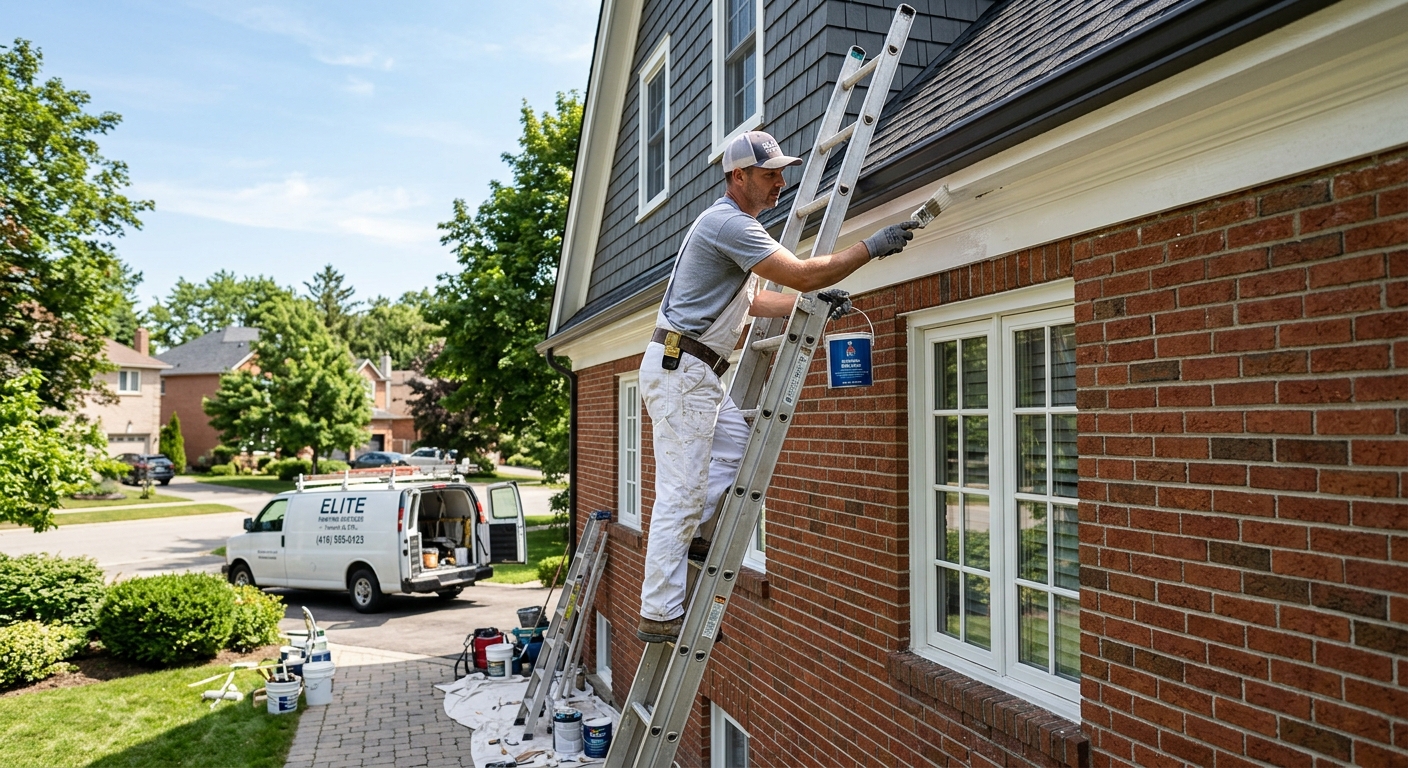
Painting options and costs in Vaughan
Vaughan homeowners typically have a wide range of painting options, but the real cost differences come down to prep time, finish level and the short exterior weather window. Vaughan has a lot of established housing—about 7.6% of homes were built before 1981, and many of these properties have older trim details and multiple paint layers. That usually means more scraping, sanding, caulking and priming before any topcoat goes on. On interiors, the biggest “hidden” driver is labour: masking, patching and ceiling work can quickly make a “simple refresh” feel like a full repaint.
In the Greater Toronto Area, exterior painting is tightly climate-dependent. Contractors generally schedule siding and trim work from late May through June, then again from early September to mid-October—when temperatures are above roughly 10°C for at least 24–48 hours and humidity is manageable for adhesion and curing. In June–August, demand spikes and ideal scheduling weeks can be limited, which often pushes exterior pricing up by about 10–15% compared with shoulder-season dates. Neighbourhoods like Maple (and surrounding areas near Vaughan Mills and Highway 400) tend to see strong contractor demand because of ongoing turnover and renovation cycles.
Use the table below as a starting point to compare common projects in Vaughan, then we’ll break down what moves those numbers up or down.
| Service |
What's Included |
Typical Duration |
Price Range |
| Interior — whole home (walls, ceilings, trim) |
Move/cover furniture, protect floors, fill & sand minor imperfections, caulk where needed, prime patched areas, 2-coat finish on walls/ceilings, paint trim/doors; clean-up and final walkthrough |
6–14 business days |
$2,000 – $6,000 |
| Interior — per room (standard bedroom or living room) |
Protect floors, patch & sand as needed, caulk trim gaps, prime if required, 2-coat finish on walls, spot-prime stains, paint trim/doors (if included in scope) |
2–5 business days |
$400 – $1,500 |
| Exterior — full house (siding, trim, soffits) |
Thorough wash, scrape/sand loose coatings, caulk openings, prime bare/prepped areas, 2-coat exterior system on siding; paint trim/soffits where accessible |
5–12 business days |
$4,000 – $8,000 |
| Exterior — trim and accent colours only |
Wash and prep areas, light scrape/sand, spot-prime, caulk where needed, 2-coat finish on trim/accents; minimal siding disturbance |
2–6 business days |
$1,500 – $4,500 |
| Kitchen cabinet painting (doors, frames, spray finish) |
Degrease and de-gloss, remove/label doors where feasible, repairs/sanding, prime suitable for cabinets, sprayed finish (doors/drawers), hardware masking, re-install and final protection |
5–12 business days |
$1,200 – $4,000 |
| Specialty / faux finish (accent wall, texture) |
Surface preparation for texture adhesion, base coat, specialized application, 1–2 colour layers depending on effect, protective topcoat where appropriate |
2–7 business days |
$600 – $5,000 |
Prices are estimates only and vary by project scope, site access and material selection.
What affects the price of painting in Vaughan
Even when two companies quote “the same” job, Vaughan prices can vary by 30–50% across the Toronto market because preparation standards and scheduling realities differ. Exterior work is especially sensitive: the exterior painting window in this region is roughly late May to early October, with contractors targeting days when temperatures stay above about 10°C and rise enough for proper film formation. When the season is short and demand concentrates, crews get booked earlier, labour rates can rise, and project start dates matter. Coastal BC often has a longer ability to paint, but high humidity and persistent dampness change coating selection and increase mildew-management steps; in the GTA, the main constraints are frost, rain and humidity spikes rather than year-round dampness.
Vaughan’s housing stock affects labour too. With many older homes, more repaint jobs require extra surface prep—commonly 50–70% of total labour. That can mean removing failing coatings, addressing cracked caulk lines, priming stained areas, and dealing with multiple paint layers on older trim and window surrounds. If you’re painting a house built in or before the late 1970s, professionals also treat sanding/scraping more carefully because lead-safe work practices may be needed (even though the legal requirement typically falls on regulated parties, the best practice is to plan for safety).
Concrete examples: a full exterior repaint can land closer to the upper end (for many projects $4,000 – $8,000) when scaffolding, lots of trim, and heavy scraping are required. A trim-and-accent refresh might stay nearer the lower band ($1,500 – $4,500) when siding is sound and prep stays to spot areas only. Finally, the region has a large base of owner households—about 85.9% of households own their home (Statistics Canada, 2021 Census)—so projects are often “done right,” with higher expectations for prep and finish consistency, which keeps pricing more stable but not cheap.
| Price Factor |
Why It Matters |
Cost Impact |
| Surface prep — scraping, sanding, patching drywall or wood |
Prep determines adhesion and whether peeling/repainting repeats; fixes are often labour-heavy and time-sensitive |
Often the largest swing factor; can change the quote by 20–40% |
| Number of coats — 2-coat system over primer vs. 1 coat over existing |
Dark-to-light changes, stain blocking, and patch coverage require proper layering for durability |
Typical add of 10–25% depending on coverage and condition |
| Paint quality tier — contractor-grade vs. premium (Benjamin Moore, Sherwin) |
Premium products often cover better and resist fading/marking longer, especially outdoors |
Material delta can add 5–15% overall, sometimes more if higher coverage reduces labour |
| Ceilings and trim — adds significant time vs. walls-only |
Cut-ins, masking, and multiple trim passes add labour even when surface area seems similar |
Can add 10–30% for interiors |
| Exterior season window — short season raises summer rates |
Limited “ideal” days and peak scheduling compress availability |
Often 10–15% higher in June–August than shoulder months |
| Lead-safe precautions — required for pre-1978 homes with lead paint |
Professional lead-safe work adds containment, HEPA cleanup and compliant disposal steps if lead is present |
Can add 10–25% on older trim/window/railing repaint scopes |
| Surface material — drywall vs. plaster vs. wood vs. stucco |
Different substrates need different primers and preparation techniques for best bond |
May shift labour 10–20% based on adhesion risk and repair needs |
| Height and access — multi-storey exterior requires scaffolding or lifts |
Access increases set-up time, safety requirements and sometimes crew size |
Can add 15–30% on two-storey exteriors or complex fascia/soffits |
Permits & regulations in Ontario
In Ontario, painting itself generally does not require a permit. However, there are important health and safety expectations—especially for older Vaughan homes. For properties built before 1978, health guidelines recommend testing for lead paint before sanding or scraping. If lead is present, professionals follow lead-safe work practices such as wet methods to reduce dust, HEPA vacuuming, and correct containment and disposal. That’s not typically a “homeowner permit” step, but it’s standard practice for professional contractors because lead exposure risk is real during surface prep.
What DOES require permits in typical homeowner painting scenarios? Most purely cosmetic paint jobs do not. Permits tend to come up when the project includes scope beyond painting—like replacing structural elements, changing building openings, or major exterior cladding work that involves different approvals. If a contractor suggests a permit is required just for “painting,” it’s worth clarifying what work they’re actually proposing.
Here’s how a Vaughan homeowner should verify your contractor before work starts:
- Ask for a clear certificate of insurance (liability) and confirm the expiry dates and listed work address.
- Confirm WSIB/WCB coverage—your contractor should be able to provide proof before crews begin.
- Request the written contract stating paint brand, sheen, number of coats, and exactly which prep tasks are included (wash, scrape, sand, caulk, prime).
- For pre-1978 properties, ask about lead-safe prep procedures and how they’ll control dust and dispose of debris.
- Get a start date and completion estimate in writing, not just a rough schedule.
Taking five minutes to check these items usually prevents weeks of delays and disputes later.
Interior vs exterior painting — getting the best result in Vaughan
In Vaughan’s climate, a long-lasting paint job is mostly about prep and the right system—not just the colour. For interiors, surface prep is the foundation: filling and sanding minor dents, addressing stains, priming patched areas, and properly caulking trim gaps. Sheen matters too. Flat paint hides wall imperfections but scuffs more easily; eggshell is a practical middle-ground for living rooms; satin or semi-gloss is usually better for kitchens, hallways and trim because it cleans well. The “two coats over the right primer” principle is what separates durable results from premature failure—one thick coat can look fine on day one, but it often wears unevenly and can show patch edges sooner.
For exteriors, prep in Ontario is even more critical because rain and humidity can interfere with curing if timing and application aren’t right. Caulk first, then paint: fresh caulking and proper tool-down are essential to prevent water ingress behind trim and into seams. Primer selection is substrate-dependent; bare wood, tannin-staining areas and previously stained surfaces often need a more appropriate primer, and existing coatings must be confirmed stable. In Vaughan, you don’t need the mildew-heavy product mindset you’d see in coastal BC, but you do need temperature-stable, exterior-grade coatings that can handle humidity spikes and freeze-thaw cycles.
Kitchen cabinet painting is where you can save money without sacrificing finish—often delivering a dramatic look for roughly $1,200 – $4,000 depending on prep and spray finish. If your cabinets are structurally worn, replacement might be the better value, but many Vaughan homes benefit from repainting because the prep plan is already known and controlled.
On lead-safe precautions: if your Vaughan home is pre-1978, ask how they’ll handle sanding and scraping on older trim and windows so dust is managed correctly. That planning can protect your home and your schedule.
| Project Type |
Key Prep Step |
Recommended Coats |
Price Band |
| Interior — fresh drywall (new construction) |
Prime properly and sand smooth before final colour application |
Primer + 2 coats |
$1,200 – $3,500 |
| Interior — repaint (good condition, no repairs) |
Wash/de-gloss lightly and spot-prime minor marks or stains |
2 coats |
$400 – $2,500 |
| Interior — repaint (patching and priming needed) |
Fill/sand imperfections and prime patches for uniform absorption |
2 coats over primer |
$800 – $4,000 |
| Exterior siding (wood or fibre cement) |
Wash, scrape failing areas, caulk seams, and prime bare spots |
Primer where required + 2 coats |
$4,000 – $8,000 |
| Exterior trim and accents only |
Feather/sand edges and prime bare or stained sections |
2 coats |
$1,500 – $4,500 |
| Kitchen cabinets (spray finish) |
Degrease, de-gloss, and prime for cabinet adhesion |
Primer + 2 finish coats |
$1,200 – $4,000 |
How to choose a painting contractor in Vaughan
Choosing the right painting contractor in Vaughan starts with verification. In Ontario, ask your contractor to provide proof of liability insurance and WSIB/WCB workers’ compensation coverage before work begins. Liability insurance confirms they can cover property damage; WSIB/WCB reduces your risk if a worker is injured on-site. Request the certificates directly and ensure they match the company name and, if listed, the job site. A reputable crew will not hesitate—“we can’t get you a certificate today” is a common warning sign.
Next, don’t accept lump sums without clarity. Get 2–3 itemised written quotes that separate labour and materials (paint, primer, patch materials) and specify what’s included. Read exclusions carefully: is exterior washing included, is lead-safe prep included if applicable, is disposal included, and are repairs limited to what’s visible or “minor fixes only”? Permits are usually not required for painting in Ontario, but you should still confirm what they assume and what they’ll do if conditions change (for example, rotten trim discovered during prep).
Look for a workmanship warranty length and whether it’s tied to specific surfaces and conditions. Product/manufacturer warranties can differ, and they may not cover improper application or failure due to inadequate surface prep. Payment should be staged: never more than 10–15% upfront; hold back the final portion until the job is complete and you’ve done a walkthrough.
- Confirm liability insurance and WSIB/WCB coverage using documents, not verbal assurances.
- Ask for a detailed scope: wash, scrape, sand, caulk, prime, number of coats.
- Request paint brand and sheen in the contract (not “equivalent” language only).
- Clarify prep inclusions: do they handle minor drywall repairs or just paint-ready surfaces?
- Confirm caulking type and where it will be applied (windows, trim joints, siding seams).
- Ask whether disposal and site clean-up are included.
- Check surface protection: drop sheets, masking plan, ventilation for interior work.
- Require an exterior schedule plan for Vaughan (rain delays, curing time, temperature targets).
- Get a written start date and completion estimate.
- Ask about colour changes on exteriors (how they handle undertones and coverage differences).
- Review warranty terms for workmanship and what voids it.
- Ensure a walkthrough happens before the final payment release.
In my experience, four to five red flags show up quickly in Vaughan: (1) “one-coat coverage” promises, (2) refusing to provide insurance/WSIB documents, (3) vague scopes like “prep as needed” without describing what happens, (4) asking for a large deposit (more than 10–15%), and (5) no written timeline or warranty terms.
Frequently asked questions — painting in Vaughan
How do I compare painting quotes?
To compare quotes in Vaughan, line them up by scope, not by the total number. Ask each contractor the same questions: is exterior washing included, how much scraping/sanding is assumed, and is caulking part of the price? Confirm the number of coats and whether primer is required on bare or stained areas. Make sure paint brand and sheen are listed—“premium” without specifying the product leads to surprises. For reference, interior projects can range from about $400–$6,000, while a full exterior repaint commonly falls in the $1,500–$8,000 range. If one quote is much lower, it often means less prep, fewer coats, or thinner material coverage.
What paint sheen should I use in different rooms?
Sheen choice depends on how the space is used and how easy you want it to be to clean. In Vaughan homes, living rooms and bedrooms often look best with eggshell or satin on walls—eggshell hides minor imperfections but still scrubs better than flat. Kitchens and hallways typically benefit from satin or semi-gloss on trim and higher-touch wall areas because fingerprints and smudges wipe easier. Ceilings are usually flat to reduce glare and hide roller marks. If you’re budgeting, the sheen difference is usually small compared with prep—proper filling and priming matter more for durability than picking a premium topcoat sheen.
Can I paint my house exterior in spring or fall in Vaughan?
Yes, and in many cases it’s smarter than painting in peak summer. In Vaughan, exterior work is limited by temperature and curing conditions; contractors typically target days when temperatures are around 10°C or higher and remain suitable for 24–48 hours after application. Spring can work if the surface is dry and weather stays stable, and fall often works well in early September through mid-October. Avoid early spring cold snaps and late fall frost/rain because adhesion and curing can suffer. A shoulder-season schedule may also help you avoid higher June–August demand pricing (often about 10–15% higher in peak weeks).
How do I choose a painting contractor in Vaughan?
Choose based on verification and detailed scope. First, request proof of liability insurance and WSIB/WCB coverage and check that the dates are current. Next, ask for a written, itemised quote with paint brands, sheens, number of coats, and explicit prep steps (wash, scrape, sand, caulk, prime). Make sure the scope matches your expectations—especially for older Vaughan homes, where multiple paint layers and more prep time are common. Get a workmanship warranty in writing and a payment plan that stays conservative—ideally no more than 10–15% upfront. Finally, confirm the start date and completion window in writing so you’re not waiting indefinitely when the weather shifts.
How many coats does an exterior repaint need in Vaughan?
Most exterior repaints require a 2-coat finish system for durability, but the exact build depends on how the surface is prepped and primed. If the siding is in good condition, you still usually need 2 coats of exterior paint, with primer applied to bare, stained, or repaired areas. If there’s significant scraping to clean back to stable substrate or repairs that need blocking, plan for primer plus 2 finish coats. This is why quotes differ: prep and priming aren’t optional. As a budgeting reference, a trim-and-accent scope might fall in the $1,500–$4,500 range, while a full house exterior repaint commonly lands in the $4,000–$8,000 band depending on access and surface condition.
What is the best primer for older Vaughan homes?
For older Vaughan homes—especially those with pre-1981 paint history—“best” depends on what you’re painting over. The right primer depends on substrate (wood, fibre cement, stucco) and the existing coating condition (sound versus peeling, stained versus clean). A contractor should assess adhesion, then choose a primer that can block stains and bond properly to the surface. If you have a pre-1978 property, professionals also plan lead-safe prep and HEPA cleanup if lead is present before sanding or scraping (this is best practice even though a homeowner typically doesn’t pull a permit). The key is that primer selection and surface prep usually affect long-term performance more than the brand of topcoat.