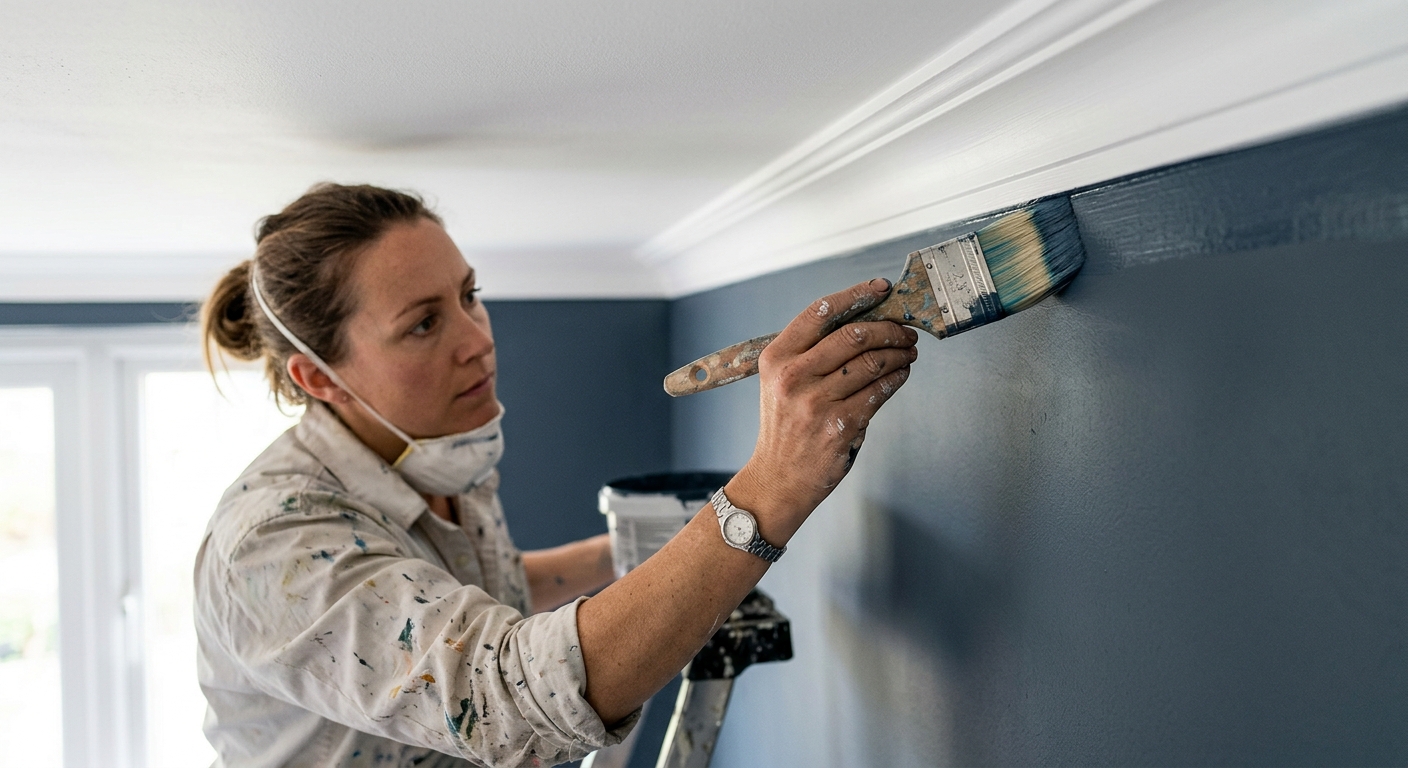
Painting options and costs in Grimsby
Painting in Grimsby usually comes down to how much prep your home needs and how busy the contractor schedule is during the short exterior season. With 42.2% of local homes built before 1981, a lot of properties start with aged trim, older caulking, and weathered surfaces that require more scraping, sanding, patching, and priming than newer construction. That matters because prep is often 50–70% of the labour on a repaint, especially when wood trim, stucco edges, and siding transitions have visible cracking or peeling.
In the Hamilton–Niagara Peninsula, the four-season continental climate tightens the exterior work window to roughly late May through early October. Contractors can’t reliably paint when surfaces are too cool or damp, and summer demand spikes for multi-storey homes around peak weeks—so you’ll often see higher quotes in July and early August. Areas with older, established neighbourhoods—like portions of west-end Grimsby near the Lake Shore Road corridor—tend to book quickly because there’s frequent demand for exterior refreshes and trim work.
Interior work is more flexible: drying time is usually manageable in summer and shoulder months, and you can often schedule without the same weather constraints that affect exterior adhesion and curing. If you’re comparing options, use the bands below as a starting point, then tighten the estimate once we know access, substrate condition, and which rooms or elevations are included.
| Service |
What's Included |
Typical Duration |
Price Range |
| Interior — whole home (walls, ceilings, trim) |
Ceilings, walls, caulking, sanding/fill where needed, primer as required, baseboards/door trim, prep protection and cleanup |
5–12 business days |
$1,800–$5,500 |
| Interior — per room (standard bedroom or living room) |
Walls, ceiling, cut-in, light patching, primer on stains/repairs as needed, basic trim touch-ups |
1–2 business days |
$500–$1,800 |
| Exterior — full house (siding, trim, soffits) |
Scrape/sand as needed, caulk, prime bare areas, paint system, protect landscaping, two-coat finishing where specified, cleanup |
3–8 business days (weather dependent) |
$3,500–$8,000 |
| Exterior — trim and accent colours only |
Trim/soffits/fascia and designated accents only; prep, prime where required, caulking and finish coats for targeted areas |
2–4 business days (access dependent) |
$1,500–$4,500 |
| Kitchen cabinet painting (doors, frames, spray finish) |
Degrease, sanding profile, repair prep, primer, sprayed topcoat, hardware masking, simple touch-ups |
4–10 business days |
$1,800–$4,500 |
| Specialty / faux finish (accent wall, texture) |
Surface prep for texture, custom application, multiple finish steps, protective sheen/clear where applicable |
2–6 business days |
$1,000–$5,500 |
Prices are estimates only and vary by project scope, site access and material selection.
What affects the price of painting in Grimsby
In Grimsby and the broader Hamilton–Niagara Peninsula, two quotes for the same visible square footage can differ by 30–50% because painting is largely a prep-and-access trade, not a “paint-by-the-can” job. Exterior work is tightly climate-bound in Ontario: contractors generally need late May to early October conditions where temperatures are above roughly 10°C and rising during application, and surfaces can dry between passes. Coastal BC typically enjoys a longer season, but humidity and rain increase the need for mildew-resistant systems and careful scheduling; Alberta can have longer dry windows but temperature swings can still affect cure and application timing. Here in Ontario, the short season concentrates demand, so summer scheduling pressure can push exterior rates higher—especially for houses that require lifts, scaffolding, or extensive repair.
Older homes drive cost in a very practical way. With 42.2% of homes built before 1981, more projects start with cracked caulking, aged wood trim, chalky paint, and stain bleed-through. Prep commonly becomes the budget lever: scraping plus sanding and priming can run $2,000+ on its own on a repaint, depending on how much of the surface is flaking or porous. That’s why a targeted “trim and accents” repaint may fit around the $1,500–$4,500 band, while a full exterior package often lands in the $3,500–$8,000 range once caulking, priming, and the full two-coat finish are included.
Concrete examples we see in Grimsby: (1) brick-to-siding transitions and window trim usually require more detail work and caulking than flat wall sections; (2) homes with south/west exposure that bake surfaces can peel paint faster, increasing scraping time; (3) good accessibility lowers the need for scaffolding time, which can noticeably reduce labour.
| Price Factor |
Why It Matters |
Cost Impact |
| Surface prep — scraping, sanding, patching drywall or wood |
Creates adhesion and smoothness; poor prep leads to peeling, flashing, or visible seams |
Often 20–50% of total job cost; can be higher on older exteriors |
| Number of coats — 2-coat system over primer vs. 1 coat over existing |
Primer plus two finish coats improves uniformity and durability |
Changing from “touch up” to full coverage can add $300–$1,500+ |
| Paint quality tier — contractor-grade vs. premium (Benjamin Moore, Sherwin) |
Coverage, scrub resistance, fade resistance, and hiding power differ |
May shift materials by roughly $200–$900 depending on scope |
| Ceilings and trim — adds significant time vs. walls-only |
Cutting in at detail lines increases labour and masking |
Walls-only vs. walls+trim can differ by $400–$1,200 per room |
| Exterior season window — short season raises summer rates |
Weather delays and peak demand compress scheduling |
Can increase exterior labour by 10–25% in peak periods |
| Lead-safe precautions — required for pre-1978 homes with lead paint |
Proper containment and HEPA cleanup reduce exposure risk during scraping |
Adds disposal/labour; commonly $300–$1,500+ depending on prep |
| Surface material — drywall vs. plaster vs. wood vs. stucco |
Different absorption and bond requirements change prep and primer choice |
May add $150–$800 for primer complexity and repair time |
| Height and access — multi-storey exterior requires scaffolding or lifts |
Access time drives labour; safety needs affect workflow |
Often adds $500–$2,500+ on multi-storey exteriors |
Permits & regulations in Ontario
In Ontario, painting a home generally does not require a municipal permit, because painting is treated as a finishing trade rather than a structural or occupancy-change project. Where regulation and safety practices come into play is for older homes—especially those built before 1978—because health guidelines recommend testing for lead paint before you sand, scrape, or disturb surfaces. If lead is present, professional lead-safe work practices are expected (for example, wet methods to reduce dust, HEPA vacuuming during cleanup, and proper disposal of debris). While these steps are not typically a homeowner “permit requirement,” they are the standard contractors follow because the work can create hazardous dust.
There are also a couple of items you can confirm without guessing. Ask your contractor to carry liability insurance and WSIB/WCB workers’ compensation coverage before work starts. Get a written contract that clearly lists paint brand and sheen, the number of coats, surface prep scope (what gets primed and what doesn’t), and what’s included for protection, cleanup, and waste removal.
How to verify in Grimsby: (1) ask for their certificate of insurance and check that it’s current; (2) confirm WSIB/WCB coverage via their documentation before crews begin; (3) ensure the contract spells out lead-safe procedures for pre-1978 areas if applicable; (4) for licensing, rely on the contractor’s business registration and any trade credentials they claim, and require proof if a licence is represented in the estimate. If anything is “verbal only,” that’s a red flag.
Interior vs exterior painting — getting the best result in Grimsby
In Grimsby’s four-season climate, long-lasting results come from matching the preparation to the substrate and choosing the right sheen and application system. For interiors, surface prep beats “brand hype”: filling nail holes and dents, sanding repairs smooth, removing dust, and spot-priming stained areas prevent flashing and uneven sheen. Sheen choice should also match room use. In living areas, eggshell or satin is typically easier to clean than flat, while ceilings are usually flat for reduced glare. Realistically, two coats over a proper primer outlast one thick coat—especially when you’re covering darker colours or patchy drywall repairs.
For exteriors, the job is won (or lost) on caulking, prep, and timing. Exterior paint adhesion in Ontario depends on clean, sound surfaces; peeling or chalky layers must be scraped and sanded back to a stable edge. Caulk first—then paint—so gaps don’t become water paths behind the coating system. Primer selection matters: different substrates (wood, fibre cement, previously painted surfaces) need the correct primer to seal porosity and prevent bleed-through. In this region, we also prioritise mildew-resistant formulations and proper dry-time management during the late spring–early fall window around Lake Ontario humidity.
Cabinet painting is often a cost-effective alternative to replacement when the cabinet boxes are solid and you’re accepting an updated finish. If you’re trying to budget, note that cabinets typically sit in the $800–$4,500 band depending on prep and spray finish; compared to replacement, labour and disposal savings can be significant, but only if the prep is done thoroughly.
Example: if an exterior repaint is quoted around $3,500–$8,000, that higher figure is often justified by more scraping/caulking and primer work—not the paint itself. Skipping those steps is what causes early peeling in our humidity and freeze-thaw cycles.
| Project Type |
Key Prep Step |
Recommended Coats |
Price Band |
| Interior — fresh drywall (new construction) |
Prime and seal drywall properly; sand for a uniform surface |
Primer + 2 finish coats |
$1,200–$3,800 |
| Interior — repaint (good condition, no repairs) |
Light scuff-sand, dust removal, spot prime any marks |
1–2 finish coats over appropriate primer |
$500–$2,500 |
| Interior — repaint (patching and priming needed) |
Patch, sand, and spot-prime repairs to prevent flashing |
2 finish coats after primer where required |
$800–$4,000 |
| Exterior siding (wood or fibre cement) |
Scrape/sand to sound edges, clean, caulk, prime bare/porous areas |
Primer + 2 finish coats (system dependent) |
$3,500–$8,000 |
| Exterior trim and accents only |
Detail prep and caulking; spot-prime for adhesion at cut lines |
2 finish coats over primer where needed |
$1,500–$4,500 |
| Kitchen cabinets (spray finish) |
Degrease, sand profile, prime for bonding, mask thoroughly |
Primer + 2 finish coats (often sprayed) |
$1,800–$4,500 |
How to choose a painting contractor in Grimsby
Choosing the right painting contractor in Grimsby starts with verifying the right coverage and then demanding itemised clarity. In Ontario, confirm they carry liability insurance and WSIB/WCB workers’ compensation coverage—ask for the certificates before scheduling crews. For the quote process, request 2–3 itemised written quotes that break out labour and materials (paint/primer supplies, surface prep materials, caulking, masking/disposal). Avoid “one line” estimates; painting problems often hide inside the scope.
Next, read the scope for what’s excluded: is disposal included, will they remove or move furniture, and is deck/rail or eaves work included for exterior projects? Confirm whether a permit pull is included (painting typically doesn’t need one, but any related work or investigations should be explicit). Also ask how they handle prep on older surfaces and whether lead-safe procedures apply if your home is pre-1978.
Warranty matters. Look for a clear workmanship warranty length, what it covers (peeling, adhesion failures tied to their prep, etc.), and whether product/manufacturer warranties apply separately. Payment schedules should be conservative: never pay more than about 10–15% upfront, and hold back until the job is complete and inspected. Finally, get the start date and completion estimate in writing, because weather delays can affect exterior work in the Hamilton–Niagara Peninsula.
- Proof of current liability insurance provided before work begins.
- WSIB/WCB coverage confirmed (not just promised).
- Written scope: surfaces included and surfaces excluded.
- Itemised materials list (primer, caulk type, paint line and sheen).
- Prep standards stated (scrape/sand/spot-prime, drywall patch approach).
- Coat count specified (e.g., primer + 2 finish coats).
- Protection plan documented (floors, landscaping, driveways, vents).
- Clear waste/disposal responsibility and haul-off included.
- Colour-change plan if painting over dark or high-porosity surfaces.
- Lead-safe procedure stated for pre-1978 areas if applicable.
- Schedule confirmed in writing with weather contingencies for exteriors.
- Warranty terms in the contract, including start date and coverage limits.
Red flags I commonly see in Grimsby: quotes with no primer/coat details, “we’ll just paint over it” language on flaking surfaces, pressure for large upfront payments, vague warranty wording, and contractors who can’t show insurance/WSIB/WCB paperwork when asked.
Frequently asked questions — painting in Grimsby
How much does it cost to paint a house in Grimsby?
For a typical Grimsby home, total cost depends heavily on prep and whether you’re doing interior, exterior, or both. For exterior only, many homeowners land in the $3,500–$8,000 range for a full house repaint once scraping, caulking, and priming are included (especially on older trim). Interior whole-home projects often start around $1,800 and can run to about $5,500 depending on how many rooms, whether ceilings and trim are included, and how much patching is needed. Because 42.2% of local homes were built before 1981, aged surfaces can require extra labour to prep properly for adhesion in Ontario’s weather. (Statistics Canada, 2021 Census)
How much does interior painting cost per room in Grimsby?
Interior per-room pricing usually reflects ceiling height, wall condition, and how much prep is needed. For a standard bedroom or living room with walls, ceiling, cut-in, and reasonable protection, you’ll often see a band around $500–$1,800 per room. If the room has lots of patching, stained areas, or you want the trim fully refreshed (not just a light touch-up), the job typically moves toward the higher end because primer and sanding time increase. In Grimsby’s homes—where many are older and can have wall texture or previous patchwork—you can also expect spot-priming to be part of a durable finish plan, which affects cost and coat count.
When is the best time for exterior painting in Grimsby?
The best window in Grimsby is usually late spring through early fall—roughly late May to early October—when surfaces stay dry and temperatures are suitable for proper adhesion and curing. Hamilton–Niagara Peninsula demand can spike in mid-summer because many homeowners line up exterior work for the same short weather window. If your schedule is flexible, shoulder weeks in spring or early fall can sometimes avoid peak rates and reduce weather-related downtime. Also, if your exterior includes detailed trim, soffits, or multi-storey access, booking earlier helps secure the right crew and equipment. In Ontario’s climate near Lake Ontario, humidity can also slow drying, which is another reason timing matters.
How many coats of paint do I need?
Most quality repaint systems in Grimsby use a primer plus two finish coats. Two coats improve uniformity and reduce the risk of uneven sheen, flashing, and premature wear—especially when covering darker colours, repairing drywall, or painting over porous or chalky surfaces. In interiors, if the surface is in good shape and colour change is minimal, some jobs may use 1–2 finish coats after the correct primer step. For exteriors, you typically need a full system approach: prep and primer where bare areas exist, then two finish coats for a proper protective film. When quotes differ widely, it’s often because the cheaper one is effectively reducing coats or skipping primer on key areas.
What paint is best for Grimsby's climate?
For Grimsby, “best” means the right product system for the substrate and the right durability for humidity and seasonal temperature swings. On exterior siding and trim, homeowners generally do best with a quality exterior paint system that includes appropriate primer and—where relevant—mildew-resistant performance. For interiors, choosing the right sheen for the room is often more important than chasing one brand: flat ceilings hide imperfections, while eggshell or satin on living areas resists scuffs and is easier to clean. If you have older wood trim and possible lead-safe considerations in pre-1978 areas, proper surface prep and correct primer selection are the biggest predictors of long-term performance.
How long does exterior paint last here?
With correct prep, caulking, primer selection, and proper timing within Ontario’s exterior season, many homeowners see exterior paint last several years, but the exact lifespan depends on how the surface was prepared and what failed first—adhesion, adhesion at caulk lines, or coating breakdown from moisture. Homes with aged trim, cracked caulking, or peeling paint started too soon (or without scraping to stable edges) often show problems earlier. If your exterior estimate includes thorough scraping/sanding and priming bare or porous sections, you’re paying for the parts that protect the coating system in Grimsby’s freeze-thaw and Lake Ontario humidity.