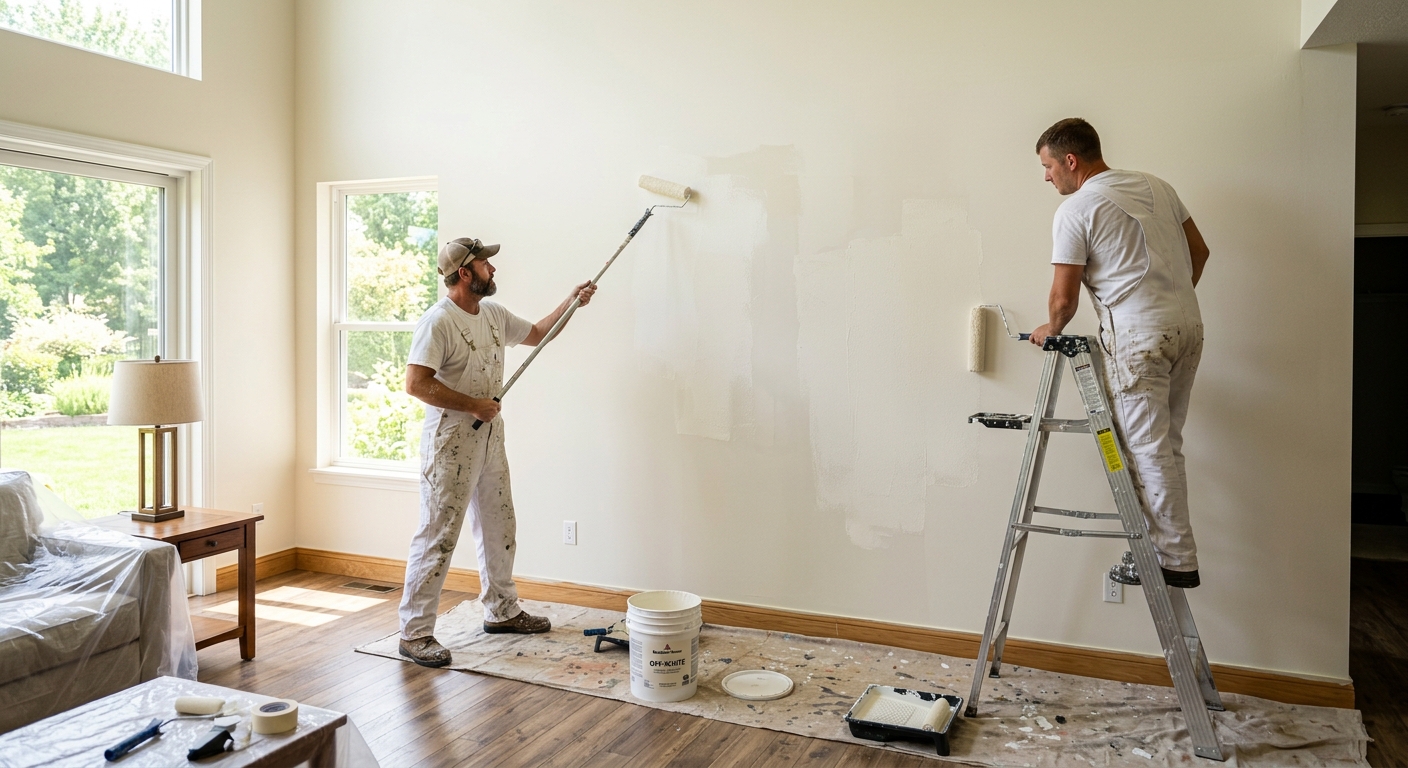
Painting options and costs in Hawkesbury
Painting in Hawkesbury is shaped by a mix of older housing stock and a short, dependable exterior season. In 2021, Hawkesbury’s population was 10,194, and a sizeable share of homes were built before 1981—60.1% of dwellings. Older surfaces usually mean more prep (scraping, caulking, patching and priming) before any colour goes on, which is where most of the cost difference shows up. If your home has pre-1978 coatings, professionals often plan for lead-safe work practices to control dust and manage cleanup, even when no permit is required.
In the Ottawa economic region, exterior painting is largely limited to late spring through early fall, when daytime temperatures typically sit around 10–30°C and nights stay above freezing—this supports proper curing and adhesion. That compressed demand window can tighten scheduling and push exterior rates upward compared with areas that can paint year-round. Interior work, by contrast, can be scheduled much more flexibly, but pricing still reflects premium low-VOC coatings and the time needed to prep aging drywall, plaster and trim.
In Hawkesbury, areas seeing steady work include the residential pockets around Notre-Dame Street and the surrounding neighbourhood streets, where repainting cycles are common in older single-detached homes. Below is a clear cost range comparison to help you budget before you request detailed, itemised quotes.
| Service |
What's Included |
Typical Duration |
Price Range |
| Interior — whole home (walls, ceilings, trim) |
Protect floors/furniture, prep and sand, patch and caulk where needed, prime repairs, apply 2-coat wall system and 2-coat trim/doors (sheen matched by surface) |
6–12 days |
$1,800 – $6,500 |
| Interior — per room (standard bedroom or living room) |
Prep, patch and sand, prime repairs, paint walls (2 coats) and touch up/paint trim as specified |
2–4 days |
$550 – $1,950 |
| Exterior — full house (siding, trim, soffits) |
Wash/rinse and remove flaking coatings, scrape and sand, repair caulking and damaged wood, prime bare areas, 2-coat exterior system on siding and 2-coat trim/soffits |
7–18 days |
$4,200 – $9,000 |
| Exterior — trim and accent colours only |
Prep and spot-prime as needed, protect landscaping, 2-coat trim/accent application (not a full siding repaint) |
3–8 days |
$1,200 – $3,800 |
| Kitchen cabinet painting (doors, frames, spray finish) |
Degrease and scuff, remove/label doors where possible, prime cabinets, spray doors/drawers for a smoother finish, paint frames (2-coat system) |
5–14 days (including dry/cure) |
$1,500 – $4,500 |
| Specialty / faux finish (accent wall, texture) |
Custom prep, base coat and layering, texture application, sealing for durability (as required by room use) |
2–7 days |
$500 – $3,200 |
Prices are estimates only and vary by project scope, site access and material selection.
What affects the price of painting in Hawkesbury
Even when neighbours agree to “the same job,” painting quotes across the Ottawa region—and across Ontario more broadly—can differ by 30–50%. The biggest drivers are not just paint brand; they’re surface condition, prep scope, access, and how a contractor prices risk during a short outdoor season. For exteriors in Ottawa, Cornwall and surrounding areas, work is concentrated late May through early October, when temperatures are roughly above 10°C during application and nights are less likely to dip below freezing. That shorter season compresses demand, and it often means fewer crews available when you want to start.
Across Ontario and Alberta, proper cure depends on steady conditions; if application is pushed into cooler or damp stretches, contractors may need extra time between coats. By comparison, coastal British Columbia’s marine climate brings persistent humidity and mildew pressure; crews typically use mildew-resistant products and do stricter moisture checks, which increases labour and material costs. Older homes are common here too—Hawkesbury’s larger pre-1981 housing share (60.1%) usually translates into more labour for scraping, caulking and priming to stabilize old coatings.
Concrete examples from Hawkesbury: a repaint where most surfaces are intact might land closer to the exterior range (for example, around the low end of $1,200 – $9,000 when it’s trim/accent only). But the same house, once flaking trim or failed caulking is discovered, can quickly add several days for repairs and a full primer/spot-prime plan, pushing the total toward the upper end. Interior jobs also shift: a quick refresh in good condition can fit the lower end of interior pricing (near $300 – $3,500), while ceilings with staining and patched drywall routinely require more sanding and sealing, which adds time.
| Price Factor |
Why It Matters |
Cost Impact |
| Surface prep — scraping, sanding, patching drywall or wood |
Prep is where adhesion and durability are won or lost |
Often the largest variable; can swing total by 20–40% |
| Number of coats — 2-coat system over primer vs. 1 coat over existing |
Existing coatings may not provide even film build or stain blocking |
Can add 1–2 days labour and extra materials |
| Paint quality tier — contractor-grade vs. premium (Benjamin Moore, Sherwin) |
Premium products typically cover better and resist scuffing/fading longer |
May increase materials but reduce rework |
| Ceilings and trim — adds significant time vs. walls-only |
Trim requires cutting in, multiple sheen considerations, and extra protection |
Typically increases cost by 15–35% for interior |
| Exterior season window — short season raises summer rates |
Scheduling pressure limits availability and increases crew premiums |
Can raise exterior estimates by 10–25% depending on timing |
| Lead-safe precautions — required for pre-1978 homes with lead paint |
Dust control, HEPA vacuuming and proper disposal add time |
Can add 5–20% if lead is present and containment is needed |
| Surface material — drywall vs. plaster vs. wood vs. stucco |
Different substrates need different primers and prep approaches |
Primers and labour time vary; can swing by 10–30% |
| Height and access — multi-storey exterior requires scaffolding or lifts |
More set-up time and safety measures |
Often adds several hundred to multiple thousand dollars on exteriors |
Permits & regulations in Ontario
In Ontario, painting itself generally does not require a permit. If you’re painting a typical home—interior walls, trim, ceilings or exterior siding—the process is usually handled under standard building and health-and-safety practices rather than permits. Where things change is around older coatings: for homes built before 1978, health guidelines recommend considering lead paint awareness before you sand, scrape or disturb flaking surfaces. For professional contractors, lead-safe work practices (such as wet methods, HEPA-filtered vacuuming, controlled sanding, containment when needed, and proper disposal) are standard when lead is present or suspected; for homeowners, it’s not a legal permit requirement, but it’s still the safest approach.
Also confirm your contractor has the right coverage. At a minimum, ask for liability insurance and workers’ compensation coverage (WSIB in Ontario). A clear written contract matters: it should specify the paint brand/line (or equivalent), sheen levels, number of coats, and the exact prep scope (repairs, caulking, priming) included.
To verify in Hawkesbury step-by-step: (1) ask for certificate(s) of insurance and confirm the named insured; (2) request proof of WSIB coverage; (3) check the contractor’s business registration/listing information through available provincial online resources; and (4) insist on a written scope that spells out what’s included and excluded (prep, disposal, and cleanup). If you can’t get these documents up front, treat it as a scheduling and cost risk.
Interior vs exterior painting — getting the best result in Hawkesbury
In Hawkesbury, a long-lasting paint job is mostly about prep and correct film build, not shortcuts. For interiors, filling and sanding matter more than the brand of topcoat—especially where hairline cracks, patched drywall, or older plaster transitions show through. Sheen choice is equally practical: flat works best for low-traffic ceiling areas, eggshell is commonly used for bedrooms and living rooms, satin handles scrubbing better in hallways, and semi-gloss is typically reserved for trim and doors. The durability difference between one “thick” coat and a true system is real: two coats over a proper primer generally outlasts one coat that tries to do all the coverage at once.
For exteriors, Ontario’s freeze-thaw cycles and wind-driven rain demand a careful sequence. Caulking before painting helps prevent water ingress at joints and trim lines. Primer selection should match the substrate—oil/alkyd primers or special bonding primers may be required over certain surfaces, while compatible latex primers are typical for newer or properly prepared materials. In this Ottawa region, products must also tolerate temperature swings during the late spring to early fall application window. You’ll sometimes see homeowners quote-warned about mildew resistance—while Hawkesbury isn’t coastal like BC, using a mildew-resistant system where moisture sits (shaded eaves, north-facing walls) helps prevent spotting.
Cabinet painting is a smart budget alternative to replacement when the frames and boxes are solid; a professionally sprayed finish can refresh your kitchen without full demolition. For pre-1978 homes, lead-safe controls are still the safest plan when sanding or scraping old coatings.
Example: if you’re deciding between interior repainting vs. exterior trim work, interior per room pricing often fits around $550 – $1,950, while exterior trim-only work commonly starts in the low end of the exterior range (around $1,200 – $3,800). That gap is justified when exterior repairs and primer/caulking are truly required, not when it’s only a cosmetic colour swap.
| Project Type |
Key Prep Step |
Recommended Coats |
Price Band |
| Interior — fresh drywall (new construction) |
Prime drywall thoroughly to seal and uniform absorption |
Primer + 2 coats |
$300 – $3,000 |
| Interior — repaint (good condition, no repairs) |
Light scuff/sand and clean, then spot prime as needed |
2 coats (primer only if required) |
$300 – $1,650 |
| Interior — repaint (patching and priming needed) |
Patch, sand smooth, caulk transitions, prime repairs |
1–2 coats depending on coverage + primer on repairs |
$450 – $2,400 |
| Exterior siding (wood or fibre cement) |
Scrape flaking areas, sand edges, repair caulking, spot prime bare surfaces |
Prime where needed + 2 coats |
$2,800 – $9,000 |
| Exterior trim and accents only |
Remove loose paint, clean and spot prime edges and stains |
2 coats (primer where required) |
$1,200 – $3,800 |
| Kitchen cabinets (spray finish) |
Degrease and scuff-sand, then prime for adhesion |
Primer + 2 coats (doors/drawers typically sprayed) |
$1,500 – $4,500 |
How to choose a painting contractor in Hawkesbury
Start by verifying coverage and credentials. In Ontario, painting does not usually require a permit, but it does require responsible work. Ask for liability insurance—request the certificate of insurance and confirm it’s current. Then ask for WSIB proof (workers’ compensation coverage). This is a homeowner protection: if a painter is injured on site, you don’t want the risk landing on you.
For quotes, get 2–3 options that are itemised. You want a breakdown for labour and materials (paint, primer, supplies), plus specific prep inclusions. Avoid quotes that only list a single “lump sum” without explaining surface prep, caulking, patching, priming, and disposal. Read the scope for exclusions like: asbestos/lead remediation, mould removal beyond spot treatment, power-washing availability, or ceiling height limitations.
Warranty matters too. Confirm the workmanship warranty length and what triggers it (peeling, blistering, cracking under normal conditions). Ask whether any product/manufacturer warranty is included and whether it’s transferable if you sell your home. Payment schedule should be conservative: never pay more than about 10–15% upfront, with a holdback until the job is completed, cleaned and touch-ups are done. Finally, get the timeline in writing: an expected start date and a completion estimate based on the season—especially for exterior work in Hawkesbury’s late spring to early fall window.
- Ask for proof of liability insurance and confirm the effective dates.
- Request WSIB coverage documentation (not just a verbal claim).
- Insist on an itemised quote: labour + materials, not a single total only.
- Confirm prep scope: scraping, sanding, patching, caulking, and priming.
- Check whether lead-safe practices are included or excluded for pre-1978 homes.
- Confirm paint line and sheen (e.g., ceiling flat, walls eggshell/satin, trim semi-gloss).
- Ask what’s included in surface cleaning (wash/rinse, degreasing for cabinets).
- Clarify the number of coats and when spot-priming replaces full priming.
- Ask how they protect landscaping, floors, and fixtures (drop cloths, masking).
- Confirm disposal and cleanup: brush/roller disposal, waste hauling, and final wipe-down.
- Review warranty terms in writing: workmanship coverage and limitations.
- Use a payment schedule with 10–15% maximum upfront and a holdback until completion.
Red flags I see in Hawkesbury include: a quote that skips or downplays surface prep (“no need to prime”), refusing to provide WSIB or proof of insurance, offering only lump-sum pricing without scope details, asking for large upfront payments (more than 15%) before any work begins, or giving a vague timeline with no written schedule—especially if they’re proposing exterior work outside the late spring to early fall window.
Frequently asked questions — painting in Hawkesbury
How many coats of paint do I need?
Most quality residential projects in Hawkesbury use a system of two coats for the colour layer, with primer included where it’s needed for adhesion and uniform coverage. If you’re repainting and the walls are in good condition, many contractors can paint two coats over a properly prepared surface; primer is typically limited to spots (stains, patched areas, bare drywall, or failed areas). On exteriors, the plan is usually primer where bare or compromised areas exist, then two full finish coats. The age of your home matters too—since many dwellings were built before 1981 (Statistics Canada, 2021 Census), prep often involves scraping and priming, which supports the two-coat durability approach. If you want a realistic budget, a typical per-room interior job often falls in the $300 – $3,500 interior band depending on repairs and trim.
What paint is best for Hawkesbury's climate?
For Hawkesbury and the Ottawa region, “best” means coatings that handle temperature swings during the late spring to early fall exterior season and can cure properly when nights stay above freezing. For exteriors, most homeowners are best served by a quality exterior house paint system that includes the right primer for your substrate and a protective finish designed for freeze-thaw and rain exposure. Where moisture tends to sit (shaded eaves, north-facing corners), ask for mildew-resistant options as part of the system—this is especially important on older homes where caulking and joints may have aged. For interiors, choose low-VOC, scrubbable finishes appropriate for the room’s use (eggshell/satin for walls, semi-gloss for trim). If you’re comparing quotes, don’t judge only by sticker price; better coverage can reduce rework and supports the expected lifespan. For exterior budgets, full-house projects commonly land in the broader $1,200 – $9,000 range depending on prep and accessibility.
How long does exterior paint last here?
In Hawkesbury’s Ottawa-area climate, exterior paint longevity depends heavily on surface prep and how well the system cures during the limited working window (late spring through early fall). With correct prep—scraping flaking areas, repairing caulking, priming bare substrate—and proper application conditions, many well-prepared exteriors can last roughly 7–12 years before noticeable repainting is needed. If a job tries to “paint over” failing coatings, expect premature peeling sooner because adhesion doesn’t recover on its own. Homes built decades ago often need more repairs before coating, which is why prep time is a major cost driver. Also, multi-storey access, damaged trim, and moisture issues can shorten life if not addressed. When you budget, interior and exterior pricing are different because exterior includes that heavier prep and weather-dependent scheduling—exterior trim-only may fit closer to $1,200 – $3,800, while full siding/trim work often needs more prep and lands higher.
Should I paint or replace my cabinets?
In Hawkesbury, many kitchens are good candidates for cabinet painting when the box structure and doors are solid, and the surfaces aren’t swollen or deeply water-damaged. Painting is typically the cost-effective option: it avoids demolition, plumbing/hardware disruption, and disposal of bulky materials. A professional sprayed finish can improve appearance significantly, and it can be done without the timeline of a full replacement. The trade-off is that cabinet painting requires careful prep—degreasing, scuff-sanding, priming, and a multi-coat system—so quality contractors include detailed steps in the quote. If your cabinets are sagging, have serious delamination, or the boxes are structurally failing, replacement may be more sensible. If you’re aiming for a mid-range refresh, cabinet painting commonly lands in the $1,500 – $4,500 range depending on door count, finish type, and how much repair is needed before spraying.
How do I prep walls before painting?
For a homeowner prep “starter,” the goal is to make surfaces clean and stable—no loose material, no dust, and minimal oils or contaminants. Start by removing anything on the walls, protecting floors and fixtures, and cleaning with a suitable degreaser or wall cleaner (especially in kitchens). Fill holes and cracks with a patch compound, then sand smooth once dry; wipe away sanding dust so primer and paint bond. If there are water stains, use an appropriate stain-blocking primer before colour. If the wall has flaking paint, don’t just paint over it—scrape back to sound material and address the cause if possible (moisture leaks). For high-traffic areas, check for glossy spots from prior paint; a light scuff helps the primer grip. In a finished quote, prep is usually included—so you can compare how contractors handle patching, caulking, sealing, and priming. This prep-heavy approach is part of why interior jobs can range widely—often within the $300 – $3,500 interior band depending on repair scope.
Do I need to worry about lead paint in an older Hawkesbury home?
Yes—at least as a safety consideration. In Ontario, painting itself usually doesn’t require a permit, but for homes built before 1978, health guidelines recommend being cautious with lead paint: testing for lead before sanding or scraping is recommended, and lead-safe work practices are important if lead is found. For professionals, that typically means wet methods to reduce dust, HEPA vacuuming, proper containment when needed, and correct disposal procedures. Homeowners may not have the same formal requirements as contractors, but the safest outcome is the same: don’t create dust you can’t control. In Hawkesbury’s older housing context (many homes were built before 1981—Statistics Canada, 2021 Census), plan for more prep time if coatings are aged or failing. When you get quotes, ask directly whether lead-safe precautions are included for pre-1978 materials and how they’ll protect you and occupants. This is one reason a “cheap” quote can be misleading—lead-safe controls add labour and materials.