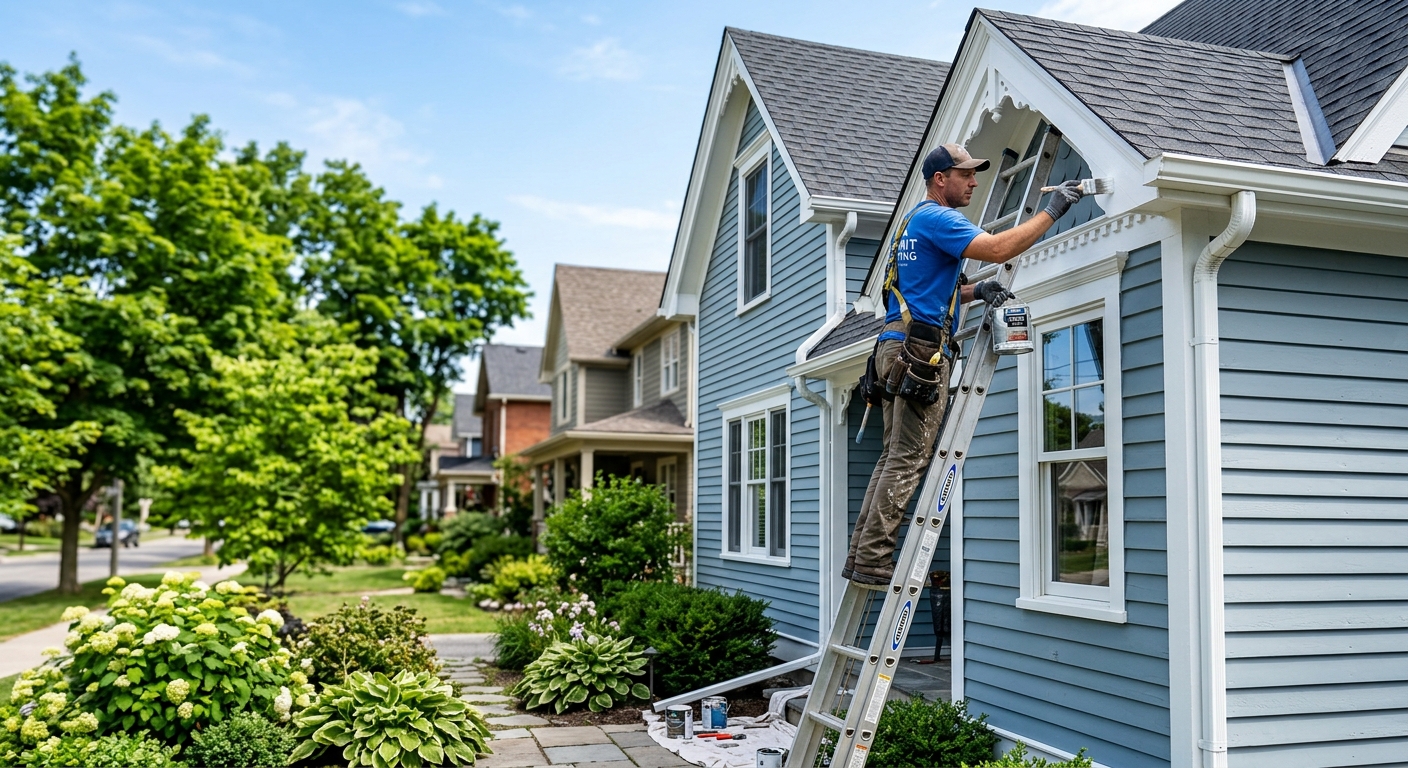
Painting options and costs in Welland
Welland is a great place to refresh a home, but painting costs can swing quickly from one quote to the next. That’s partly because many houses in the area are older—65.6% of dwellings were built before 1981—so you often get more scraping, caulking, drywall patching, and priming than homeowners expect. In a city with 16,315 homeowner households (69.0% of households own), the demand is steady, and repaint projects are common in neighbourhood pockets where single-detached homes dominate—especially around the older residential areas near central Welland. In practice, the Hamilton–Niagara Peninsula market is shaped by a short exterior season: contractors usually win or lose schedules based on whether late spring weather holds and whether surfaces stay dry long enough for adhesion and curing.
Interior work is typically easier to schedule, and you’ll usually see contractors adding dates in summer and early fall when there’s good indoor light and faster dry times. Exterior work, on the other hand, tends to spike during peak summer because the late spring–early fall window is tightly climate-bound. That pressure is more noticeable on multi-storey homes or projects that need repairs to wood trim, soffits, or deteriorated caulking—common in older housing stock. You’ll also see quote differences from the amount of prep required: in older homes, prep can be 50–70% of the labour, which is where costs compound.
Below are typical Welland price bands so you can compare options before you request itemised quotes.
| Service |
What's Included |
Typical Duration |
Price Range |
| Interior — whole home (walls, ceilings, trim) |
Move/cover protections, surface prep, patching and sanding, caulking where needed, primer as required, 2-coat system on walls/ceilings, trim painting, cleanup |
5–10 business days |
$2,200 – $5,200 |
| Interior — per room (standard bedroom or living room) |
Prep, patching/sanding, primer as required, 2-coat paint on walls, and optional trim/ceiling included depending on the scope you confirm |
1–3 business days |
$650 – $2,000 |
| Exterior — full house (siding, trim, soffits) |
Wash, scrape/sand spot prep, patching, caulking, priming bare spots, 2-coat exterior system on siding/trim/soffits, labour for access up to standard heights, cleanup |
7–15 business days |
$3,000 – $8,000 |
| Exterior — trim and accent colours only |
Prep and prime as needed on trim, 2-coat application, masking/protection, cleanup |
3–7 business days |
$1,500 – $4,500 |
| Kitchen cabinet painting (doors, frames, spray finish) |
Degrease/clean, sanding/abrade, primer, spray or brush system, hardware handling as agreed, light touch-ups, curing time planning |
5–12 business days |
$1,200 – $4,500 |
| Specialty / faux finish (accent wall, texture) |
Surface levelling as required, specialty system, multiple passes/steps, sealing where appropriate, cleanup |
2–7 business days |
$1,000 – $6,000 |
Prices are estimates only and vary by project scope, site access and material selection.
What affects the price of painting in Welland
For the same “average” job, Welland quotes can differ by 30–50% across the Hamilton–Niagara Peninsula and Ontario because painting is won or lost on prep and conditions—not just square footage. For exterior work, the season is tightly climate-bound in our region. In Ontario, exterior painting typically runs roughly late May to early October when temperatures are reliably above about 10°C and rising during application. On the Lake Ontario side and near the Escarpment, humidity and rain stretches can slow drying and lead to extra scheduling days, so contractors protect their timelines with higher-quality primers and mildew-resistant topcoats when needed.
Older homes throughout the region also raise the base labour load. With 65.6% of dwellings built before 1981, expect more old paint layers to manage, more caulking replacement around windows/trim, and more priming for adhesion. Prep can be 50–70% of total labour on a repaint, so a “same-size house” quote can swing dramatically if one contractor finds failing caulk or weathered trim and the other doesn’t account for it. Another real reason: paint quality tier. Using a premium exterior system can shift the project toward the upper end of the local exterior band (for example, $3,000–$8,000), but when prep is heavy, materials upgrades often make sense to reduce early peeling or blistering.
Concrete examples in Welland: (1) a house with aluminum/vinyl siding usually needs less restoration than rotted wood trim—so exterior work can land closer to the mid-range; (2) multi-storey frontage that needs lifts or scaffolding raises labour and safety time; (3) a badly cracked stucco section adds patching and priming steps before you ever reach the “pretty” coat. These are the differences you’ll see reflected when comparing interior pricing (often starting around the $500–$5,000 band depending on how much trim/ceiling work is included) versus exterior pricing, which is more weather constrained.
| Price Factor |
Why It Matters |
Cost Impact |
| Surface prep — scraping, sanding, patching drywall or wood |
Determines adhesion and longevity; older surfaces require more work to reach a stable base |
High: commonly adds 20–60% to labour |
| Number of coats — 2-coat system over primer vs. 1 coat over existing |
Coverage and durability rely on proper build-up after primer and patching |
Medium to high: 10–25% swing |
| Paint quality tier — contractor-grade vs. premium (Benjamin Moore, Sherwin) |
Premium binders and pigments can reduce early fading and improve washability |
Medium: usually 5–15% materials shift (prep often dominates total cost) |
| Ceilings and trim — adds significant time vs. walls-only |
Trim detail and edges take more cutting-in, masking, and back-brushing/rolling time |
Medium: can add 15–35% depending on scope |
| Exterior season window — short season raises summer rates |
When weather allows only a narrow spray/coat schedule, crews cost more to secure dates |
Medium to high: often higher in peak summer |
| Lead-safe precautions — required for pre-1978 homes with lead paint |
Lead-safe methods increase labour and disposal requirements if testing indicates lead |
Medium: can add several hours to multiple days on bigger areas |
| Surface material — drywall vs. plaster vs. wood vs. stucco |
Different substrates need different primers/patch compounds for adhesion |
High: wrong product can cause peeling; correct product costs more but saves failures |
| Height and access — multi-storey exterior requires scaffolding or lifts |
Access equipment and safety time increases labour and crew planning |
High: can add thousands on larger multi-storey elevations |
Permits & regulations in Ontario
In Ontario, painting typically does not require a municipal permit for standard interior or exterior decorative painting on residences. The part that matters more than permits is safe work practice—especially for older homes. For homes built before 1978, health guidelines recommend testing for lead paint before sanding or scraping. If lead is present, lead-safe work practices are standard for professional contractors: wet methods to minimize dust, HEPA-filtered vacuuming, proper containment, and correct disposal of debris. It’s not usually a homeowner permit requirement, but it is part of how responsible crews manage risk.
Before work starts, confirm your contractor has liability insurance and workers’ compensation coverage (WSIB in Ontario). Ask for a clearance letter if they can provide it, and keep copies of certificates. Then insist on a written contract that spells out the paint brand and sheen, the number of coats, the prep steps included (washing, scraping, patching, priming, caulking), and what’s excluded (drywall repairs beyond small patching, rot replacement, power-washing equipment, permit pull where applicable).
Homeowners in Welland can verify credentials step-by-step: (1) request their Ontario business information and insurance certificates; (2) check WSIB/WCB status using the certificate number or contractor details provided; (3) confirm the contractor’s liability insurance is active and names the business doing the work; (4) ask for a signed scope summary before payment. If you’re hiring for any unusual scope—like demolition of painted components or extensive remediation—ask directly whether any additional approvals are required for that specific work.
Interior vs exterior painting — getting the best result in Welland
The difference between a long-lasting paint job and an early failure in Welland usually comes down to prep discipline and coat planning, not the paint label. For interiors, the most common “premature failure” is peeling or patch shadowing caused by skipping the right surface preparation. Filling and sanding drywall imperfections, cleaning grease/marks, and priming stains or repaired areas matter more than brand alone. Sheen choice also affects durability: flat/ceiling paints can work for low-touch areas, while eggshell or satin on walls often handles scuffs better. Whatever sheen you choose, the reliable rule is that two coats over a properly matched primer typically outlasts “one thick coat” over raw or patchy spots.
For exteriors, Ontario weather turns small shortcuts into big problems. Caulking must be done before painting so you prevent water ingress behind trim and seams. Primer selection is equally important: different substrates (bare wood, masonry, repaired drywall on exterior soffits, or patched stucco) need the right primer for bonding. We also plan product choice around local conditions—especially around humidity and mildew risk after rainy stretches. This is where quality exterior systems can justify cost, because the wrong coating can fail during the same season you painted.
Cabinet painting is a practical budget alternative to replacement, but it’s only cost-effective if the prep and coating system are right. Proper degreasing, sanding/abrading, priming, and a controlled application method (often spray for a smoother finish) protect the finish from daily kitchen wear.
Dollar example: if you’re considering interior repainting and exterior trim touch-ups together, many homeowners find that spending toward the upper end of interior per-room painting (for instance, approaching the $650–$2,000 range for a room with more trim) is cheaper than repeatedly redoing neglected prep—because the exterior side of the project often sits in the $1,500–$8,000 exterior bands and compounds when caulking or failed primer is missed. For pre-1978 homes, lead-safe precautions should be planned up front so the timeline and prep are priced accurately.
| Project Type |
Key Prep Step |
Recommended Coats |
Price Band |
| Interior — fresh drywall (new construction) |
Prime all patched and bare drywall, sand smooth, caulk edges and transitions |
Primer + 2 finish coats |
$1,200 – $4,500 |
| Interior — repaint (good condition, no repairs) |
Clean, light scuff-sand, spot prime if needed, mask clean edges |
1–2 finish coats (typically 2 for best uniformity) |
$500 – $2,500 |
| Interior — repaint (patching and priming needed) |
Patch and sand, spot prime repairs/stains, feather edges |
Primer + 2 finish coats (as required) |
$800 – $5,000 |
| Exterior siding (wood or fibre cement) |
Wash, scrape loose paint, sand, prime bare/weathered spots, caulk gaps/seams |
Primer + 2 exterior coats (system-based) |
$3,000 – $8,000 |
| Exterior trim and accents only |
Prep edges, replace/repair failing caulk, prime bare trim |
Primer as needed + 2 finish coats |
$1,500 – $4,500 |
| Kitchen cabinets (spray finish) |
Degrease, proper sanding/abrade, stain-blocking/adhesion primer, mask thoroughly |
Primer + 2 finish coats (system-based) |
$1,200 – $4,500 |
How to choose a painting contractor in Welland
Choosing a contractor in Welland is mostly about verifying that the person on the quote is insured, accountable, and experienced with local prep realities—older trims, humidity swings, and tight exterior scheduling. First, verify Ontario insurance details. Ask for (1) liability insurance—so you’re protected if there’s property damage; and (2) WSIB coverage confirmation (Ontario’s workers’ compensation). Don’t rely on a verbal “we’re covered.” Request the certificate of insurance and WSIB clearance documentation, and confirm the coverage is active for the business entity doing the work. If they can’t provide documents promptly, treat that as a major warning.
Next, request 2–3 itemised written quotes. You want a labour + materials breakdown or, at minimum, a clear breakdown of prep scope, primer steps, number of coats, paint brand and sheen, and what the crew will do for cleanup and disposal. Reading the scope carefully prevents the “small changes add up” problem later—especially exclusions like removal of damaged wood, power washing, lead-safe containment/disposal for pre-1978 homes, or whether caulking is included and replaced where needed.
For warranty, ask for two parts: workmanship warranty (how long they stand behind surface prep and application) and product/manufacturer warranty (often dependent on system use). Confirm if it’s transferable if you sell the house. Payment schedule matters too: never pay more than 10–15% upfront. Hold back the remainder until the job is complete and you’ve reviewed the finish. Finally, get a start date and a realistic completion estimate in writing—especially for exteriors where weather can compress the late spring–early fall window.
- Ask for liability insurance certificate before signing.
- Confirm WSIB coverage for the specific contractor/company name.
- Insist on a written scope: prep, primer, caulking, and number of coats.
- Verify paint brand and sheen are named (not “equivalent” only).
- Confirm which surfaces are included (ceilings? trim? soffits? doors?)
- Ask how they handle peeling paint layers and bare wood spot priming.
- For pre-1978 homes: ask whether they test for lead and what containment/disposal method they use.
- Ask whether power washing is included and how they protect landscaping.
- Clarify what’s excluded: drywall patching beyond small repairs, carpentry/rot replacement, or stain removal.
- Request disposal included for scraping debris and masking waste.
- Confirm warranty terms in writing (workmanship + product system).
- Use a payment schedule with 10–15% max upfront and holdback until walk-through.
Concrete red flags I see in Welland: (1) quotes that don’t specify paint brand, sheen, or number of coats; (2) no mention of caulking/spot priming or how they address peeling/flaking; (3) reluctance to share proof of WSIB and liability insurance; (4) “one coat will be fine” promises over stained or patchy areas; (5) requests for large upfront payments or no written contract/schedule.
Frequently asked questions — painting in Welland
When is the best time for exterior painting in Welland?
In Welland, the best exterior painting window is usually late spring through early fall, when surfaces stay dry and temperatures are warm enough for proper curing. Contractors typically plan work around stretches of dry weather, especially after rainy periods common near Lake Ontario. If your home needs more prep (scraping, sanding, patching, and caulking replacement), we often schedule that prep first so the paint coats happen when conditions are stable. Because demand concentrates in summer, pricing can trend toward the upper part of the exterior band—commonly $3,000–$8,000 for full-house scope—when crews are booking peak weeks. If you can be flexible on dates, you may find better scheduling even if the project size is the same. (Statistics Canada, 2021 Census)
How many coats of paint do I need?
Most durable residential results in Ontario come from a system: proper primer where needed and then two finish coats. If you’re repainting an interior in good condition, sometimes a well-prepared surface can take 1–2 coats; however, many contractors still recommend 2 coats for uniform sheen and better scuff resistance. On older exteriors, bare or weathered areas require primer and spot work before the full exterior coats. If you’re budgeting, it helps to know that skipping primer or trying to cover with one heavy coat often leads to premature failure—peeling or uneven colour—especially with Welland’s humidity swings. For a realistic reference, many homeowners planning interior room work often end up in the $650–$2,000 range depending on whether two coats and trim are included.
What paint is best for Welland's climate?
For Welland’s climate in the Hamilton–Niagara Peninsula, the “best” paint is the one matched to substrate and conditions, not just the highest sheen. Interiors usually benefit from stain-resistant, washable coatings and the right sheen by room: flatter ceilings, eggshell or satin on walls where scuffs are expected. For exteriors, choose a coating designed for exterior durability and mildew resistance—particularly because humidity can stay high near Lake Ontario and the Niagara Escarpment. Equally important is primer selection: bare wood, masonry, and repaired areas need bonding primers so the finish coat adheres. In practical terms, if your home is built before 1981 (which is common in Welland), you should expect more spot priming and caulking replacement, and that’s where higher-quality exterior systems often pay off.
How long does exterior paint last here?
When prep is done correctly, exterior paint in Welland commonly lasts several years before major retreatment is needed, but the exact lifespan depends on substrate condition and exposure. Homes with older trim, failing caulking, and peeling paint layers usually need more prep first, and that prep directly affects longevity. If moisture is allowed to get behind trim or into seams—something that caulking decisions influence—the finish can fail faster, regardless of the topcoat. That’s why quotes can differ widely across the region: the amount of scraping/sanding and the quality of primer work often matter more than the “brand of the colour.” If you’re trying to forecast cost, compare total system scope against the exterior band—often $1,500–$8,000 depending on full-house vs. trim-only work—and ask how they’ll handle bare spots and caulking lines.
Should I paint or replace my cabinets?
In most kitchens in Welland, painting cabinets is worth considering when the box and frames are structurally sound and the issue is mainly colour or dated finish. Replacement usually costs more and adds kitchen downtime. Cabinet painting can also be smoother-looking when the prep is thorough and the finish system is applied correctly (often with spray for an even surface). The trade-off is that you must plan for proper degreasing, sanding/abrading, priming, and adequate curing time before heavy use. If your cabinets have moisture damage, warped frames, or major panel delamination, replacement may be the more practical route. As a budgeting reference, cabinet painting in our market commonly falls around the $1,200–$4,500 band depending on how many doors and what finish approach you choose.
How do I prep walls before painting?
For the best result in Welland, homeowners can help by removing wall hazards and making prep easier, but the critical prep steps should be contractor-grade: cleaning, patching, sanding, caulking, and priming where required. Before the crew arrives, remove or cover artwork, photos, and hanging items, and ensure easy access to baseboards and trim. If you have kitchen grease or nicotine stains, don’t just paint over—stains need targeted cleaning and sometimes stain-blocking primer. For patching, avoid quick “spackle only” fixes if cracks are recurring; proper sanding and feathering matter. If you’re dealing with a home built before 1978, ask the contractor about lead-safe practices before any sanding or scraping—professionals may test and use dust control methods as needed. This prep diligence is what helps keep interior painting results from failing early.