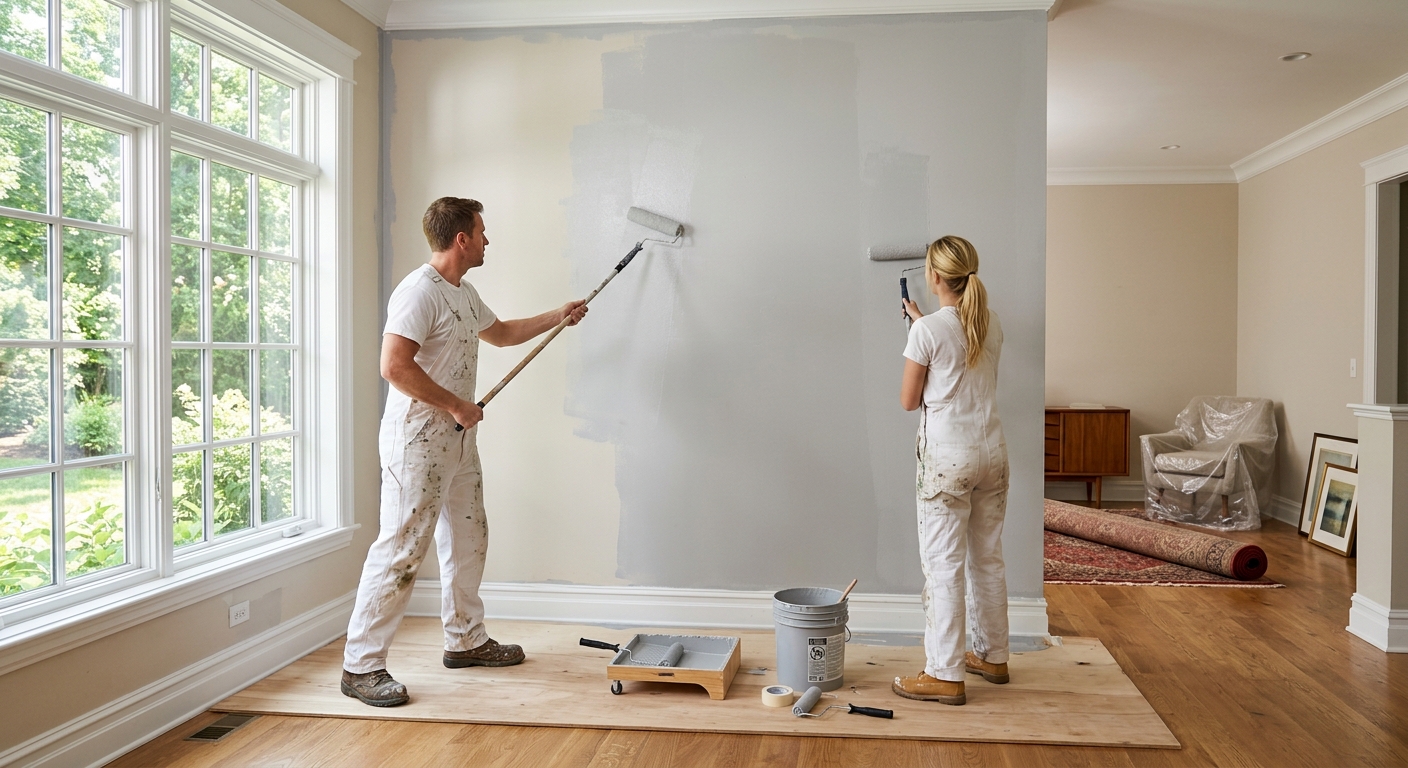
Painting options and costs in Revelstoke
Revelstoke is a mountain community where paint needs to handle real swings in temperature, sun, and moisture exposure—so the “cheapest” quote is often not the best value when prep is cut. In the city, a large share of homes are older: 66.4% of dwellings were built before 1981, and that matters because aged surfaces usually require more scraping, patching, caulking, and priming than newer walls or trim. With 2,510 homeowner households (74.9% of households owning), many projects are full repaints and trim refreshes rather than new-build touch-ups. That mix of owner-occupied, older stock helps explain why interior and exterior demand can be steady, but exterior work still concentrates when conditions cooperate.
In the Thompson–Okanagan region, exterior painting costs are shaped by a short, climate-bound window: contractors typically target late spring through early fall when surfaces are dry and temperatures are reliably above freezing. In Revelstoke specifically, summer scheduling pressure can push rates higher for urgent jobs, while rain interruptions can extend timelines and increase labour on protection, re-coats, and spot-priming. If you’re in high-demand areas such as downtown Revelstoke and the surrounding hillside neighbourhoods where access can be tight, you can expect more competition for crew time.
Use the table below as a realistic starting point, then we can narrow it down based on surface condition, number of colours, and access.
| Service |
What's Included |
Typical Duration |
Price Range |
| Interior — whole home (walls, ceilings, trim) |
Preparation, caulking where needed, sanding/spot-priming, 2-coat finish system, protect floors and fixtures, cleanup |
4–10 days |
$2,000–$6,000 |
| Interior — per room (standard bedroom or living room) |
Prep, patch/sand as required, primer on bare spots, 2-coat walls; trim handled based on scope |
1–3 days |
$500–$1,800 |
| Exterior — full house (siding, trim, soffits) |
Powerwashing/cleaning as needed, scraping and sanding, caulking, spot-priming, 2-coat exterior system, surface protection and final cleanup |
5–12 days |
$3,000–$12,000 |
| Exterior — trim and accent colours only |
Surface cleaning, scrape/sand loose coatings, caulk, prime exposed areas, 2-coat trim/accent application |
2–6 days |
$800–$4,500 |
| Kitchen cabinet painting (doors, frames, spray finish) |
Degrease, light sanding/priming, cabinet-grade topcoats (typically 2–3 coats total), hardware protection and final reinstall |
4–10 days |
$1,800–$5,000 |
| Specialty / faux finish (accent wall, texture) |
Prep and base coat, decorative application, protective clear coat if required, cleanup |
1–4 days |
$700–$3,800 |
Prices are estimates only and vary by project scope, site access and material selection.
What affects the price of painting in Revelstoke
Even when you’re comparing quotes for the “same” job in Revelstoke, it’s common to see swings of 30–50% across the Thompson–Okanagan region and broader BC because paint work is labour-heavy when prep is heavy. In this market, exterior pricing is especially sensitive to scheduling: the exterior painting season is tightly climate-bound in the Thompson–Okanagan—typically a late spring to early fall window when temperatures are reliably above freezing and surfaces can dry out between rain events. In Ontario and Alberta, the exterior window is also seasonal, but crews can still face rapid turnarounds because temperatures need to be above roughly 10°C and rising during application. In coastal BC, humidity and intermittent rain often require mildew-resistant primer/topcoat systems and careful day-to-day scheduling to prevent blistering or adhesion failures. The net effect: shorter windows concentrate demand, raise summer rate pressure, and increase how much a contractor has to “protect the calendar.”
Locally, older housing stock is a major driver. With 66.4% of homes built before 1981, many projects involve multiple previous paint layers, sun-chalking, and wood movement—meaning more scraping, sanding, caulking and spot-priming. On a repaint, surface prep can reach 50–70% of total labour. For example, the difference between interior painting at $250–$6,000 and the higher end of the band often comes down to how much repair work is required (not just wall coverage). Similarly, exterior trim-only at $800–$12,000 climbs quickly when trim is failing, needs crack treatment, or requires scaffolding due to height and access. If a home has lead-risk older coatings, responsible lead-safe work practices can add time through containment and HEPA vacuuming, increasing labour—sometimes without visibly changing the final look.
Below are the most common price factors we see on real Revelstoke projects, and why they move bids up or down.
| Price Factor |
Why It Matters |
Cost Impact |
| Surface prep — scraping, sanding, patching drywall or wood |
Prep determines adhesion and how long paint lasts |
Often +15–40% on repaints |
| Number of coats — 2-coat system over primer vs. 1 coat over existing |
Coverage and hiding power vary by substrate and colour change |
Can swing +10–25% |
| Paint quality tier — contractor-grade vs. premium (Benjamin Moore, Sherwin) |
Different resins and pigment loads affect durability in UV and weather |
Often +5–20% materials |
| Ceilings and trim — adds significant time vs. walls-only |
Ceilings require cut-in precision and more protection/covering |
Typically +10–30% |
| Exterior season window — short season raises summer rates |
More demand per day increases crew and scheduling costs |
Often +10–25% during peak |
| Lead-safe precautions — required for pre-1978 homes with lead paint |
Containment, wet methods, HEPA vacuuming, and disposal add labour |
Can add +10–30% |
| Surface material — drywall vs. plaster vs. wood vs. stucco |
Different primers and patch methods are needed |
Varies widely; +10–35% |
| Height and access — multi-storey exterior requires scaffolding or lifts |
Access equipment increases setup and labour time |
Often +15–45% |
Permits & regulations in British Columbia
In British Columbia, painting itself does not require a building permit, whether you’re repainting an interior or painting an exterior façade. Where BC rules come into play is health and safety: for homes built before 1978, health guidelines recommend testing for lead paint before sanding, scraping, or disturbing old coatings, and then using lead-safe work practices if lead is present. Common professional controls include wet methods to minimize dust, HEPA vacuuming, careful containment, and proper disposal of dust and debris. This is not something homeowners must legally do in the same way, but it is standard practice for professional contractors to protect occupants and workers.
Separately, ensure your contractor is properly covered. Confirm they carry liability insurance and workers’ compensation coverage (WSBC/WCB) for their crew. Ask for certificates before work starts. Also insist on a written contract that clearly lists paint brands, sheen selections, number of coats, and what prep tasks are included (for example, scraping, caulking, priming, and disposal).
What typically does NOT require a permit: interior repainting, exterior painting, staining, and trim colour changes. What could require other approvals is not typical for painting work itself, but if your scope involves structural changes, exterior alterations beyond paint, or significant changes to building elements, you should ask the contractor to confirm requirements first.
For Revelstoke verification, start by asking the contractor for: (1) liability insurance certificate (showing your project address as applicable), (2) WSBC/WCB clearance documentation for workers, and (3) proof of any relevant trade affiliation they hold. If they refuse documentation, that’s a warning sign.
Interior vs exterior painting — getting the best result in Revelstoke
In Revelstoke’s climate and the Thompson–Okanagan market, long-lasting results come from matching prep and coating systems to the surface—not from chasing the most expensive brand. Indoors, the biggest predictor of failure is poor preparation: filling nail holes, sanding rough patches, removing dust, and priming any bare spots. Sheen choice matters too. Flat paint hides wall imperfections, but in high-touch areas it can scuff. Eggshell or satin is typically better for living rooms and bedrooms, while semi-gloss is more forgiving on trim and doors because it wipes clean. Practically, two coats over the correct primer almost always outlast one “thick” coat—even if the colour looks fine on day one.
Outdoors, the prep stage is even more critical. British Columbia weather cycles drive expansion and contraction, and water can get behind failing edges if caulking isn’t renewed before repainting. Proper caulking and crack treatment before paint helps prevent water ingress that leads to peeling. Primer type matters: different substrates (wood, fibre cement, previously painted surfaces) often require different primer chemistry so the topcoat adheres reliably. In BC-style conditions, crews commonly choose mildew-resistant products where appropriate and time application windows so surfaces are dry and film cures properly. If you’re comparing options, a budget cabinet paint job that skips proper degreasing and priming can look “close” at first, but it’s often the prep shortcuts that lead to early softening or poor adhesion. The same logic applies to older trim: for pre-1978 homes, lead-safe practices can add labour cost, but they reduce health risk if old coatings contain lead.
Where does the price difference pay off? If a full interior repaint is quoted at the mid-to-upper range of $250–$6,000, that extra cost is usually justified by more patching and spot-priming. For exteriors, choosing a full house system at the higher end of $800–$12,000 can be worthwhile when prep shows widespread chalking or failed adhesion—otherwise you may have to repaint much sooner.
| Project Type |
Key Prep Step |
Recommended Coats |
Price Band |
| Interior — fresh drywall (new construction) |
Seal and prime new drywall, then sand and clean dust |
Primer + 2 finish coats |
$500–$2,500 |
| Interior — repaint (good condition, no repairs) |
Light sanding/scuff, spot prime where needed, thorough cleaning |
2 finish coats over sound substrate |
$400–$2,000 |
| Interior — repaint (patching and priming needed) |
Patch, sand smooth, prime repaired areas for uniform sheen |
Primer (on repairs) + 2 finish coats |
$600–$3,500 |
| Exterior siding (wood or fibre cement) |
Scrape loose coating, caulk where required, prime bare spots |
Primer on bare areas + 2 exterior topcoats |
$3,000–$12,000 |
| Exterior trim and accents only |
Clean and abrade glossy areas, caulk edges, spot prime |
2 coats (primer only where needed) |
$800–$4,500 |
| Kitchen cabinets (spray finish) |
Degrease, sand, apply bonding primer, correct flash times |
Primer + 2 topcoats (often 3 total stages) |
$1,800–$5,000 |
How to choose a painting contractor in Revelstoke
Choosing the right contractor in Revelstoke is mostly about verifying coverage, then verifying scope. In British Columbia, you should request proof of liability insurance and workers’ compensation coverage (WSBC/WCB) before work begins. Check the certificate of insurance for validity dates and whether it lists the insured contractor entity (not a vague “we do projects” page). For WSBC/WCB, ask for current clearance documentation. If a contractor can’t produce current documentation, pause the decision.
Next, get 2–3 itemised written quotes rather than one lump-sum number. A good quote breaks out labour for prep and painting, and lists materials items clearly (primer type, topcoat sheen, paint brand/line where specified, and disposal/powerwashing assumptions). Read exclusions: is lead-safe work included if pre-1978 coatings are disturbed? Is pressure washing included, or billed separately? Are window caulking and prep around eaves included, or “as needed” with extra charges?
For warranty, ask for workmanship warranty length and whether it’s in writing. Product/manufacturer warranties can be limited by surface prep and application conditions, so confirm what your contractor guarantees. Payment schedules matter: never pay more than 10–15% upfront, and hold a final portion until the job is complete and you’ve done a walkthrough. Finally, demand a start date and an estimated completion timeline in writing, especially because exterior work in the Thompson–Okanagan region is tied to a shorter dry window.
- Ask for proof of liability insurance and WSBC/WCB coverage before signing.
- Request an itemised quote (labour + materials), not a single total.
- Confirm which primer and topcoat lines are included, including sheen.
- Verify the scope: prep tasks, caulking, scraping, sanding, and patching.
- Check disposal and cleanup: is debris haul-away included?
- Ask how they protect landscaping, decks, windows, and nearby finishes.
- Confirm lead-safe practices for pre-1978 homes if sanding/scraping is planned.
- Get a written schedule and weather contingency approach for exteriors.
- Clarify how colour changes are handled (primer on dark surfaces, test spots).
- Review the warranty wording for workmanship and any exclusions.
- Payment terms: no large deposit; hold back until final walkthrough.
- Ensure they include caulking detail around trim edges and penetration points.
Red flags in Revelstoke include: (1) quoting without discussing surface prep and number of coats, (2) refusing to provide insurance/WSBC documentation, (3) asking for a large upfront payment, (4) leaving prep and disposal as “extra” after work starts, and (5) offering a “guarantee” that contradicts their actual scope (for example, no primer specified but promising long-term exterior adhesion).
Frequently asked questions — painting in Revelstoke
What paint sheen should I use in different rooms?
In Revelstoke homes, sheen choice is about balancing cleanability and hiding power. For most ceilings, a flat or ceiling paint finish helps hide imperfections. For living rooms and bedrooms, eggshell or satin on walls tends to resist scuffs from everyday use while still looking smooth. For kitchens and hallways, satin is usually a safe middle ground because it wipes clean without looking too glossy. Trim, doors, and railings benefit from semi-gloss or high-quality trim finishes because they handle fingerprints and cleaning better. If you’re repainting older walls (66.4% of local homes are pre-1981), using the right primer and sheen together matters—otherwise repaired areas can flash differently under mountain light.
Can I paint my house exterior in spring or fall in Revelstoke?
You can paint in spring or fall in British Columbia, but in Revelstoke the bigger risk is temperature and drying time. The Thompson–Okanagan market typically focuses exterior work in a late spring to early fall window when conditions support proper curing. If nights are too cold or surfaces stay damp, coatings can fail early (peeling, poor adhesion, or uneven sheen). Spring is usually best once the siding is fully dry; fall work should be scheduled with a clear forecast and enough dry days for curing. A reputable crew will often use a tighter timeline than in milder coastal areas and will factor short season demand into scheduling and pricing—especially around peak booking periods.
How do I choose a painting contractor in Revelstoke?
Start with verification: ask for liability insurance and WSBC/WCB coverage and confirm they’re current. Then request 2–3 itemised written quotes that list labour and materials separately, including primer type, number of coats, and what prep is included. For older Revelstoke homes (66.4% built before 1981), make sure the scope addresses scraping/sanding and whether lead-safe precautions apply if pre-1978 coatings are suspected. Budget for the fact that surface prep is often the deciding factor—prep can represent 50–70% of labour on repaints. Finally, compare pricing ranges realistically: interior work might start in the $250–$6,000 band, but an accurate quote depends on repairs and prep, not just square footage.
How many coats does an exterior repaint need in Revelstoke?
Most exterior repaints require a 2-coat system over primer. If you’re painting bare wood, properly priming all exposed areas is essential before topcoats. On well-adhered, properly cleaned surfaces where only minor touch-ups are needed, you might see primer just on spots and then two finish coats overall. If the home has chalking, failed edges, or multiple old paint layers that need correction, expect more prep and more primer to keep adhesion consistent. In the Thompson–Okanagan region, delays from damp weather can also affect film formation, so contractors may protect schedules and build in time for correct drying. That’s why a full exterior repaint can sit anywhere from the $800–$12,000 band depending on prep severity and access.
What is the best primer for older Revelstoke homes?
There isn’t one single “best” primer, but for older Revelstoke homes—many built before 1981—the best choice depends on substrate and condition. If existing paint is chalky, loose, or partially failing, primer must promote adhesion to the remaining surface. For bare wood or areas where old coatings are removed, a bonding primer is typically required before finish coats. If there are metal components or specific substrate transitions, the primer selection changes again. If your home is pre-1978 and sanding or scraping will disturb old coatings, lead-safe work practices are recommended if lead is present—so primer and topcoat planning should be coordinated with dust control. A good contractor will specify the primer system in writing so you’re not guessing mid-project.
Should I paint or wallpaper my Revelstoke home?
In Revelstoke, many homeowners choose paint because it’s faster to maintain and easier to correct when walls have patchwork or texture from older construction (66.4% built before 1981). Wallpaper can look great for feature walls, but it’s less forgiving if surfaces aren’t perfectly smooth; seams can telegraph and repairs are harder. Paint, paired with proper priming and patching, tends to be more cost-effective over time. If you’re debating interior options, consider that specialty textures or faux finishes can fall into the $300–$6,000 range depending on complexity, while a painted room is often more straightforward to prep and refresh later. If humidity is manageable indoors and you want long-term flexibility, paint is usually the safer value choice.