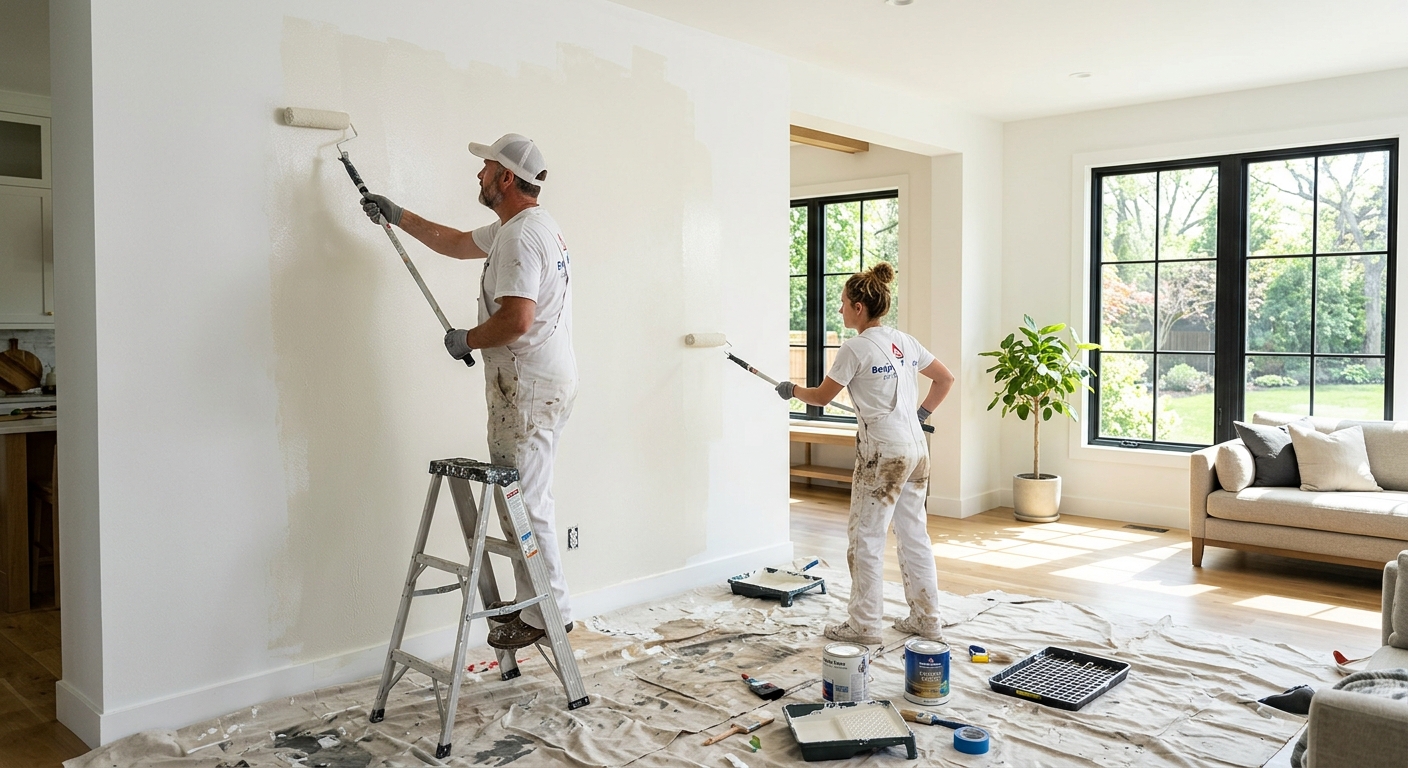
Painting options and costs in Lake Country
Lake Country homeowners typically have a wide choice of painting approaches—clean, modern finishes for occupied homes, or full “repaint + prep” projects for older siding and trim. With 28.3% of local homes built before 1981, many properties arrive with sun-chalking, small cracks, older caulking failures, and multiple paint layers. That extra surface work (scraping, sanding, patching, and spot-priming) is often what separates a paint job that looks great at handover from one that still looks sharp after another couple of seasons.
In the Thompson–Okanagan, exterior costs are shaped by demand timing and weather reliability. Contractors plan most exterior work around a late-spring to early-fall window when surfaces dry and temperatures stay workable. Even though Lake Country is closer to the lakeside “milder” end of the region, you still see intermittent humidity and summer downpours that can slow crews or force rescheduling—especially for full-house repaints that require consistent drying between coats. That scheduling pressure is why you’ll often see exterior pricing in the upper part of the local exterior band during peak months, while interior work can be booked more flexibly.
In areas with lots of older stock and established neighbourhoods—such as close to downtown Lake Country and around the older residential blocks near the Lake Country core—exterior prep-heavy repaints are in steady demand. Below is a practical comparison of typical scopes so you can line up budget expectations before you request quotes.
| Service |
What's Included |
Typical Duration |
Price Range |
| Interior — whole home (walls, ceilings, trim) |
Move-protective prep, dust control, caulking spot repairs, primer where needed, 2-coat wall/ceiling system (sheen selected by room), sanding and touch-ups, and brush/roller finish on trim |
3–7 days |
$3,000–$6,000 |
| Interior — per room (standard bedroom or living room) |
Prep and patching of minor scuffs/holes, primer as required, 2-coat application on walls, and clean cut-in to trim |
1–2 days |
$600–$1,800 |
| Exterior — full house (siding, trim, soffits) |
Power wash (as needed), detailed scraping/sanding, caulking in prep, primer for bare/repairs, 2-coat exterior system, attention to transitions/trim, and basic site cleanup |
5–14 days |
$3,800–$12,000 |
| Exterior — trim and accent colours only |
Surface prep for trim areas, spot priming, 2-coat finish on selected elements, careful masking, and touch-up of missed edges |
2–6 days |
$1,200–$4,500 |
| Kitchen cabinet painting (doors, frames, spray finish) |
Degreasing, sanding/assurance of adhesion, bonding primer, spray-applied finish on doors/drawers, reinstall and hardware masking, and light touch-ups |
5–10 days |
$2,500–$5,000 |
| Specialty / faux finish (accent wall, texture) |
Surface stabilization, texture/faux application technique, colour testing, and protective topcoat depending on finish |
1–4 days |
$600–$3,200 |
Prices are estimates only and vary by project scope, site access and material selection.
What affects the price of painting in Lake Country
In Lake Country and across the Thompson–Okanagan, it’s normal to see quote spread of 30–50% for “the same” paint job because painting prices aren’t only about paint—they’re about preparation, scheduling, access, and product choices. Even within British Columbia, crews price differently depending on the pace of the exterior season and how often a job gets interrupted by humidity, rain, or cool nights. When the same exterior work is squeezed into a shorter, late-spring to early-fall window (as it is across much of the interior/lakeside corridor), labour demand rises and contractors allocate crews to the most time-sensitive jobs first—pushing exterior rates toward the upper end of the regional exterior band.
Older housing stock also matters. Homes built before 1981 (28.3% locally) often require more labour: scraping loose paint, sanding edges smooth, re-caulking failing joints, and priming areas where adhesion has been compromised. On a repaint, prep can account for a large share of labour—commonly 50–70%—especially when there are multiple previous paint layers. A rough budget example: if you’re targeting an interior repaint in the $250–$6,000 interior band, minor repairs and patching keep you closer to the lower end; adding substantial patching and priming can move the job toward the upper range. Similarly, a full exterior repaint can span the $800–$12,000 exterior band depending on how much prep and masking is needed around trim, soffits, and transitions.
In Lake Country specifically, two common cost drivers are: (1) older caulking and trim joints that need re-sealing before paint to prevent water ingress, and (2) access requirements near eaves and second-storey areas, where lifts or scaffolding add time and protection measures. The upside is that interiors usually stay more predictable—fewer weather delays—so you’ll often find more consistent pricing for interior work year-round.
| Price Factor |
Why It Matters |
Cost Impact |
| Surface prep — scraping, sanding, patching drywall or wood |
Adhesion and smoothness depend on prep; older surfaces need more repair and priming. |
+20% to +60% on repaints |
| Number of coats — 2-coat system over primer vs. 1 coat over existing |
Coverage and durability depend on full hiding; skipping coats leads to flashing and early wear. |
+10% to +35% |
| Paint quality tier — contractor-grade vs. premium (Benjamin Moore, Sherwin) |
Higher-quality lines typically cover better and resist scuffing/fading longer. |
+5% to +25% materials; labour may drop if fewer coats needed |
| Ceilings and trim — adds significant time vs. walls-only |
Ceilings require more cutting-in and attention to drips; trim needs precision and sanding between applications. |
+15% to +45% |
| Exterior season window — short season raises summer rates |
When weather windows shrink, scheduling pressure increases and crews prioritize urgent availability. |
+10% to +40% during peak periods |
| Lead-safe precautions — required for pre-1978 homes with lead paint |
If lead is present, contractors use containment, HEPA vacuuming, and safe disposal methods. |
+15% to +60% depending on extent of disturbed coatings |
| Surface material — drywall vs. plaster vs. wood vs. stucco |
Different substrates need different primers, binders, and adhesion checks. |
+10% to +40% |
| Height and access — multi-storey exterior requires scaffolding or lifts |
Safety setup, masking, and protection take time and influence crew size. |
+10% to +50% |
Permits & regulations in British Columbia
In British Columbia, painting typically does not require a permit for normal residential work—so you generally don’t need to apply for permission to paint interior walls, ceilings, or exterior surfaces. That said, if you have a home built before 1978 (many older properties in Lake Country fall into this category), health guidelines strongly recommend treating the project as potentially lead-contaminated before sanding or scraping. For contractors, this usually means lead-safe work practices if lead is present: wet methods to reduce dust, HEPA vacuuming, plastic containment where appropriate, and proper disposal of debris. For homeowners, this isn’t always legally mandated, but following those practices is considered standard due diligence in the industry.
What does require a permit? For painting itself, residential painting generally does not. However, you may need permits if your project expands beyond paint—such as exterior structural changes, envelope work that affects building components, or if you’re doing work that triggers other municipal processes. For a straightforward repaint, assume “no permit” and focus on contract scope and safety practices.
To verify a contractor in Lake Country, do it step-by-step: (1) check contractor licensing/credentials through the provincial registry or the contractor’s business profile online; (2) request a certificate of insurance and confirm liability coverage is active for the project period; and (3) confirm workers’ compensation coverage (often shown via a clearance letter or proof of coverage). Then ask for a written contract that specifies paint brands/line, sheen, the number of coats, and exactly which prep steps are included.
Interior vs exterior painting — getting the best result in Lake Country
In Lake Country, the biggest difference between a long-lasting paint job and a premature failure is preparation quality and how it matches the local conditions. For interiors, surface prep matters more than the topcoat brand: filling holes and sanding flush, addressing stains or water marks correctly, and priming patched areas so they don’t telegraph. Sheen selection also affects durability and cleaning. Flat/eggshell is common for ceilings, eggshell works well for many bedrooms, satin is popular in high-touch areas like hallways, and semi-gloss is often chosen for trim and more washable surfaces. In practice, two coats over a proper primer and matched system will outlast one thick coat—especially on uneven patches.
For exteriors in British Columbia, prep is even more non-negotiable because adhesion fails when moisture gets trapped under coatings. Proper caulking before paint (not after) helps prevent water ingress at joints. Primer selection is critical: different primers are used based on whether the substrate is wood, fibre cement, stucco, or previously painted surfaces. Thompson–Okanagan temperature swings also affect drying time, so contractors coordinate coat timing to avoid trapping moisture. Because Lake Country has lakeside humidity influences and intermittent damp conditions, mildew-resistant products and careful scheduling around rain days are practical risk reducers.
Cabinet painting can be a smart budget alternative to replacement, but only when adhesion prep and spray-quality finishing are handled correctly. For example, if cabinet replacement is priced much higher, a properly scoped cabinet paint project can keep you within the $400–$5,000 trim/cabinet painting reality—while still achieving a factory-like finish. For pre-1978 homes, lead-safe practices should be built into prep if coatings are disturbed, which can affect both time and cost.
| Project Type |
Key Prep Step |
Recommended Coats |
Price Band |
| Interior — fresh drywall (new construction) |
Prime bare drywall and spot-treat joints for uniform absorption |
Primer + 2 coats |
$1,000–$3,200 |
| Interior — repaint (good condition, no repairs) |
Degrease, light scuff-sand, and caulk visible gaps |
2 coats (primer only if needed) |
$600–$2,200 |
| Interior — repaint (patching and priming needed) |
Fill, sand flush, spot-prime repairs to prevent flashing |
Primer + 2 coats |
$900–$3,800 |
| Exterior siding (wood or fibre cement) |
Scrape to sound edges, sand, caulk joints, and prime properly before finish |
Primer where needed + 2 finish coats |
$2,800–$10,500 |
| Exterior trim and accents only |
Mask carefully and spot-prime bare or weathered areas |
Spot primer + 2 finish coats |
$1,200–$4,500 |
| Kitchen cabinets (spray finish) |
Degrease and adhesion prep, then bonding primer before spray finish |
Primer + 2 sprayed finish coats |
$2,500–$5,000 |
How to choose a painting contractor in Lake Country
Choosing the right painting contractor in Lake Country starts with verification and clear paper. In British Columbia, request proof of liability insurance and confirmation of workers’ compensation coverage before work begins; ask for documents, not just verbal reassurance. To check licensing/credentials, use the contractor’s business information and look up the relevant registry entry online where applicable. Then review: (1) certificate of insurance—make sure it’s current and shows coverage limits sufficient for the job; (2) workers’ compensation coverage—request proof such as a clearance letter; and (3) your contract documents—confirm the scope is consistent with what’s quoted.
Next, get 2–3 itemised written quotes, not a single “lump sum” number. You want a breakdown for labour and materials (including primer type, paint line, sheen, and whether trim is included). Read the scope: what’s excluded (e.g., window screens, heavy furniture moving, lead-safe containment, disposal), whether a permit is included (for painting, it usually isn’t, but exclusions matter), and whether caulking/spot-priming are part of the quote. Ask about warranty: workmanship warranty length and whether it’s tied to specific surfaces or conditions. Manufacturer warranties usually cover product defects; the workmanship warranty covers application.
For payment, never pay more than about 10–15% upfront. Hold back a portion until the job is complete, cleaned, and inspected. Finally, get a start date and completion estimate in writing, along with what happens if weather delays exterior work.
- Verify liability insurance (active certificate) and the correct insured party name.
- Confirm workers’ compensation coverage via clearance letter/proof.
- Ask for the exact paint line and sheen, not “equivalent.”
- Request primer details (bonding/stain-blocking/adhesion primers as needed).
- Insist on surface prep scope in writing (scrape/sand/patch/spot-prime).
- Confirm caulking is included for exteriors and which joints are addressed.
- Ask how they handle mildew-resistant products in damp periods (BC practice).
- Clarify disposal (paint tins, debris, sanding dust containment).
- Request colour testing where warranties or high-cost colours are involved.
- Require an itemised labour + materials breakdown in the quote.
- Get a workmanship warranty term and what it covers.
- Set payment milestones tied to inspections and punch-list completion.
Red flags I see too often around Lake Country: vague scopes (“we’ll prep and paint as needed” with no detail), no proof of insurance/coverage, quotes that omit primer type and number of coats, sudden pressure for large upfront payments, and refusal to put warranty and timeline terms in the contract.
Frequently asked questions — painting in Lake Country
How much does interior painting cost per room in Lake Country?
Per-room interior pricing in Lake Country commonly falls within the local interior painting band, which ranges from $250–$6,000 depending on room size, prep needs, and whether trim/ceilings are included. For a typical bedroom or living room, many homeowners land around $600–$1,800 when the walls are in reasonable condition and the job is primarily repainting with light patching and caulking. If you have more drywall repairs, stain blocking, or you want ceilings included, the project usually moves upward because prep and extra cut-in time increase labour. Because 28.3% of homes locally were built before 1981, some older interiors also need extra attention to adhesion and stain-prone surfaces.
When is the best time for exterior painting in Lake Country?
For Lake Country and the Thompson–Okanagan, the safest general window is late spring through early fall—when temperatures allow proper application and drying, and when you can schedule around intermittent rain. The Thompson–Okanagan market often compresses exterior work into a late spring–early fall period because contractors need reliable conditions for dry surfaces between coats. Even lakeside areas can experience humidity swings and sudden damp days, so crews typically plan coating days with careful weather checks. If you’re booking in peak summer, expect tighter availability and possibly pricing toward the higher end of the exterior band ($800–$12,000), especially for full-house repaints with lots of prep.
How many coats of paint do I need?
Most durable interior and exterior systems in British Columbia use a 2-coat finish over a primer that matches the substrate. If walls are in good condition and colour change is minimal, some projects may proceed without full-prime—still aiming for two finish coats for uniform coverage. For patching, bare spots, or stained areas, a primer step becomes essential before the two finish coats. For exteriors, a common approach is primer where needed plus two finish coats; skipping primer over problematic areas can cause flashing, poor adhesion, and faster wear. If you’re planning a full exterior repaint in the Lake Country area, that “2 coats + proper primer” approach is built into most budgets within the $800–$12,000 exterior range.
What paint is best for Lake Country's climate?
For British Columbia’s interior-to-lakeside conditions, “best” is really about choosing the right system for the surface and the local weather stresses. Exteriors benefit from mildew-resistant products and primers that match wood, fibre cement, or stucco so adhesion holds when humidity changes. Contractors in Lake Country also pay close attention to drying times between coats to reduce the chance of moisture-related failures. On interiors, you’ll get better results by matching sheen to room function—washable sheens like satin/semi-gloss for trim and higher-touch areas, and softer sheens like eggshell for many walls. Your home’s age matters too: because 28.3% of homes locally were built before 1981, older trim and siding may need adhesion-focused priming and careful prep before choosing topcoats.
How long does exterior paint last here?
Exterior paint longevity in Lake Country depends heavily on prep, moisture management, and the condition of the substrate—not just the brand. With correct scraping to sound surfaces, proper caulking, primer selection for the material, and two finish coats, many homeowners see results that hold for several years; however, coastal-lakeside humidity and temperature swings can shorten lifespan if coating adhesion was compromised. Homes with older caulking failures or multiple paint layers often require more prep time, which is why exterior budgets can swing within the $800–$12,000 band. If your home has lots of cracking, failing trim joints, or signs of previous water issues, addressing those underlying problems is what typically protects paint life.
Should I paint or replace my cabinets?
In many Lake Country homes, painting kitchen cabinets is the better value when the cabinet boxes are solid and the doors/frames are the main visual issue. Replacement is often justified when there’s structural damage, warped materials, or you want a completely different layout. If the boxes are fine, cabinet painting can deliver a refresh without the disruption and cost of full replacement; a properly scoped sprayed cabinet finish commonly sits in the $400–$5,000 range (and often lands around the middle when prep is detailed and doors are sprayed). The deciding factor is prep: degreasing, sanding, and priming determine durability far more than the final colour choice. For older homes, your contractor should also consider safe handling practices if coatings have older composition and you’re disturbing layers.