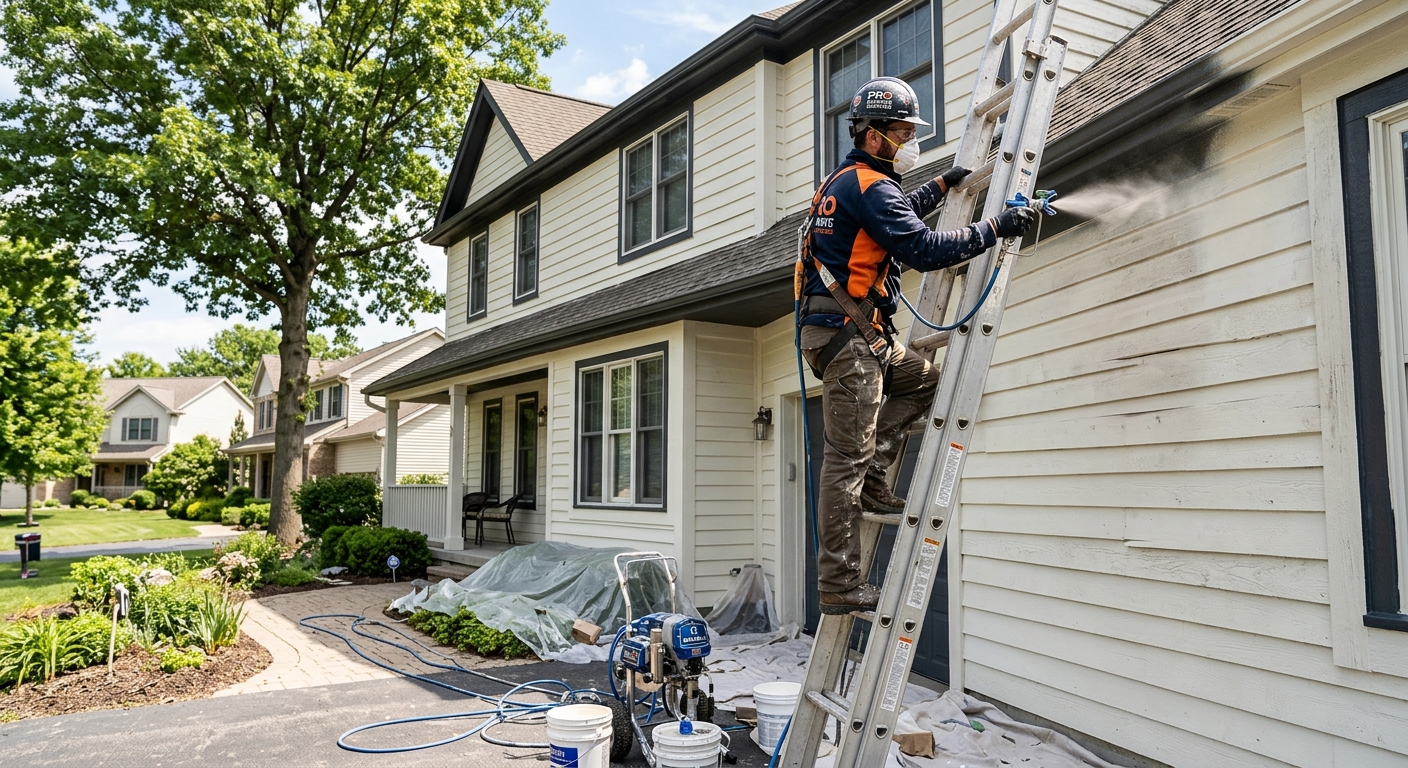
Painting options and costs in Fraser Heights
Fraser Heights is a great place to live, but it also means homeowners are often repainting in a climate that can swing between foggy damp mornings, rainy stretches, and bright drying days. With a population of about 25,000 (Statistics Canada, 2021 Census), there’s steady demand in the Lower Mainland–Southwest, especially around established family neighbourhoods where turnover and renovations are common. Many homes in the wider area were built mid-century through the 1990s, so “same-room repaint” bids can still vary a lot once contractors discover older finishes, patchy drywall, or staining that requires block/primer. For pre-1978 homes, health guidelines recommend lead paint testing before sanding or scraping—meaning additional containment, cleanup and disposal time if lead is present. That prep work is often the difference between a paint job that looks great for a year and one that stays looking sharp through multiple wet seasons.
In Fraser Heights, exterior cost is shaped less by deep freezes and more by moisture management. Rain and humidity affect how coatings level, how primer bonds, and how quickly crews can mobilize and re-mobilize between dry windows. Interiors are steadier year-round, so contractors often shift crews indoors in fall and winter, which can slightly ease scheduling pressure. Before you pick a service, it helps to compare typical scopes and budgets, which is why the table below sets out realistic Fraser Heights price bands for common projects—then you can line up your quote against the right line item.
| Service |
What's Included |
Typical Duration |
Price Range |
| Interior — whole home (walls, ceilings, trim) |
Move-protect floors/furnishings, prep and patch, prime as needed, paint walls/ceilings, caulk trim, paint trim/doors, cleanup |
5–10 days |
$3,500–$8,000 |
| Interior — per room (standard bedroom or living room) |
Prep, spot repair, prime if required, paint walls, optional ceiling, caulk/brush touch-ups, cleanup |
2–4 days |
$900–$2,800 |
| Exterior — full house (siding, trim, soffits) |
Pressure wash (as required), scrape/spot-repair failing coatings, patch and caulk, prime where needed, paint siding/trim/soffits, weather-window scheduling, cleanup & disposal |
1–3 weeks (weather dependent) |
$4,500–$14,000 |
| Exterior — trim and accent colours only |
Surface prep on trim only, prime/spot prime, paint trim/accents, caulk, cleanup & disposal |
3–7 days (weather dependent) |
$1,200–$4,500 |
| Kitchen cabinet painting (doors, frames, spray finish) |
Hardware masking/removal, degrease & prep, bonding primer, spray enamel finish, multiple coats, reinstall hardware, cleanup |
1–2 weeks |
$2,200–$6,500 |
| Specialty / faux finish (accent wall, texture) |
Surface prep, specialized material application, topcoat protection, design consultation, cleanup |
2–6 days |
$800–$6,000 |
Prices are estimates only and vary by project scope, site access and material selection.
What affects the price of painting in Fraser Heights
In Fraser Heights and the broader Lower Mainland–Southwest, two quotes for the same “paint the house” request can differ by 30–50% because prep and weather planning drive most of the labour. The material choice matters too—especially if you’re using premium paint, high-build primers, or mildew-resistant exterior systems designed for coastal humidity. On top of that, contractor availability can concentrate into the same short stretches of suitable weather, which can raise rates during peak demand.
Exterior painting is tightly climate-bound in coastal BC. While the region avoids the deep cold you’d see in Ontario or Alberta, rain and humidity create their own constraints: coatings may dry slower, surfaces can stay damp, and mildew can undermine adhesion if the wrong products are used or if work proceeds during marginal conditions. That’s why Lower Mainland–Southwest bids often assume careful scheduling and re-visits between weather windows. By comparison, Ontario and Alberta exterior work tends to be aligned to a rough late May to early October rhythm with warmer application conditions; in coastal BC, the season can be longer, but successful application is still very timing-sensitive.
Older housing stock also pushes budgets upward. For repainting jobs, surface prep can account for 50–70% of labour—scraping failing coatings, patching settlement cracks, sanding rough areas, and priming stains or tannin bleed. A pre-1978 home may require lead-safe practices if lead is present, including containment and HEPA clean-up, which adds time and disposal costs. Practically, that’s why an exterior “trim and accents only” repaint might land around the $1,200–$4,500 range, while a full-house repaint with extensive prep can quickly move into the $4,500–$14,000 band depending on siding condition and how much bonding/primer work is needed.
| Price Factor |
Why It Matters |
Cost Impact |
| Surface prep — scraping, sanding, patching drywall or wood |
Most coating failures start at the surface; proper repairs improve adhesion and longevity |
High; often 50–70% of labour on repaints |
| Number of coats — 2-coat system over primer vs. 1 coat over existing |
Coverage and durability depend on build; coverage also changes with dark-to-light transitions |
Medium to high; can swing cost by 10–25% |
| Paint quality tier — contractor-grade vs. premium (Benjamin Moore, Sherwin) |
Better film build, stain resistance, and smoother application reduce callbacks and touch-ups |
Medium; materials add up but prep usually dominates |
| Ceilings and trim — adds significant time vs. walls-only |
Trim edges require more masking/caulking and careful cutting-in |
Medium; easily 15–30% of interior job time |
| Exterior season window — short season raises summer rates |
Crews may sit idle between dry days; mobilizations cost money |
Medium to high during peak scheduling |
| Lead-safe precautions — required for pre-1978 homes with lead paint |
Containment, HEPA vacuuming, and disposal add labour and materials |
Can add 10–30% depending on findings/scope |
| Surface material — drywall vs. plaster vs. wood vs. stucco |
Different substrates require different primers and repair techniques |
Medium; primer systems can change |
| Height and access — multi-storey exterior requires scaffolding or lifts |
Access equipment increases setup time and affects safety practices |
High on two-storey and complex façades |
Permits & regulations in British Columbia
In British Columbia, painting work itself typically does not require a permit for residential homes. The main regulatory “hook” most homeowners run into is health guidance—not building permits—especially for older homes. For homes built before 1978, guidelines recommend testing for lead paint before sanding, scraping or grinding. If lead is present, professional lead-safe work practices are expected: wet methods to control dust, HEPA vacuuming, proper containment, and correct disposal of affected debris. Homeowners aren’t usually required by law to do lead work the way a contractor would, but reputable contractors treat it as standard practice because it protects occupants and reduces contamination risk.
Separately, what you should confirm from your contractor is insurance and coverage. Ask whether they carry liability insurance and workers’ compensation coverage (WSIB/WCB). Painting is hard work and ladders/scaffolds are involved—so you want the right coverage in place before any material is opened or any work begins.
Step-by-step, in Fraser Heights:
- Ask for the contractor’s insurance certificate and confirm it includes liability coverage with your address listed or applicable territory.
- Request proof of workers’ compensation coverage (WSIB/WCB).
- Verify their licence/registration status through the appropriate provincial registry search on the contractor’s official documentation (many contractors include links on their website or in proposal packages).
- Ensure the written contract lists paint brand/line, sheen, number of coats, and a clear prep scope (scrape/sand/prime/caulk responsibilities).
- Confirm whether disposal is included and how lead-safe debris would be handled if applicable.
Interior vs exterior painting — getting the best result in Fraser Heights
In Fraser Heights and the Lower Mainland–Southwest, the biggest reason a paint job fails early isn’t usually the topcoat—it’s how the surface was prepared and how the system was matched to moisture and use. For interiors, start with repairs: filling and sanding, then spot-priming bare drywall or patched areas. After that, sheen choice matters for how the room holds up to everyday life. Flat paint hides imperfections well, but it scuffs more; eggshell is a common compromise for bedrooms and living rooms; satin or semi-gloss on trim and higher-touch areas cleans better. A key rule of thumb: two coats over the correct primer consistently outlast one “thick” coat. In a repainted room, skipping primer over stained or patched areas can cause flashing, patchiness, or faster wear—especially with Vancouver-area humidity cycling affecting drying behaviour.
For exteriors, coastal BC is unforgiving to thin systems. Thorough prep (cleaning, scraping loose material, sanding edges, patching cracks) plus caulking before painting is crucial to prevent water ingress behind the coating. Primer type matters by substrate—oil/alkyd primers are sometimes required for certain staining or adhesion issues, while modern systems use latex/bonding primers in other cases. Use mildew-resistant, high-adhesion products for damp-prone surfaces and plan for rain pauses, because painting in marginal conditions can trap moisture and lead to adhesion failure.
Cabinet painting can be a smart budget alternative to replacement, often landing in the $2,200–$6,500 band, where you’re paying for prep, bonding primer, and a spray-finish enamel system instead of new cabinetry. For pre-1978 homes, lead-safe precautions also apply to interior work if sanding/scraping is involved.
If you’re deciding where to spend, the best justification is when prep is already required: a full-house repaint can move into the $4,500–$14,000 range, but in exchange you get consistent coating thickness and fewer “missed spots” across siding, soffits, and trim. On the other hand, opting for trim-and-accent only can be a cost-effective refresh around $1,200–$4,500 when the siding coating is still bonded and sound.
| Project Type |
Key Prep Step |
Recommended Coats |
Price Band |
| Interior — fresh drywall (new construction) |
Prime all drywall, fill and sand fasteners/seams, caulk trim edges |
2 coats (plus primer) |
$1,200–$4,200 |
| Interior — repaint (good condition, no repairs) |
Light scuff/clean, spot prime if needed, keep sheen consistent |
2 coats |
$900–$3,000 |
| Interior — repaint (patching and priming needed) |
Patch settlement/cracks, sand smooth, prime patched/bare areas and stain spots |
2 coats over primer |
$1,200–$3,800 |
| Exterior siding (wood or fibre cement) |
Wash, scrape loose coating, spot prime, caulk as needed, control moisture timing |
2 coats (plus primer) |
$4,500–$14,000 |
| Exterior trim and accents only |
Spot prep and prime trim edges; focus on adhesion and caulking lines |
2 coats over primer/spot primer |
$1,200–$4,500 |
| Kitchen cabinets (spray finish) |
Degrease and bonding prime, proper masking and surface build for spray enamel |
3–4 coats (primer + finish coats) |
$2,200–$6,500 |
How to choose a painting contractor in Fraser Heights
Choosing the right painter in Fraser Heights is mostly about verifying coverage and getting comparable scope. Start by checking British Columbia licensing/registration status through the province’s online contractor search (use the name shown on the proposal/contract—don’t rely on “similar names”). Next, request insurance documentation: a current certificate of liability insurance and proof of workers’ compensation coverage (WSIB/WCB). Before the first day of work, ask them to send updated copies—many contractors include these automatically with their contract package.
Then ask for 2–3 itemised written quotes. You want a breakdown that separates labour and materials and clearly lists paint products/lines, sheen, primer type, surface prep tasks (scrape/sand/patch/caulk), and whether disposal is included. Avoid “lump sum only” quotes where it’s unclear what’s included in surface prep—because on exterior repaints in coastal BC, that’s where costs rise or fall.
Look closely at exclusions: are windows/rails/masonry prep included, is old caulk removed and replaced, is power washing included, and is mildew removal part of the system? Confirm warranty terms: workmanship warranty length, whether the manufacturer product warranty is tied to proper application, and whether warranties are transferable if you sell the home. For payment, never pay more than 10–15% upfront; use a holdback until the job is complete and cleanup is done. Finally, insist on a written start date and an estimated completion window—weather can shift exterior work, but the plan should still be documented.
- Confirm their BC registration/licence status matches the proposal.
- Request liability insurance certificate (with expiry date) before any work.
- Provide proof of WSIB/WCB coverage for workers on site.
- Ask for 2–3 itemised quotes (labour + materials, not just totals).
- Verify paint brand/line and sheen are written into the contract.
- Make sure surface prep scope is explicit: scrape, sand, patch, prime, caulk.
- Confirm exterior includes weather-aware scheduling and mildew-resistant system selection.
- Check whether power washing and disposal are included.
- Get cabinet finishes specified (primer type and finish enamel system).
- Review warranty: workmanship duration, what defects are covered, how claims are handled.
- Use a payment schedule with a 10–15% max deposit and holdback until completion.
- Ensure colour transitions and trim/ceiling lines are noted (no surprises).
Red flags I commonly see with Fraser Heights painting contractors include: refusal to provide insurance/coverage documents, vague prep language like “prep as needed” without defining tasks, quotes that omit caulking or primer steps, very low bids that don’t reflect scraping/patching realities, and demanding large upfront payments with no written timeline or workmanship warranty.
Frequently asked questions — painting in Fraser Heights
What's the difference between paint quality tiers?
In British Columbia, “quality tier” usually means how much performance you get in film build, stain blocking, and how evenly the paint lays out. Premium contractor lines often cover better, resist scuffs, and handle moisture challenges (important in Fraser Heights where damp shoulder seasons can affect drying and adhesion). Lower-tier paints can still look fine at first, but you may need extra coats to reach consistent coverage or you can see faster wear on trim and high-touch areas. For context, an interior bedroom repaint might land somewhere in the $900–$2,800 band—if the quote uses a premium system, the difference is often reflected in primer, coverage expectations, and prep allowances. The strongest “quality” predictor is still whether the contractor matches the primer and coats to your surface condition.
How do I compare painting quotes?
Compare quotes line-by-line, not by total price. Ask each contractor to list exactly what prep is included (scrape/patch/sand/prime/caulk), what paint brand and sheen they’re using, and how many coats they’re planning over primer. In Fraser Heights, exterior bids are especially sensitive to prep—one contractor may properly address failing coatings and bonding/primer needs, while another may paint over unstable material to hit a lower number. Also confirm whether disposal and cleanup are included, and whether caulking replacement is part of the scope. If you’re comparing interior, make sure ceilings and trim are included if that’s in your expectation. A quote in the $1,200–$4,500 range for trim accents should not be missing primer/patch steps; similarly, a full exterior repaint often falls into the $4,500–$14,000 territory when prep is extensive.
What paint sheen should I use in different rooms?
In Fraser Heights homes, sheen choice is about balancing cleanability with how well the wall hides imperfections. Flat (or matte) is common for ceilings and low-traffic walls where you want minimal sheen. EggshelI is a popular interior wall sheen for bedrooms and living areas because it has a slight cleanable surface without looking glossy. For kitchens, bathrooms, hallways, and trim, satin or semi-gloss is typically more forgiving for scuffs and easier wipe-downs. Trim and doors are usually best with semi-gloss so the edges wipe clean over time. If a room has patching or uneven drywall finishing, the right sheen helps—but it doesn’t replace proper sanding and priming. The correct primer + two-coat approach matters more than chasing the “shiniest” product, especially in British Columbia where humidity can influence drying and final appearance.
Can I paint my house exterior in spring or fall in Fraser Heights?
You can often paint outside in spring or fall in Fraser Heights, but the success depends on moisture and the actual weather window, not just the calendar. Coastal BC conditions mean painters must schedule around dry stretches so the surface isn’t damp and the coating can cure properly. Rainy days can delay drying, trap moisture, and reduce adhesion—especially on siding seams and trim. In practice, most contractors plan exterior work around reliable stretches and will use mildew-resistant products and high-adhesion systems appropriate for damp conditions. If your quote assumes “exterior full house” work, make sure it includes weather-window scheduling and a clear plan for when conditions aren’t suitable. If lead-safe prep is needed for pre-1978 homes, the timing can also shift because containment and cleanup steps take additional time.
How do I choose a painting contractor in Fraser Heights?
Start by verifying coverage and registration: check their British Columbia licence/registration status, request a current liability insurance certificate, and confirm workers’ compensation coverage (WSIB/WCB) before work begins. Then insist on 2–3 itemised written quotes with labour and materials broken out and the exact paint line and sheen specified. Scope clarity is key—ask what’s included for prep, caulking, power washing (for exteriors), primer type, and disposal. In Fraser Heights, a “low bid” often means missed prep; exterior jobs are won or lost on scraping, patching, priming and timing. Review the workmanship warranty and manufacturer warranty details, including how claims are handled. Be cautious with payment terms: a deposit higher than about 10–15% upfront is a warning sign. If your project is a cabinet repaint, make sure the finish system and coat build are clearly documented, since cabinet work has a different standard than walls.
How many coats does an exterior repaint need in Fraser Heights?
Most exterior repaints in Fraser Heights use a 2-coat paint system over a correctly matched primer/spot primer. The exact primer strategy depends on substrate and condition—whether the surface needs bonding primer, stain-blocking, or adhesion treatment after scraping and repairs. If you’re seeing rust bleed, tannin staining on wood, or contamination residue, you may need additional spot-priming steps even if the topcoat count stays at two. The key is that primer + two coats is the durable baseline for a long-lasting finish in British Columbia’s damp coastal conditions. If prep is skipped, you can end up paying for failure sooner (peeling, flaking, mildew staining). For a full exterior repaint, budgets often fall into the $4,500–$14,000 band when extensive prep is required; trim-only refreshes often land around $1,200–$4,500 but still require proper prime/caulk for longevity.