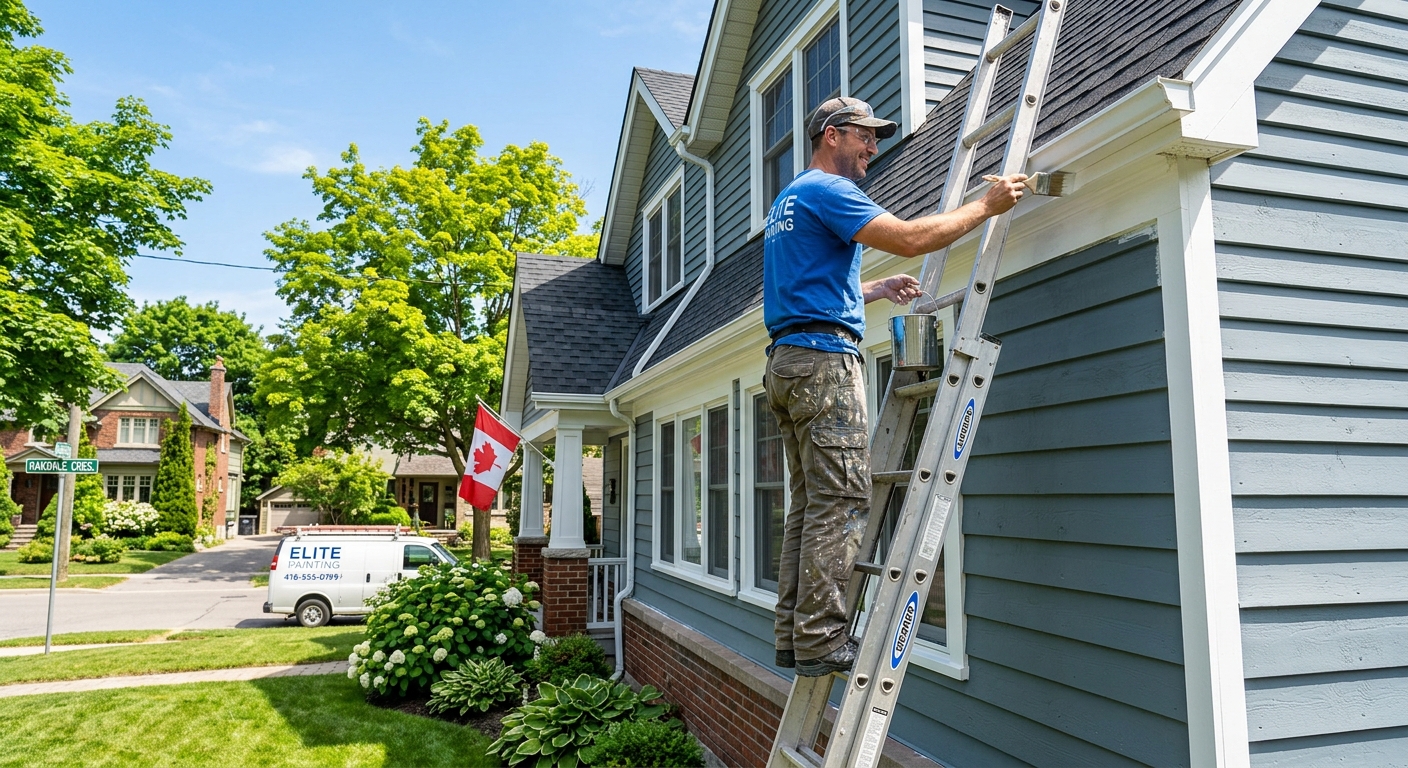
Painting options and costs in Willowdale
Willowdale is a great place to own a home, but it also means you’re painting a lot of older building stock—Toronto’s housing mix includes many pre-1980 properties, which typically need more surface work (scraping, sanding, patching, caulking, and priming) than a newer build. In Ontario, this is especially relevant because pre-1978 homes may contain lead paint; contractors commonly use lead-safe work practices when they’re sanding or scraping older trim, windows, or railings. (Statistics Canada, 2021 Census). With Willowdale’s population sitting at 79,440 residents in 2021, neighbourhood demand is steady, and exterior work can get booked quickly when conditions are favourable (Statistics Canada, 2021 Census).
On the cost side, Toronto exterior painting is tightly tied to weather. In the Greater Toronto Area, contractors typically work from late May through June and again September to mid-October, when temperatures stay above about 10°C and drying time is reliable. In June–August, the short “ideal” window plus peak summer demand often pushes exterior pricing up 10–15% versus shoulder-season weeks. For interiors, the season matters far less, but labour still drives cost—especially if you have ceilings, stairwells, lots of trim, or an older home with uneven drywall and multiple paint layers.
Here are realistic ranges homeowners in Willowdale usually budget for common projects, along with what you should expect in the scope. Use the table to compare apples-to-apples before you request quotes.
| Service |
What's Included |
Typical Duration |
Price Range |
| Interior — whole home (walls, ceilings, trim) |
Move/cover contents as agreed, prep, patching/sanding where needed, caulking at trim, prime (as required), 2-coat painting plan, cut-in around doors/windows, clean-up and final touch-ups |
5–10 business days |
$2,000–$6,000 |
| Interior — per room (standard bedroom or living room) |
Prep and patching for minor imperfections, prime where needed, 2-coat finish on walls/ceiling per agreed sheen, protective masking, trim touch-ups (if included) |
1–3 business days |
$400–$1,200 |
| Exterior — full house (siding, trim, soffits) |
Powerwash where appropriate, scrape/sand loose paint, spot prime, caulk repair (where needed), 2-coat exterior system (primer + finish or per manufacturer), detailed trim work and final wash-down |
1–3 weeks |
$4,000–$8,000 |
| Exterior — trim and accent colours only |
Surface prep limited to trim/accent areas, spot prime, caulk as needed, 2-coat trim painting, protection/masking for surrounding cladding |
3–7 business days |
$1,500–$3,500 |
| Kitchen cabinet painting (doors, frames, spray finish) |
Degrease and sand, box/door removal as needed, repairs to minor damage, bonding primer, sprayed finish plan, hardware masking, re-install and final clean-up |
5–10 business days |
$1,800–$4,000 |
| Specialty / faux finish (accent wall, texture) |
Surface prep, base coat, custom texture/faux application per design, topcoat protective sheen, patching/leveling where required |
2–6 business days |
$300–$5,000 |
Prices are estimates only and vary by project scope, site access and material selection.
What affects the price of painting in Willowdale
In Toronto and across Ontario, two quotes for the “same paint colour” can differ by 30–50% because painting pricing is driven by preparation, access, and the number of coatings you truly need—not the brand on the bucket. Exterior work is also scheduled around a short climate window in our region: contractors usually target late May through June and again September to mid-October, when temperatures are reliably above about 10°C and drying/curing takes place within the day’s conditions. During June–August, peak demand compresses scheduling, so even efficient crews can price higher. Coastal BC often has longer seasonal activity, but persistent humidity and rain require product choices that resist mildew and stricter timing—so the cost drivers shift. In the GTA, the main constraints are frost risk, rain days, and humidity spikes rather than year-round dampness.
Older homes throughout the region mean more prep. For many repaints, surface preparation (scraping, caulking, sanding, patching, and priming) can be 50–70% of total labour. In Willowdale, that labour load matters in dollars: if a repaint would fall near the interior range of $400–$1,200 per room, the equivalent exterior repair-heavy scope often lands closer to the $4,000–$8,000 band for full houses once you factor in caulking repairs and primer where old coatings have failed.
Concrete examples from Willowdale: (1) a home with peeling trim near window edges costs more because you’re not just repainting—you’re removing failing paint back to stable edges, then priming to stop future blistering; (2) multi-storey front elevations often trigger lift/scaffold time, increasing labour; and (3) if walls are in good shape and you can do a clean 2-coat finish without heavy patching, interior projects can stay nearer the lower end of the $1,500–$3,500 exterior trim band (when the scope is limited) or the $400–$1,200 per-room interior band (when repairs are minimal).
| Price Factor |
Why It Matters |
Cost Impact |
| Surface prep — scraping, sanding, patching drywall or wood |
Paint only lasts as long as the surface is sound; prep removes failing layers and improves adhesion |
$300–$2,500+ depending on damage |
| Number of coats — 2-coat system over primer vs. 1 coat over existing |
Coverage and durability depend on correct film build and uniform hiding; “one thick coat” can fail |
10–35% of the labour/materials line |
| Paint quality tier — contractor-grade vs. premium (Benjamin Moore, Sherwin) |
Premium coatings can cost more per litre, but often improve coverage, hide, and scuff resistance |
+ $150–$1,000 materials over standard |
| Ceilings and trim — adds significant time vs. walls-only |
Cutting in, protecting floors, and achieving crisp lines is labour-intensive |
+ $250–$1,500 |
| Exterior season window — short season raises summer rates |
Limited “ideal” weeks concentrate demand; rain delays can compress crew availability |
+ 10–15% in June–August typical |
| Lead-safe precautions — required for pre-1978 homes with lead paint |
Extra containment, wet methods/HEPA cleanup, and disposal increase labour and materials |
+ $300–$1,800+ |
| Surface material — drywall vs. plaster vs. wood vs. stucco |
Different substrates need different primers and sanding/patching approaches |
+ $200–$1,200 |
| Height and access — multi-storey exterior requires scaffolding or lifts |
Access equipment and safety procedures add time and cost |
+ $400–$2,000+ |
Permits & regulations in Ontario
In Ontario, painting work typically does not require a permit for homeowners to hire a contractor—most exterior and interior repainting is treated as maintenance and finish work. Where you do need to be more careful is around hazardous materials, not permits. For homes built before 1978, health guidance recommends testing for lead paint before sanding, scraping, or removing old coatings. If lead is present, standard lead-safe work practices include wet methods to reduce dust, HEPA vacuuming, containment/coverings, and proper disposal. This isn’t legally mandated in the same way for all homeowners, but professional contractors follow it to protect occupants and workers.
What usually does require permits is work outside painting itself—such as structural changes, window/door replacements, major renovations, or electrical/plumbing alterations. Painting alone is generally not a permit-triggering scope.
Before you sign, confirm three things in writing: (1) liability insurance (contractor’s general liability), (2) WSIB or WCB workers’ compensation coverage for the painters who will be on-site, and (3) a written contract that specifies the paint brand/line, sheen, the number of coats, and exactly what surface prep is included (scrape/sand, patching, caulking, priming, and cleanup). To verify in Willowdale, check the contractor’s business listing/registry information where applicable, ask for current certificate of insurance and a clearance letter for coverage, then ensure the COI lists your jobsite address or at least shows it’s active for the contract period. Also ask whether they’ll document prep areas that required extra measures (like lead-safe protocols).
Interior vs exterior painting — getting the best result in Willowdale
In Willowdale, the difference between a long-lasting paint job and a premature failure is mostly about preparation and how the coating system matches the substrate and weather behaviour. For interiors, brand matters less than the surface: filling, sanding, priming stained or patched areas, and achieving clean edges around trim determine whether the finish looks smooth months later. Sheen selection is also crucial—flat/eggshell tends to hide wall imperfections, while kitchens, hallways, and areas with higher scuff risk often do better with satin or semi-gloss on trim. Most importantly, two coats over proper primer outlast one heavy coat, particularly when colour changes or when you’re covering repairs.
For exteriors, Ontario’s climate cycles drive the rules. You need caulking before painting where joints are failing to prevent water ingress behind cladding and trim. Primer type matters: some substrates need bonding primers, others benefit from stain-blocking or specifically formulated exterior primers. Product choice is also about staying within the paint’s temperature and humidity tolerances during application and cure—Willowdale’s short exterior season means delays from rain or cool nights can cause adhesion or sheen issues if crews rush.
Cabinet painting is a budget-friendly alternative to replacement when the cabinet boxes and doors are sound. A properly prepped and sprayed finish can refresh the kitchen without the demolition costs. For pre-1978 homes, lead-safe precautions should be planned for any sanding/scraping on older trim elements—even if you’re “only painting,” the dust control is what keeps the job safe.
Where price differences are justified: if a premium exterior system and additional prep move you from roughly $4,000 toward $6,000 for a typical full house repaint, that’s often money well spent when older trim has multiple failing layers and needs careful scraping, priming, and caulking—skimping there is usually what creates peeling again within a season or two.
| Project Type |
Key Prep Step |
Recommended Coats |
Price Band |
| Interior — fresh drywall (new construction) |
Prime bare drywall to seal and prevent flashing; sand lightly for uniform texture |
1 primer + 2 finish coats |
$2,000–$4,500 |
| Interior — repaint (good condition, no repairs) |
Clean/degloss if needed, light scuff-sand, caulk minor gaps |
1–2 finish coats (usually 2 for best uniformity) |
$400–$3,000 |
| Interior — repaint (patching and priming needed) |
Patch, sand, and spot prime stained or repaired areas to prevent “haloing” |
Spot primer + 2 finish coats |
$800–$6,000 |
| Exterior siding (wood or fibre cement) |
Scrape/sand loose coating, prime bare/spot areas, and caulk joints before finish |
Primer/spot primer + 2 finish coats |
$4,000–$8,000 |
| Exterior trim and accents only |
Mask cleanly and prime wherever paint has failed at edges and joints |
Spot prime + 2 finish coats |
$1,500–$3,500 |
| Kitchen cabinets (spray finish) |
Degrease thoroughly, sand for bonding, and prime for durable adhesion |
Bonding primer + 2 sprayed finish coats |
$1,800–$4,000 |
How to choose a painting contractor in Willowdale
When you hire a painter in Willowdale, start with verification. Ask for proof of Ontario liability insurance and WSIB/WCB workers’ compensation before work begins. The best check is to request the contractor’s current certificate of insurance and coverage clearance (or equivalent letter), then confirm the policy is active for the contract period and that the insured party matches the business doing the work. If they can’t provide documentation quickly, that’s a serious warning sign.
Next, get 2–3 itemised written quotes—not just a lump-sum number. You want labour and material lines broken out enough to confirm whether prep is included (scrape/sand, caulking, patching, priming), whether disposal is covered, and what they’ll do around delicate areas like window edges, railings, or ceiling lines. Ask specifically: is product cost included, are primers premium grade, and are you getting a 2-coat system?
Warranty matters too. Look for a workmanship warranty length (for example, how they address peeling, bubbling, or adhesion failures) and confirm whether product/manufacturer warranties apply and if they’re dependent on correct surface prep. For payment, avoid large up-front deposits—never pay more than about 10–15% upfront, and request a holdback until the final walkthrough is complete.
Finally, request a written timeline with a start date and completion estimate, especially for exterior work where late rain or cool snaps can force scheduling changes during the short ideal window.
- Request insurance COI and WSIB/WCB coverage clearance before the start date
- Ask for an itemised quote with prep tasks clearly listed (scrape, sand, patch, caulk, prime)
- Confirm the number of coats and whether primer is included on stained/patch areas
- Verify paint line and sheen (eggshell/satin/semi-gloss) by room and surface
- Ask how they protect floors, furniture, and landscaping during exterior work
- Confirm disposal and cleanup are included (debris removal and washing down)
- Get the warranty in writing, including what “defects” are covered and for how long
- Request a colour/finish schedule (so trim sheen doesn’t end up too glossy)
- Ask about lead-safe procedures for pre-1978 materials that require scraping/sanding
- Ensure they use caulk appropriate for exterior movement and seal joints before painting
- Clarify payment schedule and insist on a holdback until completion
- Get start/completion dates in writing, with allowance for weather for exteriors
Red flags I commonly see in Willowdale: (1) they won’t provide WSIB/WCB or liability insurance documentation, (2) they quote without talking about prep (especially scraping/priming or caulking), (3) they offer “one coat” or “paint over everything” on problematic exterior surfaces, (4) they demand a large deposit (well beyond 10–15%), and (5) their contract is vague about paint brand, sheen, or cleanup/disposal.
Frequently asked questions — painting in Willowdale
What is the best primer for older Willowdale homes?
For older Willowdale homes—many of which date back decades—the “best” primer depends on what you’re covering. If you’re repainting over a stable, sound surface, a high-adhesion bonding primer can help with uniformity. If you’re dealing with stains (water marks, tannin bleed on wood, or repairs that might ghost), stain-blocking primer is typically the right choice so the final topcoat doesn’t telegraph. For pre-1978 trim or areas that may involve lead paint, pros usually plan for lead-safe containment and HEPA cleanup before any sanding or scraping; the primer is only part of the solution—the dust control is the safety part. In terms of budget, interior repaint projects often start around $400–$1,200 per room, but the right primer plus prep is what keeps the finish from failing early.
Should I paint or wallpaper my Willowdale home?
In most Willowdale homes, paint is the safer long-term choice because it’s easier to correct issues as they appear. Wallpaper can look great, but the edges and seams are vulnerable to moisture movement and imperfect drywall texture—both are common in older pre-1980 homes where patching and settling happen over time. If your walls have hairline cracks, uneven plaster/drywall, or you’ve got previous patchwork, paint usually gives more flexibility: a proper scrape/sand, patch, prime, then two coats typically produces a clean, wipeable finish. Wallpaper may pencil out if you’re covering a single accent wall, but you’ll want the right primer base and meticulous seam alignment. Budget-wise, a basic interior room refresh often sits near $400–$1,200, while specialty finishes (including certain accent treatments) can move into the $300–$5,000 band depending on complexity and prep.
How do I fix peeling exterior paint in Willowdale?
Peeling exterior paint needs correction at the source, not just a cosmetic recoat. In Willowdale’s GTA climate, rain exposure and humidity swings can cause adhesion failures if moisture has gotten behind coatings. The proper fix is to scrape back all loose material to stable edges, sand to remove remaining ridges, and spot prime before applying exterior topcoat. Caulking is also key: joint failures around trim, window frames, and soffits should be addressed before paint so water doesn’t continue to work into the system. If the house is pre-1978, any significant scraping can trigger lead-safe precautions, including wet methods/HEPA cleanup and proper disposal. For many homeowners, repairing and repainting a full house is where you’ll see the larger exterior ranges—commonly $4,000–$8,000—because prep time is the cost driver.
What colours add the most resale value in Willowdale?
Resale value in Willowdale is usually about “broad appeal,” not trend. Neutral, well-lit colours tend to help buyers visualize their furniture and reduce risk of clashing with older trim details. For interiors, popular choices are warm off-whites, soft greiges, and gentle light colours that make rooms feel bigger; for exteriors, classic whites, light warm creams, and muted greys often balance well with brick and mature landscaping. That said, the best colour strategy depends on your existing siding/brick tones and window trim colour. Also consider sheen: too much gloss on trim can look harsh in daylight, while the wrong sheen on walls can highlight patchwork. If you’re budgeting, interior repainting for a typical room is often $400–$1,200, and a whole-home interior project can reach $2,000–$6,000 depending on trim/ceiling scope.
How much does it cost to paint a house in Willowdale?
“Painting a house” can mean very different scopes in Willowdale—interior only, exterior only, or both. For interior, a whole home (walls, ceilings, and trim) commonly falls around $2,000–$6,000 depending on how much patching and trim work is required. For exterior, costs are higher because prep is weather- and damage-dependent; a full-house exterior repaint (siding, trim, soffits) typically budgets around $4,000–$8,000. Exterior trim and accent colours only often sit around $1,500–$3,500. Season matters: contractors are busiest in the short late-spring to mid-fall window when conditions support proper curing, so June–August projects can price 10–15% higher. If you’re planning, aim for a written scope review so prep and coat counts are clear before you compare estimates.
How much does interior painting cost per room in Willowdale?
Interior painting per room in Willowdale usually lands in the $400–$1,200 range for a standard bedroom or living room, assuming typical access and a straightforward finish plan. If the room needs more work—significant patching, stained repairs that require priming, or heavy trim/corner detail—the cost can move upward toward the higher end as prep and number of coats increase. Sheen selection also matters because kitchens and hallways often benefit from satin or semi-gloss trim finishes for cleanability. Two key drivers are surface condition and whether ceilings and trim are included. If the room is in good condition with minor patching, you may stay closer to the lower range; if you’re doing a repaint with priming and sanding, it’s more realistic to budget nearer the middle to upper portion. For context, whole-home interiors often fall in the $2,000–$6,000 band based on scope.