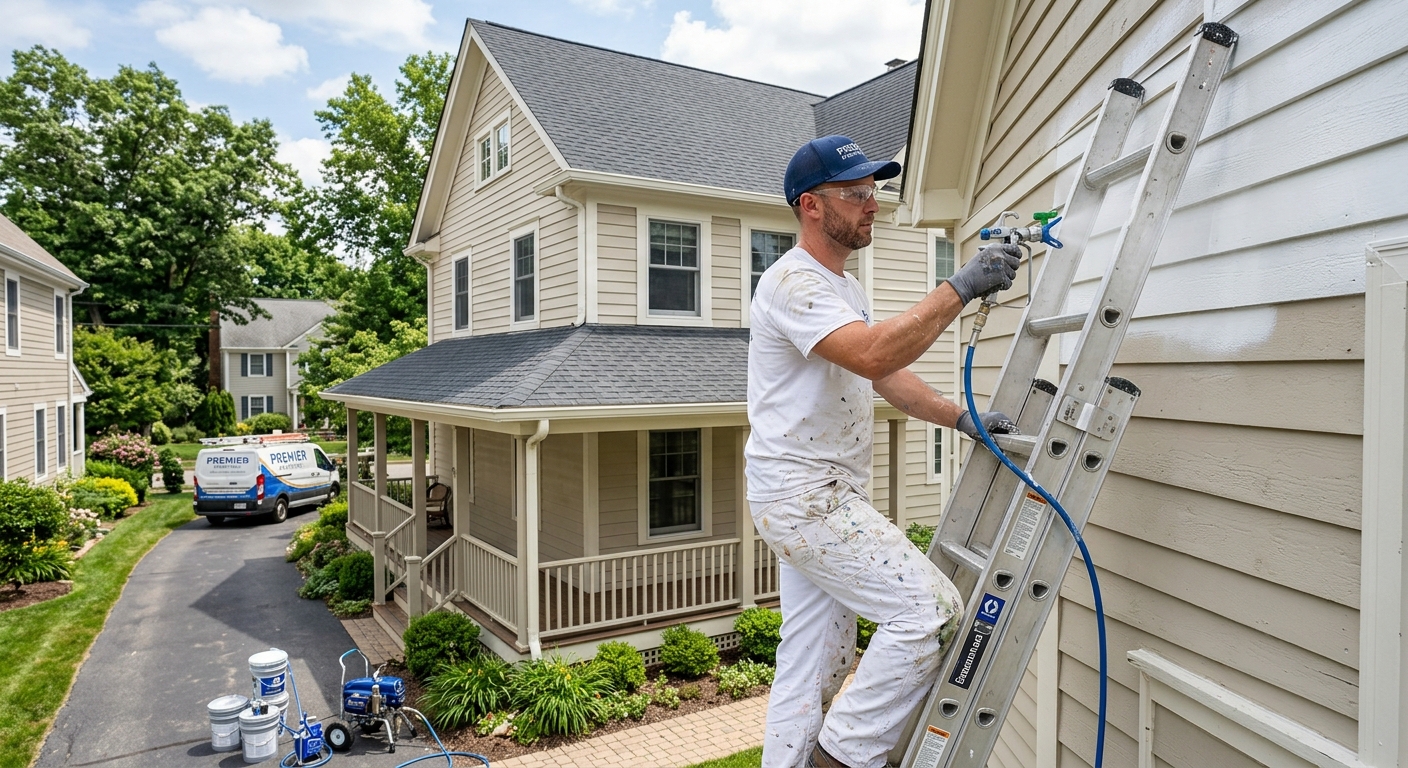
Painting options and costs in Bedford Park-Nortown
Bedford Park-Nortown is a neighbourhood where paint decisions are tied to both housing age and seasonal timing. With a population of 23,236 (Statistics Canada, 2021 Census), there’s steady demand for quality repainting, especially around the older residential pockets near Yonge Street and St. Clair. Many homes in this part of Toronto pre-date modern paint systems, so homeowners often face more preparation—scraping, sanding, caulking, patching and priming—before a topcoat ever goes on. In practice, that means prep time can become the biggest line item, and for homes built before 1978, lead-safe work practices are commonly handled by pros even though homeowners aren’t legally mandated to follow them.
Cost is also shaped by the Toronto market’s short exterior window. Exterior painting in the Greater Toronto Area is typically scheduled from late May through June, and again from September to mid-October, when temperatures stay above about 10°C for proper curing and adhesion. In June–August, demand tightens in peak weeks, so exterior pricing can run 10–15% higher. Interior work is less season-sensitive, but labour still dominates: ceilings, trim density, and how much furniture/masking is needed can swing costs significantly. If your goal is a refresh versus a premium finish, expect the pricing to reflect product tier and the number of coats over the right primer.
Below are typical ranges you’ll see for Bedford Park-Nortown, so you can compare quotes apples-to-apples before you decide on scope and finish level.
| Service |
What's Included |
Typical Duration |
Price Range |
| Interior — whole home (walls, ceilings, trim) |
Move furniture/masking as feasible, prep (patch/sand/caulk), prime where needed, paint walls/ceilings, paint trim/doors as scoped, clean-up and final touch-ups |
5–12 business days |
$2,200 – $6,000 |
| Interior — per room (standard bedroom or living room) |
Prep and patching, prime where needed, paint walls and trim (ceiling optional if noted), protected floors and clean-up |
1–3 business days |
$400 – $1,500 |
| Exterior — full house (siding, trim, soffits) |
Wash, scrape/sand spot prep, caulk where required, prime bare spots, paint siding/trim/soffits, surface protection and final clean-up; schedule depends on curing windows |
4–10 business days |
$1,800 – $8,000 |
| Exterior — trim and accent colours only |
Prep limited to trim surfaces, caulk and prime as needed, paint specified trim/accent areas; assumes siding base is in good condition |
2–5 business days |
$1,500 – $4,500 |
| Kitchen cabinet painting (doors, frames, spray finish) |
Remove/label doors where feasible, degrease, sand/scuff, prime, spray finish, reinstall hardware, protect adjacent surfaces |
4–10 business days (includes cure time) |
$2,000 – $4,000 |
| Specialty / faux finish (accent wall, texture) |
Surface prep appropriate to the effect, base coats, application of texture/faux method, sealer (as required), clean-up and touch-ups |
1–4 business days |
$300 – $5,000 |
Prices are estimates only and vary by project scope, site access and material selection.
What affects the price of painting in Bedford Park-Nortown
In Bedford Park-Nortown and across Toronto, two quotes for the “same” paint job can differ by 30–50% because the real cost is preparation, access, product system and quality of workmanship—things that often aren’t fully described. Exterior work is especially sensitive: in the GTA, the season is tightly climate-dependent. Contractors typically need late May through June and again September to mid-October when temperatures are consistently above about 10°C for application and curing. That concentration of demand can push summer rates up 10–15% in June–August, and it also affects scheduling flexibility when rain days reduce progress.
For older homes (common across this part of Toronto), labour rises because there may be multiple paint layers, aged caulking, uneven surfaces, and more time spent scraping, sanding, patching and priming. In repainting projects, prep can take 50–70% of labour, which is why a “fresh coat” promise doesn’t always hold. A practical example: an exterior that’s peeling lightly may price closer to the lower end of the exterior band, but if the contractor must do broader scraping and more priming, the same home can shift toward the upper end of the $1,500 – $8,000 exterior range.
Local conditions also affect cost in predictable ways. North-facing elevations that stay damp longer can require more careful timing and spot-priming after wash/scrape. Houses with more height and eaves get extra rigging time: scaffolding or lifts can add days even when surface area is similar. If you’re budgeting between interior refresh work and a full scope, interior projects commonly land anywhere from the $400 – $6,000 band depending on trim density, ceiling height and how many patch areas need primer-level adhesion.
| Price Factor |
Why It Matters |
Cost Impact |
| Surface prep — scraping, sanding, patching drywall or wood |
Adhesion depends on removing loose paint and smoothing edges; also determines whether caulk/primer will stick |
Can add 30–70% of labour on repaints |
| Number of coats — 2-coat system over primer vs. 1 coat over existing |
Coverage, colour uniformity and durability depend on proper coat count |
Often shifts price by 10–25% |
| Paint quality tier — contractor-grade vs. premium (Benjamin Moore, Sherwin) |
Higher-quality coatings generally cover better and resist scuffing/fading more effectively |
Materials may add 5–20%; savings come from fewer redo visits |
| Ceilings and trim — adds significant time vs. walls-only |
Ceilings and dense trim require extra cutting-in, masking and careful edging |
Can increase interior scope by 15–40% |
| Exterior season window — short season raises summer rates |
Work must be scheduled around curing temperature and rain; peak weeks cost more |
Typically +10–15% in June–August |
| Lead-safe precautions — required for pre-1978 homes with lead paint |
Professionals use containment/wet methods/HEPA vacuuming and proper disposal if lead is suspected or confirmed |
Can add 10–30% depending on extent of disturbance |
| Surface material — drywall vs. plaster vs. wood vs. stucco |
Different substrates need different primers, patching systems and texture matching |
Can move a job by 10–25% |
| Height and access — multi-storey exterior requires scaffolding or lifts |
Safety, protection and labour time rise with reach and protected areas |
Can add 15–35% on exterior access-heavy homes |
Permits & regulations in Ontario
In Ontario, painting typically does not require a permit. For homeowners in Bedford Park-Nortown, the bigger regulatory focus is on health and safety practices for older homes—not on permits for typical interior or exterior repainting. If your home was built before 1978, health guidelines strongly recommend lead-paint testing before sanding or scraping. If lead is present, standard professional lead-safe practices include wet methods to reduce dust, HEPA vacuuming, proper containment, and safe disposal. While it isn’t legally mandated for homeowners in every scenario, professional contractors usually follow lead-safe procedures because dry scraping can create hazardous dust.
What does require a permit is uncommon for paint-only scopes, but permits can come into play when painting is bundled with broader renovations (for example, structural or electrical work) or if you’re altering building systems. For paint projects specifically, think “no permit,” but do expect contractors to manage safety obligations.
Before you hire, confirm three things: (1) liability insurance, (2) workers’ compensation coverage (WSIB/WCB) for their employees, and (3) a clear written contract. Step-by-step, verify by checking the contractor’s Ontario-related business info online, requesting a Certificate of Insurance with your name/address listed as applicable, and asking for WSIB/WCB account confirmation (or a clearance letter where used). Then ensure your contract lists the paint brand/line, sheens, number of coats, surface prep scope, and whether clean-up/disposal is included.
Interior vs exterior painting — getting the best result in Bedford Park-Nortown
In Bedford Park-Nortown’s Toronto climate, the difference between a long-lasting paint job and premature failure is usually prep, not hype. For interiors, the order matters: filling and sanding first, priming where patches or stains exist, then applying two proper coats. Even when premium paints are used, one thick coat often leaves uneven sheen and makes scuffs and wash marks more obvious in high-touch areas. Sheen choice also drives durability and cleanability—flat/low-lustre in low-traffic ceiling areas, eggshell or matte on living rooms and bedrooms, and satin or semi-gloss for kitchens, trim, bathrooms and entryways where wipe-down matters.
For exteriors, Ontario’s cycles of rain, humidity spikes and freeze-thaw increase the need for caulking before painting so water doesn’t creep behind new coatings. Primer type matters: different substrates (bare wood, repaired areas, masonry, fibre cement) require appropriate primers to lock down adhesion. Unlike coastal BC where mildew resistance and persistent dampness are usually the leading concern, the GTA’s main risks are timing and curing conditions—your contractor still needs the right products and a schedule that respects rain days and temperature.
Cabinet painting is a strong budget alternative to replacement: if you want an updated kitchen without full renewal, it’s often the fastest way to get a “new” look. A realistic decision point: spending closer to the mid-range of the cabinet band (often around $2,000 – $4,000 for a full painted set) can be justified because replacement typically costs far more for materials and labour. For pre-1978 homes, ensure lead-safe precautions are covered when sanding or scraping trim, windows or railings.
If your quote sounds inexpensive, ask what prep is included—because the money you save on paint can be lost on patching, re-coating, and touch-ups next season.
| Project Type |
Key Prep Step |
Recommended Coats |
Price Band |
| Interior — fresh drywall (new construction) |
Seal/prime drywall properly to prevent flashing and to even out absorption |
1 primer + 2 finish coats |
$600 – $2,500 |
| Interior — repaint (good condition, no repairs) |
Light sanding/scuffing, degrease where needed, spot prime if stain or sheen mismatch exists |
1–2 finish coats (commonly 2 for uniformity) |
$400 – $1,600 |
| Interior — repaint (patching and priming needed) |
Patch, sand flush, and spot prime to lock in different substrate absorption |
1 primer (spot) + 2 finish coats |
$800 – $3,200 |
| Exterior siding (wood or fibre cement) |
Wash, scrape/sand loose edges, caulk, then prime bare/sanded areas |
1 primer + 2 finish coats |
$2,000 – $8,000 |
| Exterior trim and accents only |
Correct prep on trim edges (feather sand + prime) and caulk before topcoat |
Spot primer + 2 finish coats (as required for coverage) |
$1,500 – $4,500 |
| Kitchen cabinets (spray finish) |
Degrease, scuff/prime correctly, and control dust between coats |
1 primer + 2 finish coats (system-dependent) |
$2,000 – $4,000 |
How to choose a painting contractor in Bedford Park-Nortown
Choosing a contractor is about risk control and clarity. Start by verifying Ontario licensing status where applicable for their business type, then confirm liability insurance and workers’ compensation coverage (WSIB/WCB). In practice, you’ll do this by: (1) asking for a Certificate of Insurance from the contractor and checking it covers general liability (and the project address/tenant protection as applicable); (2) requesting proof of WSIB/WCB account clearance/coverage for their workers; and (3) confirming they’re in good standing as a business through Ontario business information channels. You don’t want to be the one paying if a worker is injured or if property is damaged.
Next, get 2–3 itemised written quotes—broken into labour and materials—so you can see what’s included in prep, primer and coat count. Watch the scope: are surface repairs included, is disposal included, and is there a clause about what happens if weather delays exterior work? A good contract also lists paint brand/line, sheen level, number of coats, and what’s being caulked (and where). Warranty matters too: ask for a workmanship warranty length, whether product/manufacturer warranties apply, and if the warranty is transferable if you sell the home.
For payments, a safe approach is not to pay more than 10–15% upfront, then use a holdback until final completion. Finally, demand a start date and a completion estimate in writing, especially for exteriors where curing and rain days can affect the schedule.
- Request 2–3 itemised quotes with labour + materials (no “lump sum only”)
- Confirm liability insurance and ask for the COI certificate before signing
- Confirm WSIB/WCB coverage (ask for account proof or clearance letter)
- Verify paint brand/line and sheen (flat/eggshell/satin/semi-gloss)
- Check prep scope: scraping, sanding, patching, caulking, primer coverage
- Ask how they handle lead-safe steps on pre-1978 trim/windows if applicable
- Confirm disposal and clean-up is included (scrap, empty containers, waste)
- Get written coat counts (e.g., primer + 2 finish coats) and where primer is required
- Clarify who protects floors, railings and landscaping during exterior work
- Review schedule language for exterior weather delays and rescheduling
- Ask about workmanship warranty terms and whether product warranty applies
- Use payment milestones: small deposit, then staged payments with holdback
Red flags I see in Bedford Park-Nortown: they won’t provide written scope or coat count, they ask for a large upfront payment, they can’t show WSIB/WCB/insurance documents, they provide a low price but exclude scraping/caulking/priming, or they avoid discussing lead-safe precautions for older trim when sanding is required.
Frequently asked questions — painting in Bedford Park-Nortown
Do I need to worry about lead paint in an older Bedford Park-Nortown home?
If your Bedford Park-Nortown home is pre-1978, it’s wise to treat it as higher risk. Ontario typically doesn’t require permits for painting, but lead-safe work practices are standard for professionals when sanding or scraping may create dust. The recommended approach is to test before disturbing surfaces—especially trim, windows, railings, and any areas showing old cracking or flaking paint. If lead is present, contractors should use wet methods, HEPA vacuuming, containment where needed, and proper disposal procedures. Homeowners aren’t always legally required to follow the same practices, but as a practical matter, you want a contractor who will manage the dust-control steps properly and document how they’ll protect occupants.
How long does it take to paint a house?
Timing depends on interior vs exterior and how much prep is needed. For interiors, a whole-home repaint in Bedford Park-Nortown commonly takes about 5 to 12 business days, because prep (patching, sanding, caulking) drives the schedule more than paint curing. Exteriors are more weather-bound in Ontario: contractors usually schedule late May through June, and again September to mid-October, when temperatures stay above about 10°C for proper drying. On many homes, a full exterior can take 4 to 10 business days, but rain days and short “ideal” windows can spread the work out. If your exterior needs more scraping/priming (common on older homes), expect additional time beyond the base estimate.
What's the difference between paint quality tiers?
Quality tiers mainly show up in coverage, adhesion, and how smoothly the sheen levels out. A higher-quality coating often covers better per coat, levels more consistently, and holds up to cleaning and scuffing—especially on kitchens, trim, and high-touch areas. For homeowners comparing quotes in Ontario, the cheapest line item sometimes uses a lower-grade product with different coverage expectations, which can lead to needing additional coats to look uniform. That’s why it’s important to compare the exact paint brand/line, not just “we’ll use premium.” In the field, a well-prepped job using a good system can keep costs closer to the lower end of the band, while an under-prepped job can push you toward the higher end (for example, interior projects moving up toward the $400 – $6,000 range depending on trim, patching and coat counts).
How do I compare painting quotes?
To compare quotes in Bedford Park-Nortown fairly, insist on itemised written details. Look for: prep scope (scraping/sanding/patching), caulking specifics, primer requirements, number of coats, and exact paint brand/line and sheen. Compare timelines and what’s included for clean-up and disposal. Also confirm whether scaffolding/lifts are included for exterior height and access. If one quote is dramatically lower, it’s often because it assumes less surface prep or fewer coats. A good quote should also state whether weather-related setbacks change the schedule or cost. For reference, exterior painting typically sits in the $1,500 – $8,000 range depending on prep and access—so a “full house” exterior that’s far below that usually signals exclusions or limited prep.
What paint sheen should I use in different rooms?
Sheen choice is about durability and how light reflects. In Ontario homes, I typically recommend flat/low-lustre on ceilings to minimize visible imperfections. For living rooms and bedrooms, eggshell or matte is common because it’s easier to live with and reflects less light than satin. Kitchens, bathrooms and entryways often benefit from satin or semi-gloss because they handle cleaning better and resist scuffing. Trim, doors and railings usually do well with semi-gloss for wipeability and crisp edges. The key is matching sheen to use—rather than choosing one sheen “everywhere.” Even with the right sheen, proper prep matters: a two-coat system over appropriate primer is what keeps sheen consistent and reduces patchy flashing.
Can I paint my house exterior in spring or fall in Bedford Park-Nortown?
Yes—spring and fall can work well in Bedford Park-Nortown, but timing has to respect drying and curing. In the GTA, contractors generally plan exterior work from late May through June, and again from September to mid-October when temperatures are about 10°C or higher for at least 24–48 hours after application and humidity isn’t excessively high. Early spring can be risky because nights drop below workable temperatures and surfaces may not dry evenly. Fall can be great if the weather holds, but rain and frost at the edges of October can shorten the window. If you’re planning exterior work, ask your contractor how they’ll handle delays, because proper curing is what keeps adhesion and reduces peeling later. If your quote references $1,500 – $8,000 exterior pricing, ensure it includes prep, caulking, primer, and the weather-dependent schedule details.