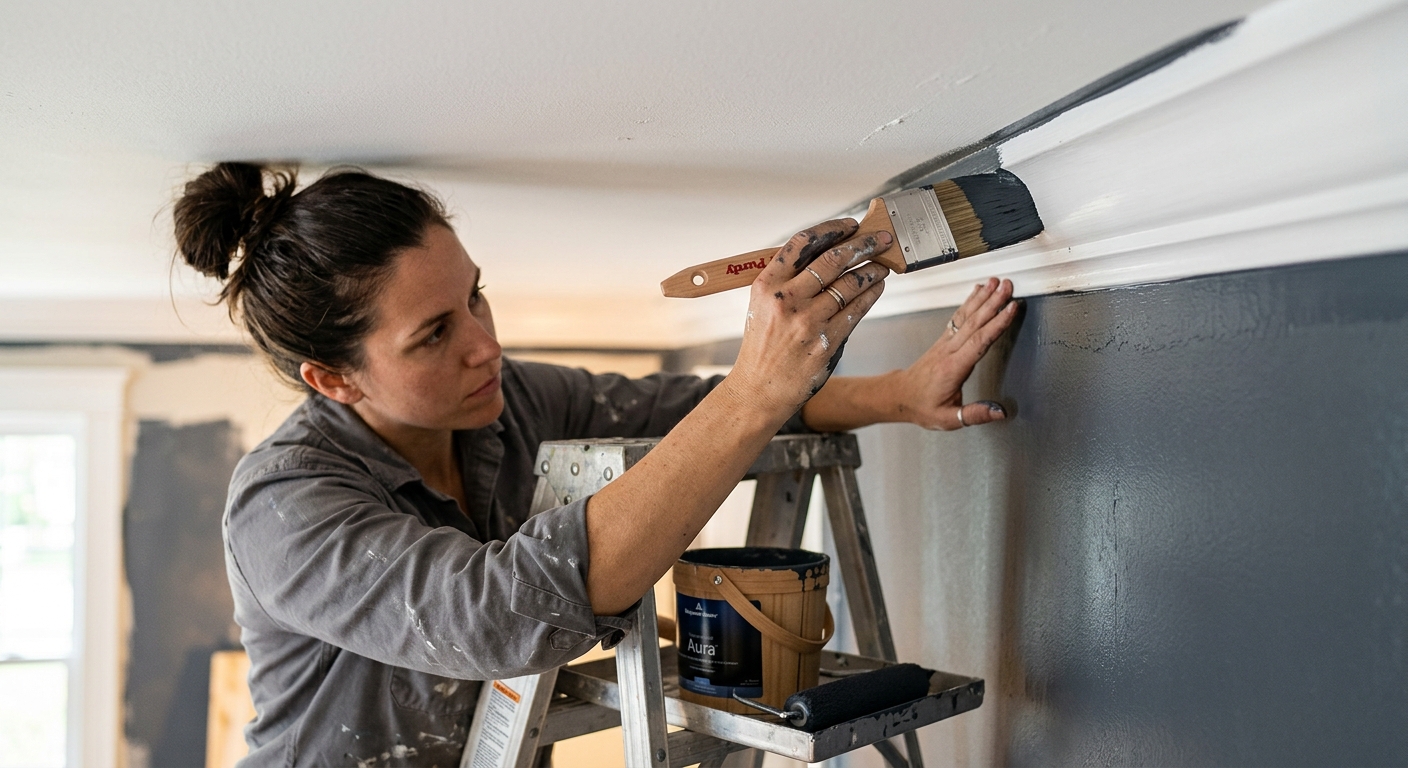
Painting options and costs in Salmon Arm
Salmon Arm homeowners usually have two realistic paths: refresh the look with an interior repaint, or tackle the exterior before the next long weather swing. With a population of 19,432 (Statistics Canada, 2021 Census) and about 6,300 homeowner households (77.7% of households own), many properties are maintained rather than replaced—so the prep work that protects paint adhesion becomes a big part of your quote. In particular, homes built before 1981 make up 38.6% of the housing stock (Statistics Canada, 2021 Census), which often means more aged trim caulking, sun-chalking, and previous paint layers that need scraping, sanding, and spot-priming before finish coats. For pre-1978 homes, responsible contractors also plan for lead-safe work practices if old coatings are likely to contain lead.
In the Thompson–Okanagan region, exterior painting demand is strongly seasonal. In and around Salmon Arm, contractors typically book siding and trim during a late spring to early fall window when surfaces are dry and temperatures support proper curing. That compressed season can lift summer scheduling pressure, especially for full-house exterior work, while material selection shifts toward mildew-resistant primers and topcoats to reduce staining and adhesion failures during damp stretches. Neighbourhoods around downtown Salmon Arm and the waterfront corridor tend to see earlier demand because homes are more accessible for staging and colour changes.
Below are typical local price ranges you can use for budgeting. Use them to compare quotes, but always verify what’s included in surface prep, number of coats, and whether trim, soffits, and doors are counted.
| Service |
What's Included |
Typical Duration |
Price Range |
| Interior — whole home (walls, ceilings, trim) |
Prep (patch/sand), prime as needed, paint walls/ceilings, caulk where required, paint interior trim and doors; clean-up and protection of floors |
3–7 days |
$3,000–$6,000 |
| Interior — per room (standard bedroom or living room) |
Prep, patch/sand, prime where needed, paint walls; typically includes ceiling touch-ups or full ceiling depending on condition; trim as scheduled |
1–2 days |
$750–$2,000 |
| Exterior — full house (siding, trim, soffits) |
Surface inspection, power wash (as required), scrape/sand, caulking, spot-priming, prime where specified, finish coats on siding/trim/soffits; protection and clean-up |
7–14 days |
$5,000–$12,000 |
| Exterior — trim and accent colours only |
Masking and careful prep of trim areas, scrape/sand, caulk, prime selected areas, repaint trim/accent surfaces |
3–7 days |
$1,500–$4,500 |
| Kitchen cabinet painting (doors, frames, spray finish) |
Degrease, scuff/sand, bonding primer where needed, spray finish for doors/drawers, back-painting/frames as agreed, hardware handling if included |
4–10 days (includes cure/door rehanging) |
$2,000–$5,000 |
| Specialty / faux finish (accent wall, texture) |
Surface preparation for texture/faux, primer as required, finish application technique, sealing/clearcoat where specified |
1–4 days |
$600–$2,500 |
Prices are estimates only and vary by project scope, site access and material selection.
What affects the price of painting in Salmon Arm
Two quotes for the same-looking job can differ by 30–50% across Thompson–Okanagan and other parts of British Columbia because painting is labour-heavy and the “hidden variables” are mostly preparation and scheduling. Exterior work is especially sensitive to the weather. In this region, the exterior painting window is tightly climate-bound: contractors aim for late spring through early fall when temperatures are reliably above freezing and surfaces are dry enough to apply and cure properly. Short demand windows concentrate crews into a rush period, and any urgent booking can carry a premium. By contrast, coastal BC can have longer calendar time but higher humidity and rain, so contractors often rely on mildew-resistant systems and schedule around damp stretches to avoid blistering and adhesion failures.
Another major driver in Salmon Arm is housing age. With 38.6% of homes built before 1981 (Statistics Canada, 2021 Census), many repaint projects involve more scraping, caulking and spot-priming than homeowners expect. Prep can account for 50–70% of labour on a repaint because older substrates may have sun-chalking, failing caulk lines, or uneven adhesion across previous layers.
Concrete examples from local job sites: if your siding has failing caulk at window trim, expect additional labour for clean removal, re-caulking, and targeted primer before finish coats—this can move an exterior job from the middle of the $800–$12,000 band toward the upper end. If your interior ceilings are textured or stained from past leaks, the “per room” estimate can climb once stain-blocking primer and extra coats are added—often pushing a single-room repaint closer to the higher part of the interior pricing range.
The best way to control cost is to confirm exactly how much prep is included and how many coats are planned over primer, not just over existing paint.
| Price Factor |
Why It Matters |
Cost Impact |
| Surface prep — scraping, sanding, patching drywall or wood |
Adhesion and long-term durability depend on what’s under the topcoat |
Often the largest variable; can add 20–60% to labour |
| Number of coats — 2-coat system over primer vs. 1 coat over existing |
Coverage, colour uniformity, and hide rate change with condition and sheen |
Typically 10–30% difference |
| Paint quality tier — contractor-grade vs. premium (Benjamin Moore, Sherwin) |
Higher solids and better pigments can reduce recoat issues |
Materials may vary; labour savings can offset higher paint costs |
| Ceilings and trim — adds significant time vs. walls-only |
Ceilings require more cutting-in and rolling control; trim needs careful edging |
Frequently adds 15–40% depending on scope |
| Exterior season window — short season raises summer rates |
Availability of crews concentrates in late spring–early fall |
Scheduling pressure can shift bids by 10–25% in peak weeks |
| Lead-safe precautions — required for pre-1978 homes with lead paint |
Extra controls for containment and clean-up increase labour time |
Can add 10–20% when lead-safe work is needed |
| Surface material — drywall vs. plaster vs. wood vs. stucco |
Porosity and flex differ, affecting primer selection and how many coats bond |
May change labour and primer quantities by 10–30% |
| Height and access — multi-storey exterior requires scaffolding or lifts |
Safe access changes equipment costs and labour productivity |
Often adds 10–35% to exterior work |
Permits & regulations in British Columbia
In British Columbia, painting itself typically does not require a permit for residential properties—there’s usually no city-issued permit process for interior or exterior paint work. However, if you’re dealing with older homes, the health and safety expectations matter. For homes built before 1978, health guidelines recommend testing for lead paint before sanding or scraping, and using lead-safe work practices if lead is present. This isn’t generally mandated for homeowners in the way a formal permit is, but it’s standard professional practice: wet methods to reduce dust, HEPA vacuuming during prep, containment where appropriate, and proper disposal of debris.
What DOES require permits is not painting alone, but related building work or hazards. For example, structural repairs, window replacement, or changes that involve building permits or regulated remediation are separate processes. For a straight paint job, you generally won’t need a painting permit, but you should still expect your contractor to manage risks properly.
For Salmon Arm homeowners verifying your contractor, do this step-by-step:
- Confirm licensing: check the contractor’s business registration status and any trade credentials they claim (many painters operate under general contracting/business numbers rather than a “painting-only” licence).
- Request proof of liability insurance: ask for a current certificate of insurance showing coverage for your project.
- Confirm workers’ compensation (WCB): request evidence they have workers’ compensation coverage for their employees.
- Ask for a written scope: ensure it lists surface prep, paint brands/lines, sheen choices, number of coats, and disposal or waste handling.
- Look for lead-safe plan language (for pre-1978 homes): testing approach, containment/wet methods, and HEPA clean-up details should be described if it’s applicable.
Interior vs exterior painting — getting the best result in Salmon Arm
In Salmon Arm’s Thompson–Okanagan climate, the difference between a long-lasting paint job and a premature failure is rarely the “brand” alone—it’s the surface preparation, the primer choices, and whether the job matches local conditions. Inside, surface prep matters most: filling and sanding defects, addressing stains, and priming patched areas so your finish coat doesn’t sink in or flash. Sheen choice is also practical: flat/eggshell for low-traffic areas helps hide imperfections, while semi-gloss or satin on trim and moisture-prone areas cleans better. A reliable rule is two coats over a proper primer outlasts one thick coat—especially when ceilings have patch marks or walls have colour change.
Outside, the critical factor is that the same surface issues that affect interior adhesion—water resistance, bond, and cleanliness—are magnified by sun, temperature swings, and intermittent damp. Caulking should be done before finish painting so you’re sealing joints before you trap water behind decorative trim. Primer type matters by substrate and condition: wood and older, chalky surfaces often need a bonding/penetrating primer strategy rather than relying on finish paint to do the job. In BC, mildew-resistant products are commonly specified to reduce staining, especially in shaded or eave-adjacent areas; in other provinces with longer warm windows, product selection may skew toward temperature stability to suit curing conditions.
Cabinet painting is usually the best “budget alternative to replacement” when boxes and doors are structurally sound. If your kitchen layout is staying, cabinet refinishing can deliver a fresh look without the demolition and cabinet re-install costs. For a quick cost reality check: a cabinet repaint can fall in the higher end of interior/specialty ranges—often closer to the $2,000–$5,000 band—while a full interior whole-home repaint can be $3,000–$6,000. Spend the extra prep time on the cabinets, and you’ll protect your finish; skip key prep, and you pay twice.
For pre-1978 homes, plan lead-safe precautions before any scraping or sanding on trim. That adds time, but it’s the right way to protect your household and your contractor’s crew.
| Project Type |
Key Prep Step |
Recommended Coats |
Price Band |
| Interior — fresh drywall (new construction) |
Seal and prime drywall to reduce flash and improve uniformity |
2 finish coats over primer |
$2,000–$4,500 |
| Interior — repaint (good condition, no repairs) |
Clean, lightly sand, and spot-prime only where needed |
2 finish coats (often 1 where colour match is exact and prep is perfect) |
$1,200–$3,500 |
| Interior — repaint (patching and priming needed) |
Patch, sand, stain-block as required, and prime all repaired areas |
2 finish coats over primer |
$1,800–$4,200 |
| Exterior siding (wood or fibre cement) |
Scrape/sand, caulk, power wash (as required), then spot-prime bare or failing areas |
2 finish coats over primer system |
$5,000–$12,000 |
| Exterior trim and accents only |
Mask carefully, remove loose paint, caulk joints, spot-prime exposed areas |
2 finish coats where trim has uneven porosity or sun damage |
$1,500–$4,500 |
| Kitchen cabinets (spray finish) |
Degrease thoroughly and use a bonding primer; scuff-sand for adhesion |
1 primer + 2 sprayed colour coats |
$2,000–$5,000 |
How to choose a painting contractor in Salmon Arm
Choosing the right painting contractor in Salmon Arm is mostly about verification and clarity. In British Columbia, painting usually doesn’t require a municipal permit, but reputable contractors still protect you with proper insurance and workers’ compensation. Start by asking for:
- Liability insurance: request a certificate of insurance and confirm it’s current for the project dates.
- Workers’ compensation (WCB): ask for evidence they’re covered for their employees (not just subcontractors).
- Business details: confirm the legal business name, phone/email, and a physical mailing address where applicable.
Next, get 2–3 written quotes that are itemised. You want labour and materials broken out, including prep. Avoid “lump sum” only pricing where the scope is vague—especially on exteriors, where scraping, sanding, caulking, and primer selection drive the real cost.
Read the scope line-by-line: what’s included for power washing, disposal, minor drywall repairs, ceiling work, and lead-safe precautions for pre-1978 homes. Confirm warranty terms: workmanship warranty length (how long they’ll correct peeling, bubbling, or adhesion failures), and whether the manufacturer’s paint warranty is transferable and tied to proper surface prep.
For payment scheduling, never pay more than 10–15% upfront. Use a holdback until the job is complete, cleaned, and touch-ups are done. Finally, insist on a written timeline with a start date and completion estimate—especially for exterior work in the late spring–early fall window.
- Verify insurance and WCB coverage before signing.
- Ask for a written scope of work including prep, priming, caulking, and number of coats.
- Confirm paint brands/lines and sheen levels (flat/eggshell/satin/semi-gloss) are listed.
- Check whether power washing is included and whether it’s “as required,” not automatically.
- Ensure scraping and spot-priming rules are defined for peeling or chalky areas.
- Clarify disposal/cleanup: are drop sheets, waste haul-away, and vacuuming included?
- Confirm how trim, soffits, doors, and eaves are counted in the exterior scope.
- For cabinets, confirm they’ll remove doors, prep edges, and use a proper spray system.
- Ask about caulking type and where it will be applied before paint.
- Get warranty details in writing and what they consider “normal wear.”
- Require a schedule that accounts for curing time between coats on exteriors.
- Keep proof of changes: any colour or scope changes should be written as amendments.
Red flags I see in Salmon Arm: contractors who won’t provide proof of insurance/WCB, quotes that omit prep and primer details, pressure to pay a large upfront deposit, vague “we’ll paint it” scope for exteriors without caulking/scraping rules, and no written warranty or timeline.
Frequently asked questions — painting in Salmon Arm
How much does interior painting cost per room in Salmon Arm?
For most Salmon Arm homes, a “per room” interior repaint (like a standard bedroom or living room) typically lands in the $750–$2,000 range, depending on wall condition, how much prep is needed, and whether trim/doors are included. If the room is in good shape—few patches, no heavy staining, and colour is staying close—you can often stay nearer the lower to mid end. If you have patching, stain-blocking primer, or significant sheen changes, expect the job to move higher because prep and additional primer/coats are what protect the finish. In older homes built before 1981, it’s especially common to spend more time on patching, sanding, and priming (Statistics Canada, 2021 Census), which is why itemised quotes matter.
When is the best time for exterior painting in Salmon Arm?
In Salmon Arm and the broader Thompson–Okanagan region, the practical “best time” is late spring through early fall—when temperatures are reliably above freezing and surfaces are dry enough to apply and cure. Summer demand can concentrate bookings because the exterior painting season is shorter in inland communities than in some coastal areas. If the forecast is cool or damp, contractors may postpone to avoid adhesion issues, blistering, or uneven sheen. For older homes with multiple previous layers, scheduling also matters because more scraping and caulking needs to happen before primer and finish coats. The goal is simple: apply when it can cure properly, and avoid painting over damp surfaces—even if you’re trying to get ahead of the season.
How many coats of paint do I need?
Most residential projects aim for a 2-coat finish system, but the exact number depends on prep and substrate. If you’re painting over properly primed surfaces with good coverage, 2 finish coats provide a uniform look and better durability than trying to “hide everything” with one heavy coat. For interiors, patched or stained areas usually require primer plus 2 finish coats. For exteriors, a typical approach is: scrape/sand and spot-prime problem areas, then apply 2 finish coats over the primer system. If a contractor suggests fewer coats than your scope implies (for example, 1 coat over bare or chalky trim), ask what primer/bonding system they’re using and what you’ll get for coverage and longevity. That’s where quotes can differ by 30–50%.
What paint is best for Salmon Arm's climate?
For Salmon Arm’s inland BC climate, the “best paint” is less about a single brand and more about choosing the right product for the surface and conditions. On exteriors, contractors commonly specify mildew-resistant primers and topcoats to handle staining risk during damp stretches, especially on shaded areas near eaves. For wood and older, chalky substrates, a bonding or penetrating primer is often necessary so the finish adheres well. Interior paints should match room use: eggshell or satin for most living areas for cleanability, and appropriate sheens for trim. If your home is older (38.6% built before 1981, Statistics Canada, 2021 Census), you’ll often need more aggressive prep and correct primer selection to prevent flashing and peeling—so insist that your quote identifies prep and primer, not just the finish paint.
How long does exterior paint last here?
With proper prep, good materials, and correct application timing, exterior paint in Salmon Arm typically performs for several years, but lifespan varies with sun exposure, shading, moisture management, and maintenance. Paint can fail sooner if caulking is cracked, water gets behind trim, or chalky surfaces are painted without spot-priming and bonding primer. The biggest predictors of durability are prep quality and whether the job accounts for local conditions during the late spring–early fall window. In older housing stock, repeated previous layers can hide adhesion problems—so even a “reasonable” finish coat can bubble or peel if prep is rushed. Ask your contractor how they handle caulking, spot-priming, and staging around damp conditions; those details are usually what separate a mid-range outcome from a longer-lasting one.
Should I paint or replace my cabinets?
If your cabinet boxes are solid and the door/drawer faces are the main issue (colour dated, minor wear, or you want a fresh look), painting is usually the better-value option. Cabinet painting typically prices around $2,000–$5,000 for a full spray-finish process, depending on size, door count, and prep needs. Replacement can be more expensive once you account for demolition, disposal, reinstallation, and matching finishes. Painting becomes less cost-effective if boxes are damaged, the layout needs major changes, or there’s extensive structural rot/warping. For pre-1978 homes, your contractor should also follow lead-safe precautions when sanding or scraping trim finishes if lead risk is present. A good paint job can modernize your kitchen without the disruption of replacement.