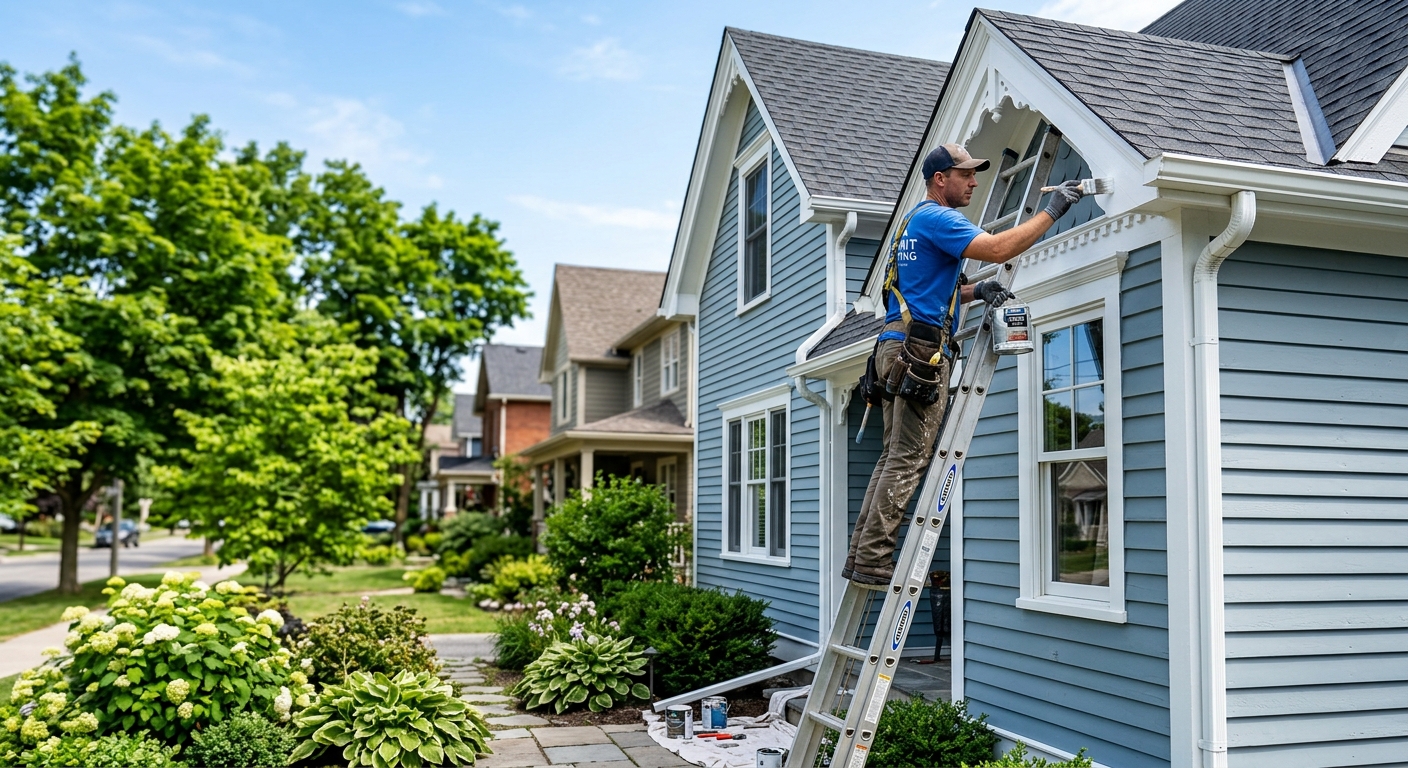
Painting options and costs in Spruce Cliff
Spruce Cliff, Alberta is a compact community with a mix of housing ages, and that directly shows up in painting quotes. In the 2021 Census profile, Spruce Cliff has a population of 4,195 (Statistics Canada, 2021 Census), and many homes in the Calgary area reflect the broader trend of older resale stock where surface preparation drives the final cost. Where properties pre-date 1978, additional lead-safe work practices are often required for professional crews, and that prep time can be significant.
In Calgary’s market, exterior painting costs tend to hold firmer through peak season because the workable weather window is short and weather-dependent: contractors generally aim for mid-May through late September when temperatures stay above 10°C and coatings can dry properly. Compared with coastal BC, you’re less likely to deal with constant damp, but freeze–thaw cycles, strong UV, and hail risk still mean we specify high-quality acrylics and elastomeric or flexible exterior coatings. That focus on durability affects materials selection and labour planning.
Demand in Spruce Cliff often concentrates around established streets close to transit and shopping corridors, where busy homeowners want fast scheduling and minimal disruption—those jobs get booked first as the season tightens. Typical totals land across the city’s established bands: interior repainting commonly starts around the lower end of the interior range, while exteriors for full houses often sit closer to the middle-to-upper portion of the exterior range once prep and multiple coats are included.
Below is a practical comparison to help you benchmark your quote before you compare contractor line-items in detail.
| Service |
What's Included |
Typical Duration |
Price Range |
| Interior — whole home (walls, ceilings, trim) |
Patch & sand, spot-prime as needed, caulking, 2-coat wall/ceiling finish, trim/door painting, surface protection, cleanup |
5–9 days |
$2,400–$7,500 |
| Interior — per room (standard bedroom or living room) |
Prep, fill/sand, prime spots, 2-coat walls, touch up trim as specified, protection & cleanup |
1–3 days |
$400–$1,800 |
| Exterior — full house (siding, trim, soffits) |
Power wash, scrape/repair as needed, caulk, prime where required, 2-coat exterior system, paint eaves/soffits/trim, protection & cleanup |
7–16 days (weather-dependent) |
$2,500–$9,000 |
| Exterior — trim and accent colours only |
Prep & prime targeted areas, 2-coat trim/accent, caulking, protection, cleanup |
3–8 days |
$800–$4,200 |
| Kitchen cabinet painting (doors, frames, spray finish) |
Degrease, light sand, bonding primer, spray finish, hardware masking/handling, cabinet protection and cleanup |
5–12 days (plus dry/cure time) |
$1,800–$7,000 |
| Specialty / faux finish (accent wall, texture) |
Surface preparation for pattern/texture, base coat, specialty application, sealing topcoat as required, cleanup |
2–7 days |
$600–$6,000 |
Prices are estimates only and vary by project scope, site access and material selection.
What affects the price of painting in Spruce Cliff
In Spruce Cliff and across the Calgary economic region, quotes for the “same” painting job can differ by 30–50% because the scope is rarely identical once prep, access, and coating systems are considered. Contractors also price risk differently: a crew that expects heavy scraping or multiple primer types will build those labour hours into the estimate rather than absorbing surprises. Product choices matter too—premium acrylics and flexible exterior coatings cost more, but they help reduce early peeling and blistering when Alberta’s sun and temperature swings attack the finish.
Exterior work is tightly climate-bound in the Calgary region. In practice, the workable window for exterior work is roughly late May to early October when daytime highs reliably stay above 10°C and surfaces can dry properly during application. That shorter season concentrates scheduling pressure, so summer rates are firmer. By contrast, coastal BC can have a longer calendar but more humidity and rainfall, which forces mildew-resistant products and careful timing; the “weather work” burden still shows up in cost, just differently.
Older homes throughout Calgary’s surrounding communities often mean significant prep—scraping, patching, caulking and stain-blocking before a top-coat goes on. On repaints, prep can easily account for 50–70% of labour. For a home interior, that’s why a standard “per room” job can start around the lower interior band, while a whole-home repaint with ceiling work and repairs can rise toward the upper end ($400–$8,000). On the exterior side, the delta between a full house ($2,500–$9,000) and trim-only ($800–$4,200) is usually a direct reflection of how much wall area, caulking, and priming is involved—not just paint quantity.
In Spruce Cliff specifically, two common cost drivers are hail-damaged trim that needs smoothing before coating and textured or previously coated siding that may require extra cleaning and primer for adhesion.
| Price Factor |
Why It Matters |
Cost Impact |
| Surface prep — scraping, sanding, patching drywall or wood |
Prep determines adhesion and appearance; missing prep leads to peeling, flashing, or visible patches |
Often adds 20–60% of labour on repaints |
| Number of coats — 2-coat system over primer vs. 1 coat over existing |
Existing colour bleed, stains, and uneven substrate require additional coats for uniform finish |
Can shift total by 10–25% |
| Paint quality tier — contractor-grade vs. premium (Benjamin Moore, Sherwin) |
Higher-end coatings typically cover better and resist chalking/fading longer under UV |
Materials may add 5–20% but reduce callbacks |
| Ceilings and trim — adds significant time vs. walls-only |
Ceilings require more masking, careful leveling, and often more sanding; trim needs precision |
Commonly increases interior totals by 15–40% |
| Exterior season window — short season raises summer rates |
Fewer days that meet drying requirements increases scheduling pressure and premium demand |
Can raise labour pricing during peak weeks |
| Lead-safe precautions — required for pre-1978 homes with lead paint |
Proper containment, HEPA vacuuming and safe disposal increase labour and materials |
May add 5–25% depending on risk and condition |
| Surface material — drywall vs. plaster vs. wood vs. stucco |
Different substrates need different primers and surface treatments for adhesion |
Primer and labour can change totals by 10–30% |
| Height and access — multi-storey exterior requires scaffolding or lifts |
Setup time, safety, and faster-than-floor coverage planning change crew time |
Often adds 10–35% on two-storey exteriors |
Permits & regulations in Alberta
In Alberta, painting typically does not require a permit for homeowners. That said, professional contractors still follow safety and health best practices, especially for older homes. For homes built before 1978, health guidelines recommend testing for lead paint before sanding or scraping, and using lead-safe work practices if lead is present. That usually means wet methods to reduce dust, HEPA vacuuming, proper surface containment, and correct disposal. While this isn’t generally a legal requirement for homeowners, it’s standard practice in the trades to protect workers, occupants, and the job site.
The work that can involve additional steps (and sometimes regulatory attention) is usually tied to how you handle dust and debris rather than the act of painting itself—for example, if you’re disturbing old painted surfaces via sanding, scraping, or demolition. If a project involves significant removal of old coatings, or you’re operating in a way that creates dust, the safe approach becomes more stringent. For subcontractors, carrying liability coverage and workers’ compensation is non-negotiable.
To verify your contractor in Spruce Cliff, start with their Alberta business and contracting information online, then request a certificate of liability insurance and proof of workers’ compensation coverage (WSIB/WCB) directly from the contractor before work begins. After that, ask for an itemised scope that specifies paint brand, sheen, number of coats, and what prep is included (scraping, patching, caulking, priming, and surface cleaning). Finally, confirm you’ll receive a written contract that matches the quote, including product names and responsibilities for cleanup and disposal.
Interior vs exterior painting — getting the best result in Spruce Cliff
In Spruce Cliff’s Alberta climate, the difference between a long-lasting paint job and an early failure is usually prep quality and the correct coating system—not the brand alone. For interiors, start with the wall condition: proper filling, sanding, and spot-priming matters more than buying the most expensive topcoat. Even small issues—pinholes, flaky patches, nicotine or water staining—telegraph through if they aren’t sealed and corrected. Sheen choice is also critical. In living rooms and bedrooms, eggshell or satin tends to balance washability and appearance; kitchens and high-traffic areas often benefit from a slightly higher sheen for easier cleaning. Regardless of sheen, two coats over a proper primer generally outlast “one thick coat” because coverage and film build are more consistent.
For exteriors, the failure points are predictable: peeling from poor adhesion, cracking around caulking lines, and premature fading from UV exposure. We treat caulking as a system step—caulk first to prevent water ingress pathways, then prime and paint over compatible materials. Primer selection depends on substrate: oil-based primers may be required for certain stain-blocking or adhesion situations on older wood, while latex primers are common for drywall and many repaired areas. While mildew resistance is especially important in damp climates like coastal BC, Alberta still benefits from quality prep and coatings that tolerate freeze–thaw stress.
Kitchens are a practical budget alternative: cabinet painting can refresh your home without replacing cabinetry, but it requires degreasing, bonding primer where needed, and a carefully sprayed topcoat for durability. If your home is pre-1978, lead-safe precautions should be part of cabinet and trim prep too.
For example, if full interior work lands around the middle of the interior band ($2,400–$7,500), a “trim-and-doors only” refresh may look cheaper initially, but it’s often a false economy when walls have scuffs, patch seams, or old stains. Spending the extra prep labour on walls is usually what keeps the finished look crisp for years.
| Project Type |
Key Prep Step |
Recommended Coats |
Price Band |
| Interior — fresh drywall (new construction) |
Seal/prime drywall, spot-treat joint compound, sand smooth before topcoat |
Prime + 2 topcoats |
$1,800–$5,200 |
| Interior — repaint (good condition, no repairs) |
Light sanding, cleaning, caulk touch-ups, then consistent coating application |
1–2 topcoats depending on coverage (often 2) |
$400–$4,800 |
| Interior — repaint (patching and priming needed) |
Fill/sand repairs, prime patched areas and any stains before finish coats |
Prime spots + 2 topcoats |
$1,200–$7,500 |
| Exterior siding (wood or fibre cement) |
Wash, scrape loose paint, repair, caulk, prime bare spots, then full system topcoat |
Primer where required + 2 topcoats |
$2,500–$9,000 |
| Exterior trim and accents only |
Targeted prep and priming of trim edges, caulking at joints, feather-sanding transitions |
Prime where required + 2 topcoats |
$800–$4,200 |
| Kitchen cabinets (spray finish) |
Thorough degreasing and bonding primer for adhesion, careful masking and sanding between coats |
Bonding primer + 2 finish coats |
$1,800–$7,000 |
How to choose a painting contractor in Spruce Cliff
To choose a contractor in Spruce Cliff, start with verification: in Alberta, painting itself usually doesn’t need a permit, but a reputable contractor should still be fully covered and accountable. Ask for their Alberta business/contracting information and confirm it’s current. Then request a certificate of liability insurance and check that it matches your project address and dates. For workers’ compensation, ask for proof of WSIB/WCB coverage. If they can’t provide it promptly—or you receive a vague document—treat it as a major warning sign.
Next, get 2–3 written quotes that are itemised, not lump sums. A fair quote separates labour and materials and spells out prep responsibilities: cleaning/power washing, scraping, patching, sanding, caulking, primer types, and what’s included in trim and ceiling work. Make sure disposal is included (paint debris, masking materials, and any sanding residue). Also confirm whether you’re paying for permits (most painting doesn’t require them, but some access or building-specific requirements may be handled by the homeowner or contractor depending on strata or property conditions). Read for coverage gaps: “surface prep as required” is common, but you want to know how they define repairs and priming.
Warranty matters. Look for a workmanship warranty stated clearly (length and what it covers). Product/manufacturer warranty is separate and usually requires correct application by the contractor. Ask if it’s transferable if you sell the home. For payment, never pay more than 10–15% upfront; hold back the remainder until the job is complete and you’ve done a final walkthrough. Finally, request a start date and completion estimate in writing, with weather contingencies noted for exterior work.
- Confirm liability insurance certificate (name, address, coverage period) before scheduling.
- Verify WSIB/WCB (workers’ compensation) coverage and ask it to be included in the quote package.
- Ask for 2–3 itemised quotes showing labour hours, prep scope, and material allowances.
- Check the scope for scraping, sanding, patching, caulking, cleaning, and priming—by area.
- Require paint brand and sheen details (and whether premium coatings are included).
- Clarify how stains, water marks, and odours are sealed (not just “we’ll repaint”).
- Ask whether furniture/hardware/mouldings are protected and how they’ll be handled.
- Confirm cleanup and disposal responsibilities (dust, debris, masking, leftover materials).
- For exteriors, ask what they consider “weather-ready” and how rain/overnight lows are handled.
- Review warranty terms for workmanship and request it in writing.
- Set a payment schedule with a small deposit and a holdback until final acceptance.
- Get a written timeline with start date and expected completion, plus contingency notes.
Red flags I see with Spruce Cliff painting contractors include: insisting on a large upfront payment with no clear schedule, refusing to provide insurance/WSIB documents, vague scopes that omit primer and prep specifics, and “bargain” exterior pricing that doesn’t explain scraping/caulking/primer assumptions. Also watch for quotes that don’t list paint brand or sheen, or that won’t include a workmanship warranty.
Frequently asked questions — painting in Spruce Cliff
How do I prep walls before painting?
For Spruce Cliff interiors, the best prep depends on what you’re starting with. If you’re doing light prep only, start by removing wall décor, cleaning grease/marks with a degreaser, and washing with a mild soap solution, then letting walls dry fully. Patch holes and dents with appropriate filler, let it cure, and sand smooth—pay special attention to edges so they don’t “ghost” after painting. If there are stains (water, smoke, old marks), you should use a stain-blocking primer; otherwise the finish can re-emerge. If the walls are in very poor shape or you see flaking paint, leave sanding/scraping to a contractor to control dust. A professional repaint often lands in the interior range, such as $400–$8,000, because proper prep is where durability comes from.
Do I need to worry about lead paint in an older Spruce Cliff home?
Yes, it’s something to consider for pre-1978 homes in Alberta, especially if you plan to sand, scrape, or cut into old coatings. In Spruce Cliff, many homeowners renovate older resale properties, and lead-safe practices are standard for professional contractors even when permits aren’t required for painting. The common approach is to test before disturbing surfaces; if lead is present, crews use wet methods to reduce dust, HEPA vacuuming, contain the work area, and dispose of debris properly. If you’re hiring a contractor, ask whether they test and how they handle lead-safe procedures. It’s not typically legally mandated for homeowners, but it’s a safety expectation in trade work—so treat it as a quality and risk-management indicator. This can also affect the prep scope and labour, sometimes adding a noticeable cost to a quote within the usual interior or exterior bands.
How long does it take to paint a house?
Timing in Spruce Cliff depends heavily on whether you’re painting interior, exterior, or both, and how much prep is needed. Interiors can often be scheduled steadily because they’re less season-sensitive; a single room may take 1–3 days, while a whole-home interior repaint commonly takes about 5–9 days including prep and drying time. Exteriors are weather-dependent in Calgary’s region: workable days are often mid-May through late September when surfaces can dry and daytime temperatures stay reliably above 10°C. That can stretch timelines, especially if rain interrupts curing between coats. A full exterior can take about 7–16 days depending on complexity, access, and how much scraping/repair is required. If you’re comparing quotes, use the contractor’s planned prep steps and stated weather contingencies to estimate whether your project will be a quick repaint or a heavier prep job within the $2,500–$9,000 exterior band.
What's the difference between paint quality tiers?
Paint quality tiers usually differ in coverage, film build, durability, and how the finish resists UV fading and wear—especially important in Calgary sun and temperature swings. Contractor-grade paints can work well for straightforward walls, but premium products typically cover better per coat and help maintain colour uniformity longer, particularly on exteriors with intense UV exposure and hail exposure. In kitchens and high-traffic areas, better coatings often clean more easily without wearing glossy spots quickly. When you compare quotes in Spruce Cliff, don’t just compare the sticker price of materials; compare how many coats the contractor is specifying and whether primer and stain-blocking are included. That’s why two “similar” estimates can land far apart—one uses a proper 2-coat system over the right primer, while another expects 1 coat over existing surfaces. Interior jobs commonly range up to $8,000 when prep and ceiling/trim work are included, and exterior work can go higher when premium elastomeric or flexible products are specified.
How do I compare painting quotes?
Comparing quotes in Spruce Cliff works best when you force apples-to-apples line-items. Ask for an itemised scope that lists prep (cleaning/power washing, scraping, patching, caulking, sanding), priming (what surfaces get it and why), and coating system details (paint brand and sheen, number of coats). Look for inclusion of surface protection and cleanup/disposal. Also confirm whether the price assumes standard access or whether scaffolding/lifts are included for multi-storey exteriors. A major difference can be how much work is “as required,” so ask how they handle heavily damaged trim or drywall with repairs. For pricing context, interior whole-home repainting may fall within $2,400–$7,500, while full exteriors typically sit in the broader $2,500–$9,000 range once prep is accounted for. If one quote is much lower, it usually means either less prep, fewer coats, or lower coating performance—not just a better deal.
What paint sheen should I use in different rooms?
Sheen choice in Alberta homes comes down to balancing cleanability with how imperfections show under light. In general, ceilings are commonly painted with a flatter finish to minimize visibility of texture and roller marks. For walls, eggshell is a popular choice in living rooms and bedrooms because it’s washable enough but still looks smooth. Kitchens, hallways, and rooms with kids or frequent wiping often do better with satin or a slightly higher sheen since they tolerate cleaning better. Trim and doors usually use a semi-gloss or satin sheen because it highlights crisp edges and stands up to scuffs. In Spruce Cliff, where older homes sometimes have patch seams, using the correct sheen can mask minor imperfections only up to a point—proper prep is still the real fix. If your contractor is proposing only one coat or skipping spot-priming, sheen won’t save the final appearance.