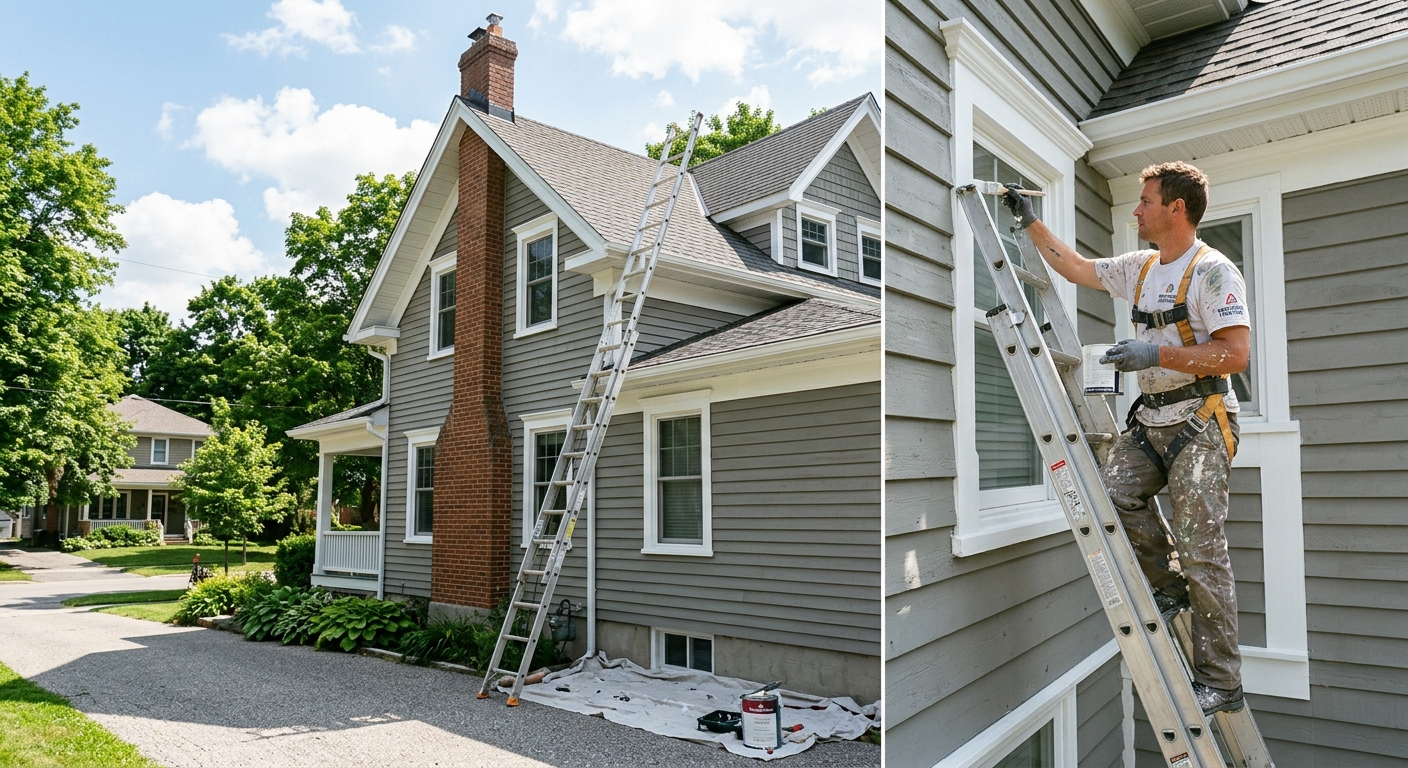
Painting options and costs in High Level
In High Level, painting costs tend to move with job prep, product choice, and how well the schedule fits northern Alberta weather. About 26.6% of homes were built before 1981, and many of those earlier builds have older caulking, uneven surfaces, and more patch-and-prime work—especially on repaints. That matters because Athabasca–Grande Prairie–Peace River has a continental climate: long, cold winters and short, busy exterior windows. Contractor availability can tighten in summer, and exterior work typically runs late spring through early fall when temperatures stay warm enough for proper drying and good film formation.
In High Level, trades are often busiest around the residential areas close to the service core (for example, the downtown/central neighbourhood where turn-over and maintenance cycles are common). On older sidings and trim, the same “full house exterior” label can include wildly different labour depending on how much scraping, repair, and caulking is needed. On the interior side, many homeowners choose to update rooms room-by-room, which spreads cost but may extend the overall timeline.
To help you compare apples to apples, the ranges below reflect what local homeowners typically see for common scopes in this region, including the impact of surface prep being the biggest labour driver on repaints. Use the table as a starting point, then ask for an itemised quote tied to your exact wall condition, trim count, and sheen selections.
| Service |
What's Included |
Typical Duration |
Price Range |
| Interior — whole home (walls, ceilings, trim) |
Surface prep, patching, caulking as needed, prime where required, 2-coat system, basic trim and door touch-ups |
5–10 business days |
$1,200–$5,500 |
| Interior — per room (standard bedroom or living room) |
Prep, patching, sanding, prime where required, 2 coats to walls; trim/doors included where accessible |
1–3 business days |
$400–$1,800 |
| Exterior — full house (siding, trim, soffits) |
Power wash, scrape/sand, repair caulking, spot-prime, 2-coat exterior system, soffits and trim included |
7–18 business days (weather-dependent) |
$1,200–$7,000 |
| Exterior — trim and accent colours only |
Preparation for trim surfaces, spot-prime where required, 2 coats on trim/accents (no full siding repaint) |
3–8 business days |
$500–$2,800 |
| Kitchen cabinet painting (doors, frames, spray finish) |
Degrease, sanding/degloss, bonding primer, spray or roll technique, 2 topcoats, hardware masking |
6–12 business days (includes dry/cure time) |
$900–$3,500 |
| Specialty / faux finish (accent wall, texture) |
Surface prep for effect, base coat, specialty technique, topcoat/clear protection where needed |
1–5 business days |
$600–$4,500 |
Prices are estimates only and vary by project scope, site access and material selection.
What affects the price of painting in High Level
Even when homeowners book the “same” paint job in High Level, bids can land 30–50% apart across the Athabasca–Grande Prairie–Peace River region and Alberta because labour time is driven by the condition of the surfaces, not just the number of rooms. Exterior repaints, in particular, swing with how much prep is needed before any paint goes on. In many older homes throughout this region, scraping and caulking can take significant time—often 50–70% of total labour on a repaint. That’s why an exterior quote that starts at the lower end of the local band can quickly move toward the middle once repairs, primer adhesion needs, and trim detailing are included.
The climate also changes the economics. For northern Alberta, the true exterior painting season is tightly climate-bound (late May to early October). Temperatures must be above 10°C and rising during application, and drying/curing has to keep up before the next cold snap or wet stretch. Coastal BC’s longer season is offset by high humidity and rainfall risk, which drives mildew-resistant systems and more scheduling constraints; in High Level, we focus more on cold-weather durability and UV stability. Short, concentrated windows increase contractor demand and can push summer rates.
Here are examples I commonly see in High Level: a full-house exterior on siding with failing caulk and peeling paint often costs closer to $1,200–$7,000 because of added scraping, spot-priming, and detailed edge work. An interior whole-home refresh can be near the lower end of the interior pricing only if drywall is in good shape; if patching and priming are needed, labour time grows and the total shifts toward the mid-to-upper part of the interior band (often $400–$3,500 depending on how many rooms/ceilings/trim are involved). For older stock—where 26.6% of homes were built before 1981—prep time is the main driver.
| Price Factor |
Why It Matters |
Cost Impact |
| Surface prep — scraping, sanding, patching drywall or wood |
Adhesion depends on removing loose material and evening out defects |
Often the biggest labour swing; can add 20–60% |
| Number of coats — 2-coat system over primer vs. 1 coat over existing |
Coverage and longevity depend on proper build, not just a “paint once” approach |
Typically +10–25% for correct 2-coat systems |
| Paint quality tier — contractor-grade vs. premium (Benjamin Moore, Sherwin) |
Sheen hold-up, colour stability, and washability vary by brand and line |
May add material cost; labour is usually similar |
| Ceilings and trim — adds significant time vs. walls-only |
Cut-ins, masking, and additional coats increase production time |
Commonly +15–40% depending on trim volume |
| Exterior season window — short season raises summer rates |
Scheduling pressure affects crews and staging costs |
Can shift pricing upward during peak weeks |
| Lead-safe precautions — required for pre-1978 homes with lead paint |
Safer sanding/containment and HEPA cleanup increases prep time |
Can add 10–30% where lead is present/likely |
| Surface material — drywall vs. plaster vs. wood vs. stucco |
Different surfaces need different primers and repair methods |
Varies widely; can move 15–35% on exteriors |
| Height and access — multi-storey exterior requires scaffolding or lifts |
Safety and setup time increases |
Often +10–25% for higher-access homes |
Permits & regulations in Alberta
In Alberta, painting does not generally require a permit for typical interior or exterior paint work. For homeowners in High Level, the practical “compliance” items are health and safety, documentation, and workmanship clarity—especially for older properties. Health guidelines recommend testing for lead paint before sanding or scraping on homes built before 1978, and if lead is present, contractors should use lead-safe methods such as wet methods, HEPA vacuuming, proper containment, and disposal. This isn’t typically something homeowners are legally mandated to do themselves, but it’s standard professional practice when risk is likely.
Separately, what does require a permit is not common for painting alone; however, permits may come into play if the scope includes work that crosses into major renovations (for example, structural changes or certain electrical/plumbing modifications). Painting-only scopes—prepping surfaces, caulking, priming, and applying paint—usually do not require a permit.
Before you book a contractor, verify three things: (1) liability insurance certificate, (2) workers’ compensation coverage (WSIB/WCB) for their employees, and (3) a written contract. Step-by-step for Alberta homeowners: (a) request their certificate of insurance and confirm the policy is active and matches your address; (b) ask for proof of WSIB/WCB clearance for their workers—if they’re subcontracting, confirm coverage for each crew; (c) check the contractor’s business details through relevant provincial directories/registries or licensing lookups; (d) ensure the written contract lists the paint brand/line, sheen, number of coats, surface prep responsibilities (including scraping/priming scope), and whether disposal and protection are included.
Interior vs exterior painting — getting the best result in High Level
In High Level, the main difference between a long-lasting paint job and one that fails early is the quality of prep for your local conditions. For interiors, surface prep matters more than brand: filling dents, sanding glossy areas, removing dust, and spot-priming stains and repairs. Sheen choice should match room use—flat/eggshell for low-traffic ceilings and living rooms, satin or eggshell for many walls, and semi-gloss in high-touch areas for easier cleaning. No matter what you pick, two coats over a proper primer nearly always outlast one “thick” coat because coverage and film build are more consistent.
For exteriors, Alberta’s temperature swings make adhesion and sealing critical. Caulking should be addressed before painting so water can’t find its way behind trim lines and into cracks. Primer type matters: oil-based primers can be useful on certain substrates or when bonding is challenging, while high-adhesion latex primers work well on sound, properly prepared surfaces. In the Athabasca–Grande Prairie–Peace River region, we also select systems that are stable under UV and temperature cycling; mildew-resistant coatings are especially important in very humid climates like coastal BC, but in northern Alberta we focus more on durability through cold-to-warm transitions and protecting edges.
Kitchen cabinet painting is a strong budget alternative to replacement when doors and frames are in decent condition—think of it as “repair + finish,” not a paint-only job. On pre-1978 homes, lead-safe precautions should be planned if scraping or sanding is required.
Example: If an exterior estimate comes in around the lower exterior band (closer to $1,200–$7,000 depending on scope) but doesn’t include caulking repairs or spot-priming, you may see early cracking or peeling within a short cycle. Paying for full prep up front is where the difference is justified; it’s usually cheaper than repeating the same labour later.
| Project Type |
Key Prep Step |
Recommended Coats |
Price Band |
| Interior — fresh drywall (new construction) |
Prime all drywall and sand nibs for a smooth finish |
1 primer + 2 topcoats |
$400–$3,500 |
| Interior — repaint (good condition, no repairs) |
Clean, scuff-sand if needed, spot-prime any marks |
1 primer where required + 2 topcoats |
$500–$2,500 |
| Interior — repaint (patching and priming needed) |
Fill, sand feathered patches, and prime repairs/stains |
Primer on patches + 2 topcoats |
$600–$3,200 |
| Exterior siding (wood or fibre cement) |
Power wash, scrape loose paint, repair caulking, spot-prime bare areas |
Spot-primer + 2 topcoats |
$1,200–$7,000 |
| Exterior trim and accents only |
Degrease/clean and prep edges for clean lines; spot-prime bonding areas |
Spot-primer + 2 topcoats |
$500–$2,800 |
| Kitchen cabinets (spray finish) |
Degrease thoroughly and bond-prime for adhesion |
Primer + 2 topcoats (spray/finish system) |
$900–$3,500 |
How to choose a painting contractor in High Level
Choosing the right painter in High Level starts with verifying coverage and then matching scope to what’s actually priced. In Alberta, confirm liability insurance first: ask for the certificate of insurance and make sure it lists your project address and dates (or is clearly applicable to the work period). Next, verify workers’ compensation coverage (WSIB/WCB). Ask for proof of coverage for their employees—if they use subcontractors, insist on seeing their coverage too. You should also confirm their business legitimacy (business information through appropriate provincial lookups) and that they can provide references for similar interior and exterior scopes in northern Alberta.
Then get 2–3 itemised written quotes. “Itemised” should mean a labour + materials breakdown or, at minimum, a detailed scope: prep steps, number of coats, which surfaces are included, and what product lines (paint and primer) they propose. Carefully read the exclusions: is disposal included? Are they removing sanding dust and debris? Is caulking included where cracks exist? Is the written contract clear about protection for floors/windows and whether touch-ups are included?
On warranty, look for both workmanship and product/manufacturer coverage details, including the length and whether it’s transferable to a new owner. For payment schedule, never pay more than 10–15% upfront; hold a fair completion holdback until the job is done and cleaned up. Get a written start date and completion estimate so you’re not relying on verbal weather promises.
- Verify liability insurance certificate is current and project-applicable.
- Verify WSIB/WCB coverage for employees and any subcontractors.
- Ask for an itemised quote (labour, materials, prep scope, number of coats).
- Confirm what prep is included (scraping, sanding, patching, caulking, priming).
- Require paint brand/line, sheen, and primer type in writing.
- Confirm disposal and surface cleanup responsibilities.
- Check whether you’ll get the warranty terms in writing.
- Ensure the contract includes start date, schedule, and weather contingency.
- Confirm protection details (drop cloths, masking, ventilation in interiors).
- Limit upfront payment to 10–15% and hold back on completion.
- Ask how colour testing is handled before full application.
- Request details on lead-safe practices for pre-1978 homes where scraping/sanding occurs.
Red flags I see in High Level: a quote that’s “lump sum” with no prep details, promises to paint exterior regardless of temperature/drying conditions, refusing to provide insurance/WSIB documentation, charging large upfront deposits, or no written warranty/contract terms for scope and workmanship.
Frequently asked questions — painting in High Level
Do I need to worry about lead paint in an older High Level home?
If your High Level home is pre-1978, it’s wise to plan for potential lead paint risk before any sanding or scraping. Lead-safe precautions are not usually a homeowner “legal mandate” in Alberta for DIY, but for professional contractors it’s standard best practice to test when risk is likely and then use lead-safe methods (wet methods, HEPA vacuuming, containment, and proper disposal) if lead is present. Because 26.6% of local homes were built before 1981, you should ask your painter what they’ll do if they encounter deteriorating paint. This can slightly increase labour and therefore your total—especially on repaints—yet it protects your family and reduces airborne dust exposure during prep.
How long does it take to paint a house?
For High Level homes, timelines depend heavily on whether it’s interior, exterior, and how much prep/repair is needed. Interior whole-home work typically takes several business days for walls and trim, often around the range homeowners see for interior projects (for example, $400–$3,500 depending on room count and ceilings). Exterior jobs are more weather-bound in northern Alberta—late spring through early fall—so even with good crews, rain or cool nights can pause work. A full exterior can take 7–18 business days in practice due to drying/cure time and staged prep. Expect extra time for older substrates with peeling paint, failing caulking, or multiple repaint cycles.
What's the difference between paint quality tiers?
Paint tiers mainly differ in coverage, durability, and how consistently the finish holds up under washing, scuffs, and UV exposure. Premium contractor lines often cost more per gallon, but they can reduce the need for additional coats because they offer better hiding and more consistent film build. In northern Alberta, exterior coatings also need strong adhesion and colour stability through temperature cycling and sun. For homeowners budgeting in High Level, think of the tier as affecting materials more than labour—prep is still the major driver. If one quote is much lower yet assumes less prep or fewer coats, the “savings” often show up later as early peeling or patchy coverage.
How do I compare painting quotes?
Compare quotes by scope, not just the bottom line. Ask each contractor to list: what prep is included (scraping, sanding, patching, caulking, priming), the number of coats for each surface, and the paint/primer brand and sheen. For exterior, ensure they specify what’s happening around trim edges and soffits, since that’s where moisture issues begin if prep is rushed. Also compare whether disposal and cleanup are included. In High Level, a “trim-only” job should not be priced like a full house repaint. If one exterior bid is near the low end of the exterior band (such as $1,200–$7,000 depending on scope) but skips caulking repairs, expect the middle or high end once repairs are accounted for.
What paint sheen should I use in different rooms?
In High Level homes, sheen selection is about cleanability and how light reflects in your space. Ceilings are typically flat or ceiling-specific flat to minimize imperfections. For walls, eggshell or satin works well in living rooms and bedrooms—satin cleans more easily if you have kids or pets. Kitchens and bathrooms usually benefit from washable finishes (often satin or a harder-using interior enamel line). Trim and doors commonly use semi-gloss for durability and easy wipe-down. The key is that sheen alone won’t fix poor prep; if patching and priming aren’t done correctly, you’ll still see flashing and patch outlines after the topcoats cure.
Can I paint my house exterior in spring or fall in High Level?
You can sometimes paint in shoulder seasons in High Level, but exterior work must be scheduled around temperature and drying conditions. Northern Alberta typically supports exterior work in the late spring through early fall window, when daytime temperatures are reliably warm and the coating can cure properly. If nights are too cold or there’s damp weather, paint can dry slowly, fail to bond well, or show defects later. Fall application can also be risky if there’s a quick early freeze before the finish cures. If you’re planning exterior painting, ask contractors about their minimum temperature/drying requirements and their weather contingency plan. This is one reason bids can differ during peak weeks in the Athabasca–Grande Prairie–Peace River region.