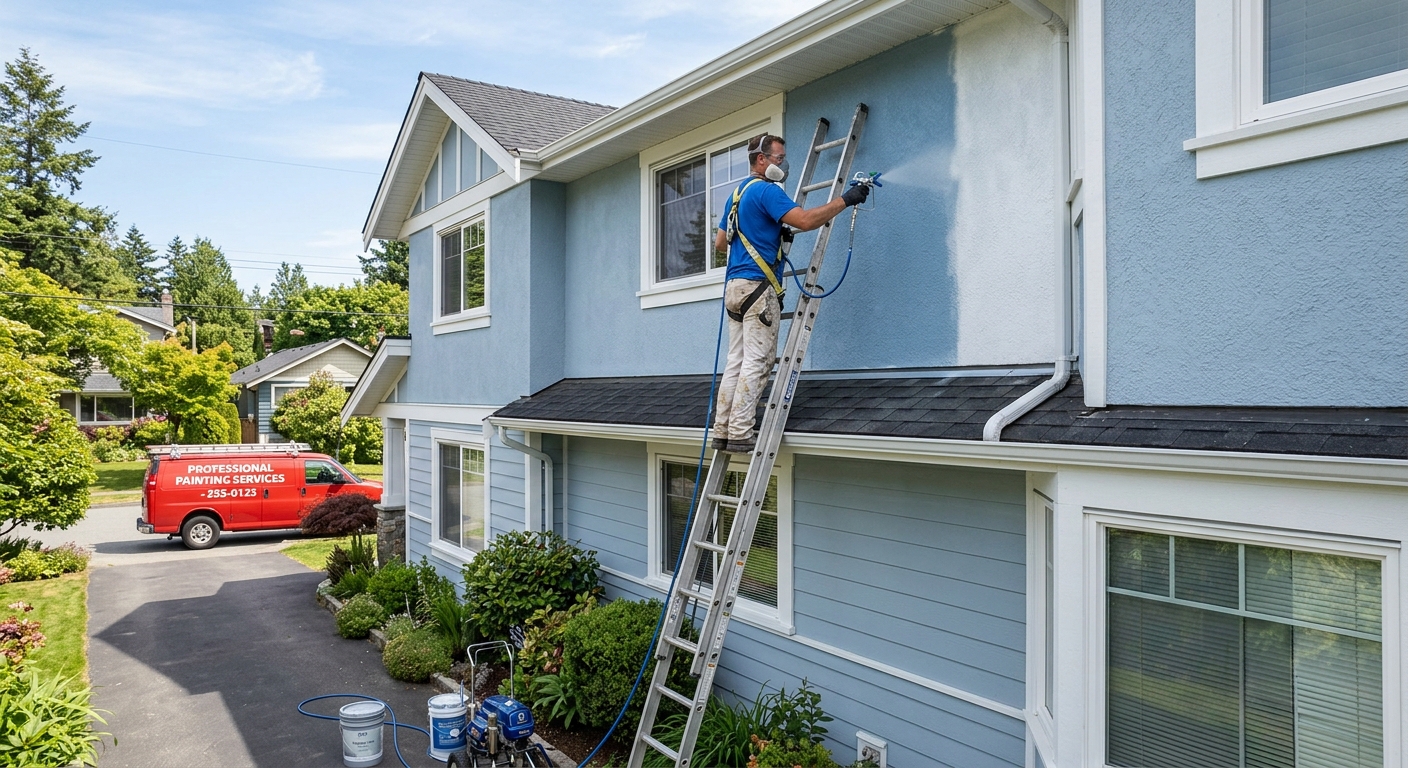
Painting options and costs in Pincher Creek
Pincher Creek homeowners usually have two things in common when they call for painting: they want it to look sharp, and they want it to last through Alberta’s quick swings between warm days and cold nights. With a population of 3,622 (Statistics Canada, 2021 Census), the workforce is smaller than in big centres, so scheduling can be competitive—especially for exterior work. Just as important, 69.2% of homes in the area were built before 1981 (Statistics Canada, 2021 Census). Older surfaces often need more prep—scraping, sanding, patching, and priming—and that prep time can move a job from “straight repaint” into “heavy prep” pricing. In a mixed housing stock like Pincher Creek, that can include older aluminum/steel siding, wood details, and patchy stucco or older repairs.
Cost is also shaped by the Lethbridge–Medicine Hat region’s tight exterior painting window. Professional crews here typically focus on late spring through early fall when daytime temperatures are consistently above about 10°C and nights stay safely above freezing, similar to best-practice guidance used in southern Alberta. That short season concentrates demand into a few months, so exterior pricing is commonly higher and schedules book earlier.
Within Pincher Creek, exterior painting demand is especially steady around the older residential streets near Main Street, where many homes date back decades and benefit from fresh caulking and durable primers. Once you know whether you’re planning an interior refresh, a full exterior repaint, or a cabinet update, it becomes much easier to compare quotes—use the table below as a practical starting point.
| Service |
What's Included |
Typical Duration |
Price Range |
| Interior — whole home (walls, ceilings, trim) |
Surface prep (patching, sanding, caulking), primer as needed, two-coat finish on walls/ceilings, scuff-sand and spot-prime trim, basic masking and cleanup |
5–12 days |
$2,000–$5,500 |
| Interior — per room (standard bedroom or living room) |
Prep and protect floors, patch/sand as required, prime stains/repairs, two-coat paint on walls, light touch-ups to trim (as scoped) |
1–2 days |
$800–$1,800 |
| Exterior — full house (siding, trim, soffits) |
Power wash (where needed), scrape/sand, patch and caulk, prime bare spots, two-coat system for siding/trim, attention to transitions and corners, disposal and cleanup |
8–18 days |
$3,800–$9,000 |
| Exterior — trim and accent colours only |
Prep and prime trim/accent areas, two-coat finish for selected colours, masking of siding, targeted touch-ups and caulking to painted boundaries |
3–7 days |
$2,500–$4,800 |
| Kitchen cabinet painting (doors, frames, spray finish) |
Full prep/degrea sing, sanding and repairs, bonding primer, spray finish on doors/drawers, hardware handling, reinstall |
5–10 days (plus dry/cure time) |
$1,800–$3,900 |
| Specialty / faux finish (accent wall, texture) |
Surface prep and leveling where needed, primer, application of decorative/texture system, protective topcoat where appropriate |
1–4 days |
$900–$2,800 |
Prices are estimates only and vary by project scope, site access and material selection.
What affects the price of painting in Pincher Creek
Two quotes for the same-looking job can differ by 30–50% around Lethbridge–Medicine Hat—and that’s usually not because someone is “overcharging.” In practice, the difference comes down to prep scope, how many coats are truly needed, whether the contractor is using a higher-quality coating system, and how tight the exterior season is in southern Alberta. In this region, exterior painting is tightly climate-bound: crews commonly work late May to early October when daytime temperatures are above about 10°C and nights are not dropping too far below freezing. Coastal BC’s longer season is often offset by humidity and mildew pressure, while Pincher Creek’s drier conditions still bring strong sun and wind that can affect curing and adhesion timing.
Older housing stock across Alberta-type communities means more surface prep. When a repaint requires scraping, sanding, patching drywall or wood, and priming mixed substrates, prep can be 50–70% of labour. If your home was built before the late 1970s, lead-safe awareness protocols can also add time if heavy scraping is required. For example, moving from a “quick repaint” to a heavy-prep exterior job can shift pricing from the lower end of the $2,500–$9,000 exterior band into the higher range—especially if bare wood, failing caulk lines, or widespread cracking show up once we start washing and opening up older paint layers.
Concrete Pincher Creek examples that commonly raise or lower cost: (1) trim and soffits that require careful ladder access or scaffolding will increase time and labour; (2) sound drywall with only minor nail holes keeps interior costs closer to the lower $800–$5,000 interior range, while extensive patching and priming pushes towards the upper end.
Bottom line: in Pincher Creek, what you can’t see—surface condition and prep effort—drives the real cost.
| Price Factor |
Why It Matters |
Cost Impact |
| Surface prep — scraping, sanding, patching drywall or wood |
Determines adhesion and finish smoothness; older coatings and damaged substrate require more labour |
Often the largest driver; +15% to +40% vs light prep |
| Number of coats — 2-coat system over primer vs. 1 coat over existing |
Proper coverage depends on substrate, sheen, and colour change |
Can change total labour/materials by +10% to +25% |
| Paint quality tier — contractor-grade vs. premium (Benjamin Moore, Sherwin) |
Higher solids and better hide can reduce re-coats and improve durability |
Typically +5% to +20% depending on area and sheen |
| Ceilings and trim — adds significant time vs. walls-only |
Ceilings require more cutting-in and edging; trim needs sanding and careful masking |
Often +10% to +30% for whole-home scopes |
| Exterior season window — short season raises summer rates |
Late spring to early fall demand is concentrated; scheduling premiums are common |
Can push exterior pricing toward the high end of the band |
| Lead-safe precautions — required for pre-1978 homes with lead paint |
Containment, wet methods, HEPA cleanup and disposal increase labour and materials |
May add +10% to +25% if heavy scraping is required |
| Surface material — drywall vs. plaster vs. wood vs. stucco |
Each substrate needs different primer/patch products and different prep technique |
Plaster/older wood can add +10% to +30% |
| Height and access — multi-storey exterior requires scaffolding or lifts |
More time for setup, safety, and controlled application |
Often +15% to +35% on multi-storey exteriors |
Permits & regulations in Alberta
In Alberta, painting does not generally require a permit for standard interior or exterior painting work. That said, if you have a home built before 1978, health guidelines recommend considering lead paint testing before sanding or scraping, and using lead-safe work practices if lead is present—things like wet methods to reduce dust, HEPA vacuuming, proper bagging/disposal, and containment where needed. Homeowners aren’t always required by law to follow these steps, but professional contractors in Pincher Creek typically treat lead-safe procedures as standard practice to protect their crew and your household.
Separate from lead health practices, permits typically come up for situations like major structural changes, renovations, or sign-offs tied to safety code requirements—not for painting itself. What you should require from your contractor is proof they operate properly: confirm they carry liability insurance and have WSIB/WCB workers’ compensation coverage for their painters. Also get a written contract that clearly states paint brand/line, sheen level, number of coats, surface prep steps included (scrape/sand/patch/prime/caulk), and how cleanup and disposal will be handled.
To verify coverage step-by-step in Pincher Creek: (1) ask for the contractor’s insurance certificate and verify the policy is active and includes your project location; (2) request WSIB/WCB clearance or registration evidence for the work; (3) review the written quote for the exact scope and materials; and (4) confirm any lead-safe approach in the contract if your house is pre-1978. If something is missing, that’s a red flag before work begins.
Interior vs exterior painting — getting the best result in Pincher Creek
In Pincher Creek, the difference between a job that looks good for a season and one that lasts years comes down to prep, correct product choice, and disciplined application. For interior spaces, surface prep matters more than brand: filling dents, sanding edges smooth, removing glossy residue, and priming repairs or stains are what prevent peeling, flashing and “ghosting.” A proper two-coat system over the right primer consistently outlasts a single heavy coat, especially on patched drywall. Sheen choice also has a big effect on durability and cleanability: flat or matte for low-traffic ceilings, eggshell for many living areas, and satin or semi-gloss for kitchens, bathrooms, trim, and doors where scuffs happen.
For exteriors, correct prep is non-negotiable in southern Alberta’s sun-and-wind conditions. Start with cleaning, then scrape/sand loose paint, patch and caulk first, and prime bare or problematic areas using a primer matched to the substrate. Caulking before painting helps prevent water ingress at joints and reduces future cracking lines around trim and corners. The paint system should be temperature-stable for Alberta swings and designed for exterior adhesion outdoors. While mildew-resistant coatings are a bigger priority in damp coastal climates, southern Alberta still benefits from good wash/prime practices to keep coatings performing through freeze-thaw.
Cabinet painting is a smart option when you want a budget refresh instead of replacement—often giving you a big visual change without the full demolition and new-door costs. If your cabinet frames and doors are in good condition, choosing cabinet repainting can be the best “bang for buck” versus replacement; for example, cabinet painting often lands in the $1,800–$3,900 range, while replacing cabinetry can quickly exceed that by a multiple once labour, new hardware and installation are included.
For pre-1978 homes in Pincher Creek, lead-safe precautions also protect your family during sanding/scraping. The best results come from combining correct prep with the right system—then applying it within the right exterior weather window.
| Project Type |
Key Prep Step |
Recommended Coats |
Price Band |
| Interior — fresh drywall (new construction) |
Prime all new drywall (and repairs) to seal and prevent uneven absorption |
Prime + 2 finish coats |
$2,000–$5,000 |
| Interior — repaint (good condition, no repairs) |
Light scuff-sand, clean, spot-prime only if needed for adhesion |
1–2 finish coats (often 2 for best uniformity) |
$800–$3,200 |
| Interior — repaint (patching and priming needed) |
Patch/sand smooth, spot-prime repairs, feather edges |
Prime repairs + 2 finish coats |
$1,200–$4,500 |
| Exterior siding (wood or fibre cement) |
Scrape loose paint, sand transitions, caulk, prime bare areas |
2-coat system over primer where required |
$3,800–$9,000 |
| Exterior trim and accents only |
Mask tightly and prep/prime trim boundaries for clean line control |
2 finish coats over primer |
$2,500–$4,800 |
| Kitchen cabinets (spray finish) |
Degrease, sand/scuff for bonding, use bonding primer |
Primer + 2 finish coats (or equivalent spray system) |
$1,800–$3,900 |
How to choose a painting contractor in Pincher Creek
Start with verification. In Alberta, painting itself doesn’t require a permit, but your contractor should still be properly insured and set up to work safely. Ask for (1) liability insurance—request the certificate of insurance and confirm it’s active; (2) WSIB/WCB coverage—request a clearance or evidence of registration for workers involved; and (3) a written contract that names the specific prep and paint system included. If they can’t provide proof promptly, look elsewhere.
Next, get 2–3 itemised written quotes, not just a lump sum. The best quotes break down labour and materials: surface prep steps (scraping/sanding/patching/priming/caulking), number of coats, paint brand/line and sheen, and whether power washing is included for exterior work. Ask what’s excluded (for example, minor wood repairs, rotten fascia sections, or replacing damaged trim boards). Clarify whether disposal is included and whether contractor-grade protection is used (masking, floor covering, plastic where needed). For warranty, request both workmanship warranty length and the product/manufacturer warranty terms—and ask if the warranty is transferable to future owners.
Payment schedule matters. Never pay more than 10–15% upfront; hold back a portion until the job is complete and cleaned. Also insist on a written timeline with a start date and a completion estimate. In Pincher Creek’s compressed exterior season, the contractor’s schedule discipline is often what protects the quality of the finish.
- Confirm liability insurance is active and request the certificate (with your address or project location listed where possible).
- Confirm WSIB/WCB coverage for the painters who will be on site.
- Ask for itemised quotes showing prep, primer, paint, labour, and materials separately.
- Check that the quote states number of coats (and primer requirements for repairs/bare spots).
- Require written details for caulking scope on exteriors (what joints, what products, and when it’s applied).
- Ask whether power washing and surface cleaning are included and what standard they use.
- Ensure paint brand/line and sheen levels are specified (not just “interior paint”).
- Confirm disposal/cleanup is included (bagging, hauling, and proper site leave-clean).
- Ask about how they protect landscaping, windows, and neighbouring surfaces.
- Ask for a workmanship warranty and the exact length of coverage.
- Confirm payment terms in writing; keep holdback until completion and touch-ups.
- Get an expected start and finish date in the contract, including weather contingency for exteriors.
In Pincher Creek, concrete red flags include: agreeing to start without proof of insurance/WSIB coverage, providing a quote that lists “paint” but not coats/brands or prep steps, skipping itemised prep (especially scraping/sanding/priming on older exteriors), asking for large deposits (more than 10–15%) up front, and offering a vague warranty with no written details.
Frequently asked questions — painting in Pincher Creek
How much does it cost to paint a house in Pincher Creek?
For Pincher Creek homeowners, typical full-house interior painting ranges broadly depending on how many rooms and how much repair work is needed—commonly from about $2,000–$5,500 for a whole-home scope (walls, ceilings and trim). For exterior painting, realistic full-house pricing is often higher due to prep and the compressed seasonal scheduling in southern Alberta; most projects land around $3,800–$9,000 for siding, trim and soffits. The biggest cost driver is usually prep on older homes—69.2% of local housing stock is older than 1981 (Statistics Canada, 2021 Census), which often means more patching, caulking, scraping and priming once we start.
How much does interior painting cost per room in Pincher Creek?
Interior painting per room in Pincher Creek typically falls around $800–$1,800 for a standard bedroom or living room. That usually assumes reasonable condition: good access, clean walls, and limited repairs (small nail-hole patching, light sanding, and spot priming where needed). If the room needs more extensive patching, wall/ceiling repairs, or more trim work, the price can move upward toward the higher end of interior ranges. Also note that sheen selection affects appearance: a satin or semi-gloss on trim and doors is often worth it for cleanability, but it requires careful prep and consistent technique to avoid visible lap marks.
When is the best time for exterior painting in Pincher Creek?
The best time for exterior painting in Pincher Creek is typically late spring through early fall—when daytime temperatures stay reliably above about 10°C and nights remain above freezing for proper curing. In the Lethbridge–Medicine Hat region, the season is shorter than many parts of Alberta, which concentrates demand; crews often book schedules months ahead. If you’re targeting a full exterior repaint, aim to schedule during the first solid window after winter, and allow some contingency for weather. Avoid painting during high wind or extreme sun glare on unprimed surfaces because rapid drying can lead to adhesion issues. A good contractor will plan application and curing time, not just “paint when it looks nice.”
How many coats of paint do I need?
Most quality jobs use a system approach: primer where required, then two finish coats for consistent coverage and durability. If your walls are being patched and primed, you generally still want two finish coats after primer—especially for uniform colour and to prevent flashing. For exteriors, a proper two-coat system over primer/bare-spot prep is the norm, particularly on siding and trim where adhesion and weather resistance are critical. If someone promises “one thick coat” to save time, that’s often where premature wear shows up—peeling, uneven sheen, and visible streaking. Ask your contractor to specify number of coats and where primer is required in writing.
What paint is best for Pincher Creek's climate?
For Pincher Creek’s southern Alberta conditions, the best choice is the right exterior coating system for siding/trim and the substrate conditions, not just a brand. Drier weather lowers mildew pressure compared to coastal climates, but sun intensity, wind, and freeze-thaw make adhesion and durability planning essential. For interiors, you’ll get better results by matching sheen to room use—flat/matte for ceilings, eggshell for many walls, and satin or semi-gloss for high-touch areas like doors and trim. If you’re painting a pre-1978 home, ask how the contractor addresses lead-safe practices during prep. Lead-safe awareness is especially important when scraping or sanding is required to expose sound surfaces.
How long does exterior paint last here?
Exterior paint life in Pincher Creek depends heavily on prep quality, substrate condition, and how many coats are applied as a system. When prep includes proper cleaning, scraping/sanding, caulking at joints, priming bare or problem areas, and applying a proper two-coat finish, many homeowners can see results for multiple years—often around the longer end of typical residential expectations. If prep is rushed or caulking is skipped, failure often starts at edges and transitions and can shorten the timeline noticeably. Because 69.2% of homes locally were built before 1981 (Statistics Canada, 2021 Census), older substrates can demand extra priming and patching, which is part of why exterior jobs—often $3,800–$9,000—can cost more but also last longer when done correctly.