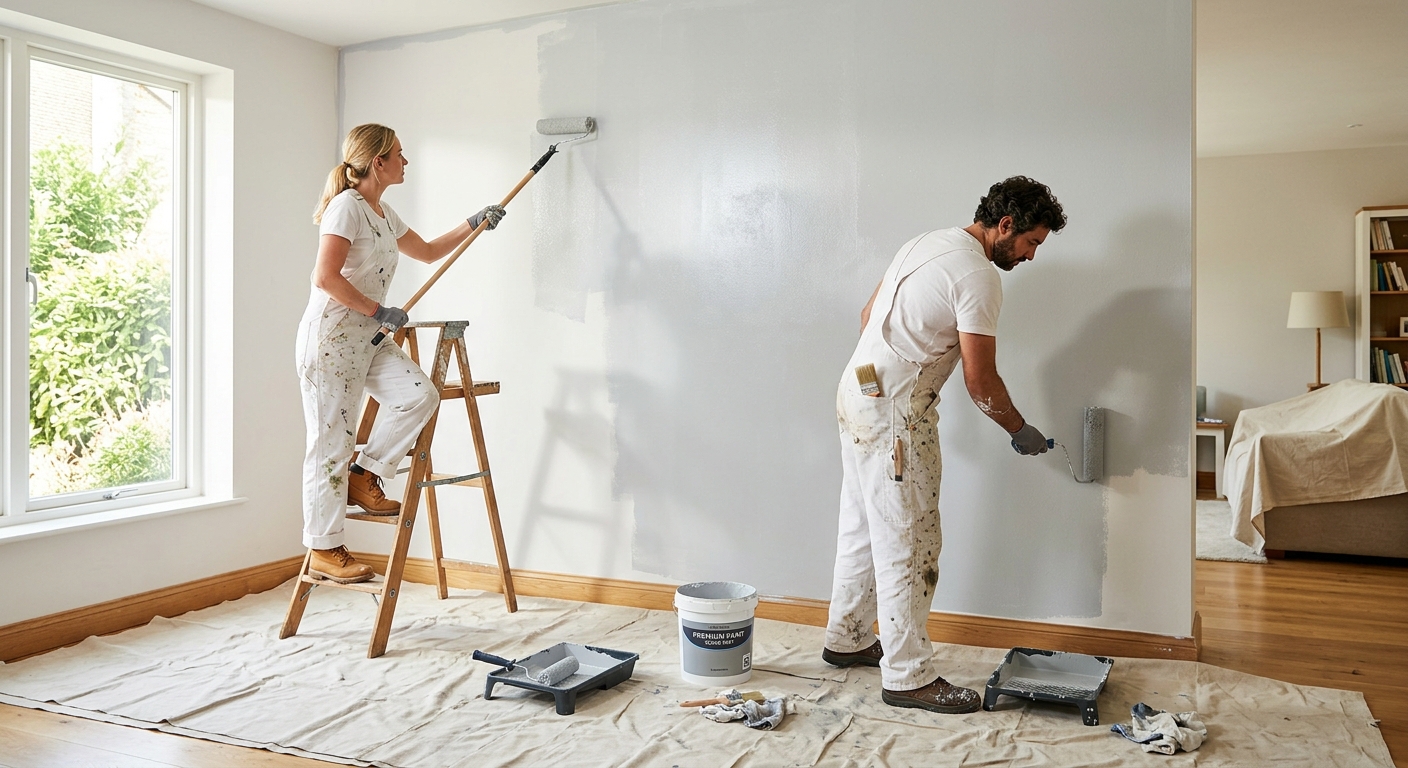
Painting options and costs in Banff Trail
In Banff Trail, Alberta, most homeowners start by comparing “paint-only” numbers with real project quotes that include prep and materials. One reason pricing swings is that many older homes across the Calgary economic region were built before 1980, and those surfaces typically need more labour: scraping, patching, caulking, and extra priming to get top-coats to adhere and last. In a small community profile like Banff Trail (population 3,805, Statistics Canada, 2021 Census), contractor availability can tighten quickly when peak scheduling opens, especially for exterior work that depends on weather.
Calgary-area exteriors are cost-sensitive to the workable season: our window is usually about mid-May to late September when daytime temperatures stay above 10°C and surfaces can dry properly between coats. Freeze–thaw cycles, strong UV, and occasional hail also push us toward higher-quality acrylics and flexible exterior systems, which can raise material lines but reduce premature cracking. Interiors are less season-bound, but they’re still affected by labour rates, ceiling height, access (stairs, hallways, and furniture protection), and how much repair work is required before coating.
In Banff Trail—particularly around the busier corridors near 16 Avenue NW and the surrounding pocket streets—exterior repainting tends to book early because homeowners want curb appeal before summer events. Once you’ve scoped your priorities, the table below gives practical starting ranges so you can compare quotes apples-to-apples.
| Service |
What's Included |
Typical Duration |
Price Range |
| Interior — whole home (walls, ceilings, trim) |
Move furniture, protect floors, patch/sand, caulk as needed, prime bare repairs, paint walls/ceilings, paint interior trim and doors (excluding detailed glazing), clean-up |
5–10 working days |
$2,000 – $6,500 |
| Interior — per room (standard bedroom or living room) |
Protect floors, prep minor patches, spot-prime, paint walls and one ceiling, basic trim touch-ups (not full trim replacement), clean-up |
1–3 working days |
$400 – $1,400 |
| Exterior — full house (siding, trim, soffits) |
Pressure-wash/clean, scrape where needed, patch/caulk, spot prime, full prime where specified, paint siding/trim/soffits, protect landscaping and windows, final clean-up |
6–14 working days |
$4,500 – $9,000 |
| Exterior — trim and accent colours only |
Surface cleaning, scrape/touch-up prep, prime bare areas, paint trim/accents (not full siding), protect surrounding surfaces, clean-up |
3–8 working days |
$2,500 – $5,500 |
| Kitchen cabinet painting (doors, frames, spray finish) |
Degrease/clean, sand/scuff, bonding primer where needed, spray finish on doors/drawers, paint frames, hardware protection, light interior cabinet touch-up, clean-up |
5–12 working days |
$800 – $4,500 |
| Specialty / faux finish (accent wall, texture) |
Surface prep and leveling where required, base coat + specialty system layers, protective top coat (as required), minor wall repairs, clean-up |
2–6 working days |
$600 – $3,500 |
Prices are estimates only and vary by project scope, site access and material selection.
What affects the price of painting in Banff Trail
Even when two homeowners describe the “same” painting job, quotes in Calgary and across Alberta can differ by 30–50%. The difference is usually prep scope, surface condition, access limitations, and product/system choices—not just the topcoat colour. For example, a repaint that’s 2 coats over a well-prepared surface often stays closer to the lower end of the interior band (from about $400 per room), while a repaint with extensive patching and primer escalation can climb quickly toward higher interior totals. On exteriors, the labour portion often dominates because older substrates and weather timing determine how much scraping, caulking, priming, and re-coating is required.
The exterior painting season is tightly climate-bound in the Calgary region. In practice, workable exterior work usually runs roughly late May to early October, when daytime temperatures reliably sit above 10°C and surfaces can dry for proper adhesion. Coastal BC typically has a longer calendar but higher humidity and rainfall, which changes drying times and increases the emphasis on mildew-resistant systems. In Banff Trail, the shorter season concentrates demand and compresses contractor availability, so summer scheduling pressure can firm up exterior pricing. Older homes throughout the region also mean more surface prep—scraping, caulking, patching, and priming can represent 50–70% of labour on repainting jobs, especially where previous DIY work left glossy patches or uneven adhesion.
Concrete examples from the Banff Trail area: (1) a fibre cement or wood siding repaint with embedded cracks and failed caulk lines tends to add days for removal and re-caulking before coatings go on; (2) a multi-storey exterior usually pushes cost toward the higher exterior band because scaffolding or lifts are needed. If you’re comparing exterior repaint budgets around $2,500 – $5,500 (trim/accents) versus $4,500 – $9,000 (full house), the justification is almost always prep depth and how much of the surface needs priming and coating system build-up.
| Price Factor |
Why It Matters |
Cost Impact |
| Surface prep — scraping, sanding, patching drywall or wood |
Adhesion depends on clean, sound surfaces; damaged coatings must be removed or keyed |
Often the biggest swing (commonly 30%–70% of labour effort on repaints) |
| Number of coats — 2-coat system over primer vs. 1 coat over existing |
Proper systems require full coverage; stain-blocking and hiding power vary by substrate |
Can move interior totals by roughly 10%–30% and exterior totals more |
| Paint quality tier — contractor-grade vs. premium (Benjamin Moore, Sherwin) |
Higher-tier products can improve coverage, durability, and resistance to sun/UV |
Material-only change, but it can reduce labour if coverage improves |
| Ceilings and trim — adds significant time vs. walls-only |
Ceilings need more cutting-in and careful roller work; trim requires detail time |
Often adds 15%–40% depending on room count and complexity |
| Exterior season window — short season raises summer rates |
Contractors can only work reliably when temperatures and drying conditions are right |
Pricing firms up during peak weeks; shoulder-month jobs may price softer |
| Lead-safe precautions — required for pre-1978 homes with lead paint |
Professional lead-safe work uses wet methods, HEPA vacuuming, and safe disposal |
Adds time and supplies when testing indicates lead-containing paint |
| Surface material — drywall vs. plaster vs. wood vs. stucco |
Different materials absorb and bond differently; primers must match substrate |
Changes primer type and prep method, impacting labour and materials |
| Height and access — multi-storey exterior requires scaffolding or lifts |
Safe access takes time and affects productivity |
Commonly pushes projects upward within the exterior price bands |
Permits & regulations in Alberta
In Alberta, painting generally does not require a permit for typical interior or exterior paint work. The permit conversation usually comes up only if another trade or regulated work is involved (for example, demolition that disturbs certain regulated materials, or work handled under a separate scope). For most homeowners in Banff Trail, the key regulation-related items are contractor compliance and safe work practices—not a municipal painting permit.
For homes built before 1978, health guidelines recommend testing for lead paint before sanding or scraping. If lead is present, lead-safe work practices are the standard: wet methods to reduce dust, HEPA vacuuming, contained cleanup, and proper disposal. This is not typically mandated for homeowners as a “permit,” but it is what professional contractors follow to protect occupants and workers. When you get a written estimate, ask whether the contractor will include lead-safe precautions where testing indicates lead paint.
Also confirm insurance and coverage. Your contractor should carry liability insurance and have WSIB/WCB workers’ compensation coverage for employees. To verify, you’ll typically: (1) check the contractor’s Alberta business registry details online for legitimacy; (2) request a current certificate of insurance and confirm it matches the legal business name and your job location; and (3) obtain evidence of WSIB/WCB coverage (or an equivalent proof document) before work begins.
Finally, insist on a written contract that lists paint brands (or specified equivalent), sheen, number of coats, and surface prep included (scraping, patching, caulking, priming) so there are no surprises later.
Interior vs exterior painting — getting the best result in Banff Trail
In Banff Trail, the difference between a long-lasting paint job and a premature failure usually comes down to prep quality and system selection for Alberta’s freeze–thaw cycles and intense UV. For interiors, start with what actually matters: filling and sanding smoothness, proper priming of repaired areas, and choosing the right sheen for the room. Flat paint can look great on low-traffic ceilings, but for walls that get scuffs, eggshell or satin typically performs better. A common failure is expecting one thick coat to “hide it all.” In practice, two coats over a correctly primed surface—especially after patching—lasts noticeably longer and looks more uniform.
For exteriors, Alberta demands a methodical approach. Caulking before painting is critical: it prevents water ingress at joints and around trim, which reduces blistering and premature peeling. Primer type matters too—oil-based or stain-blocking primers may be required for specific substrates or where tannins or old stains bleed through. On weather timing, we work around rain and overnight lows and keep to application conditions that allow proper drying. Unlike coastal BC, mildew-resistant products are less of a year-round requirement for us, but freeze–thaw stresses can still open microscopic cracks if the surface system isn’t flexible enough.
Cabinet painting is a smart budget alternative to replacement when your cabinet boxes are sound and the existing finish is compatible. It can deliver a “new kitchen” look for a fraction of replacement cost—often in the $800 – $4,500 range—provided prep and bonding primer steps are handled properly.
And if your home is pre-1978, build in lead-safe precautions so scraping and sanding don’t create contamination risks. If you’re deciding between trim/accents only versus a full exterior repaint, remember that paying closer to the higher exterior band ($4,500 – $9,000) is justified when siding, soffits, and failing prep layers need a full system refresh—otherwise you may spend again sooner.
| Project Type |
Key Prep Step |
Recommended Coats |
Price Band |
| Interior — fresh drywall (new construction) |
Prime all drywall, then sand lightly for a uniform surface before top-coat |
2 top coats after primer |
$1,200 – $4,500 |
| Interior — repaint (good condition, no repairs) |
Clean and degloss/scuff-sand where needed, then spot-prime any marks |
2 coats |
$400 – $2,500 |
| Interior — repaint (patching and priming needed) |
Patch/sand repairs, then prime bare drywall/wood and block any stains |
2 coats (primer included on repairs) |
$900 – $6,500 |
| Exterior siding (wood or fibre cement) |
Scrape and caulk correctly, then use a compatible primer and full system coating |
2 coats over primer system |
$4,500 – $9,000 |
| Exterior trim and accents only |
Remove loose paint, spot prime bare wood/failed areas, caulk joints |
2 coats where needed for coverage |
$2,500 – $5,500 |
| Kitchen cabinets (spray finish) |
Degrease thoroughly and use bonding primer where the existing finish requires adhesion |
2–3 system layers (primer + 2 top coats) |
$800 – $4,500 |
How to choose a painting contractor in Banff Trail
Choosing the right contractor in Banff Trail comes down to verification, clarity, and realistic job planning. First, confirm Alberta compliance items. Request the contractor’s proof of liability insurance and verify the certificate is current and shows coverage limits that fit your home. Next, verify WSIB/WCB workers’ compensation coverage for their employees—ask directly, and ensure the proof document matches the legal business name. If the contractor uses subcontractors, require confirmation that those subcontractors are also covered.
Then get 2–3 written, itemised quotes. You want a labour + materials breakdown (prep scope, number of coats, prime requirements, caulking, and paint brand/sheen), not a single lump-sum figure. Scope clarity matters: ask what’s excluded (e.g., lead testing, drywall repair beyond a set allowance, removal of heavy-built cabinets, permit pulls—though painting itself typically doesn’t need one) and whether disposal and clean-up are included.
Warranty should be in writing. Look for a workmanship warranty length, understand what it covers (peeling due to prep failures versus normal wear), and check whether product/manufacturer warranties apply and are transferable if you sell your home. For payment scheduling, never pay more than 10–15% upfront; hold back the balance until completion and touch-ups are done. Get a start date and completion estimate in writing, and confirm there’s a plan for weather delays for exterior work.
- Ask for insurance and WSIB/WCB proof before signing anything.
- Confirm the scope includes scraping, patching, caulking, and priming as needed (not just “paint”).
- Request paint brand, line, and sheen (flat/eggshell/satin/semi-gloss) in the contract.
- Verify the quote lists the number of coats and where extra coats apply.
- Check whether primer is included on bare repairs and any stain/bleed-prone areas.
- Ensure surface prep standards are described (sand levels, dust control, cleaning).
- Ask how they protect landscaping, windows, and floors for Banff Trail conditions.
- Confirm lead-safe approach for pre-1978 homes if testing is needed.
- Read exclusions: what happens if more repairs are found once walls are opened?
- Confirm disposal is included (scrape debris, sanding dust cleanup materials).
- Get a schedule that includes drying time and weather contingencies for exteriors.
- Require a workmanship warranty and a clear rework/touch-up process.
Red flags I watch for in Banff Trail: (1) quotes that won’t specify prep and primer scope; (2) a contractor who asks for a large upfront payment (beyond 10–15%); (3) refusal to provide proof of liability insurance and WSIB/WCB coverage; (4) vague paint specs like “premium paint” without brand/line and sheen; and (5) no written timeline or a contract that’s missing warranty details.
Frequently asked questions — painting in Banff Trail
When is the best time for exterior painting in Banff Trail?
The best time for exterior painting in Banff Trail is typically mid-May through late September, when daytime temperatures are reliably above about 10°C and surfaces can dry properly between coats. Calgary-area exteriors are sensitive to rain, overnight lows, and freeze–thaw, so contractors plan around workable conditions rather than the calendar alone. Because demand concentrates in the short season, summer start dates can book quickly—especially for neighbourhoods with strong curb-appeal expectations near 16 Avenue NW. If you’re considering a full house repaint closer to $4,500 – $9,000, aim to schedule earlier in the season so prep isn’t rushed and drying windows aren’t compromised.
How many coats of paint do I need?
Most residential projects use a 2-coat system over proper preparation, because it gives consistent coverage and better durability than “one heavy coat.” For interiors, a standard repaint usually includes 2 coats, with primer on any bare repairs, patched drywall, or areas that require stain-blocking. For exteriors, you’ll often see a primer system followed by 2 full top-coats, particularly when scraping reveals bare wood, repairs expand, or caulking requires coverage. If your home is older and prep is more involved, the number of coats can still be 2 top coats, but primer and spot coats become more important. That’s one reason interior pricing can swing toward the higher end of the band (up to whole-home ranges) even when “paint colour” looks simple.
What paint is best for Banff Trail's climate?
For Alberta exteriors in Banff Trail, the “best” choice is usually a high-quality exterior acrylic and a system designed for temperature swings, UV exposure, and surface movement around trim and joints. When we specify for Calgary-region conditions, we prioritize adhesion and flexibility where it matters (caulked edges, joints, and substrate transitions) rather than relying on thick coverage alone. Coastal BC approaches differently because mildew and persistent humidity are bigger drivers; in Alberta, freeze–thaw stress and strong sun are the recurring problems. For interiors, durability is mostly about choosing the right sheen: ceilings can use flatter finishes, while living areas often do better with eggshell or satin. If you want the most reliable look, pick the system that matches substrate and prep—not just the brand.
How long does exterior paint last here?
In Banff Trail, exterior paint longevity depends heavily on prep and on how the previous coating performed. When surfaces are cleaned, properly scraped, caulked, and primed to match the substrate, a well-executed exterior system commonly lasts many years; however, damage at joints and around trim can reduce lifespan if caulking isn’t addressed before painting. Freeze–thaw cycles can also stress coatings where the surface prep is thin or adhesion is weak. If your house has older, failing caulk lines, you may see early issues such as peeling or bubbling sooner than expected. That’s why a “trim and accents only” refresh can be a good stop-gap, but a full repaint closer to $4,500 – $9,000 is often justified when siding and soffits need a complete system refresh.
Should I paint or replace my cabinets?
Painting cabinets is usually the better choice when the cabinet boxes are solid, the doors and frames aren’t warped, and you’re comfortable with a careful prep and finishing process. In Banff Trail, many homeowners choose cabinet painting as a budget alternative to replacement, especially when they want a quick style change without the disruption of a full kitchen demo. A quality spray-finish cabinet job typically lands in the $800 – $4,500 range depending on door count and surface condition. Replacement becomes the practical option if the boxes are damaged by water, cabinets are structurally compromised, or you can’t achieve a stable base for bonding. Also note: pre-1978 homes may require lead-safe precautions if existing finishes are disturbed—your contractor should confirm the prep approach before sanding.
How do I prep walls before painting?
For most homeowners, the safest prep step is to handle light cleaning and furniture protection, while leaving the “prep that creates dust” to the contractor—especially in older Banff Trail homes. If you’re preparing for interior painting, start with removing wall items, filling small nail holes (if you’re comfortable), and cleaning grease or marks so primer and paint bond properly. Don’t start heavy sanding or scraping in pre-1978 homes without considering lead-safe practices; health guidelines recommend testing and using lead-safe controls if lead paint is present. Proper prep includes sanding rough patches, dust control, caulking gaps, and priming bare repairs and stain-prone areas. When these steps are done right, the final two-coat finish typically looks more even and lasts longer.