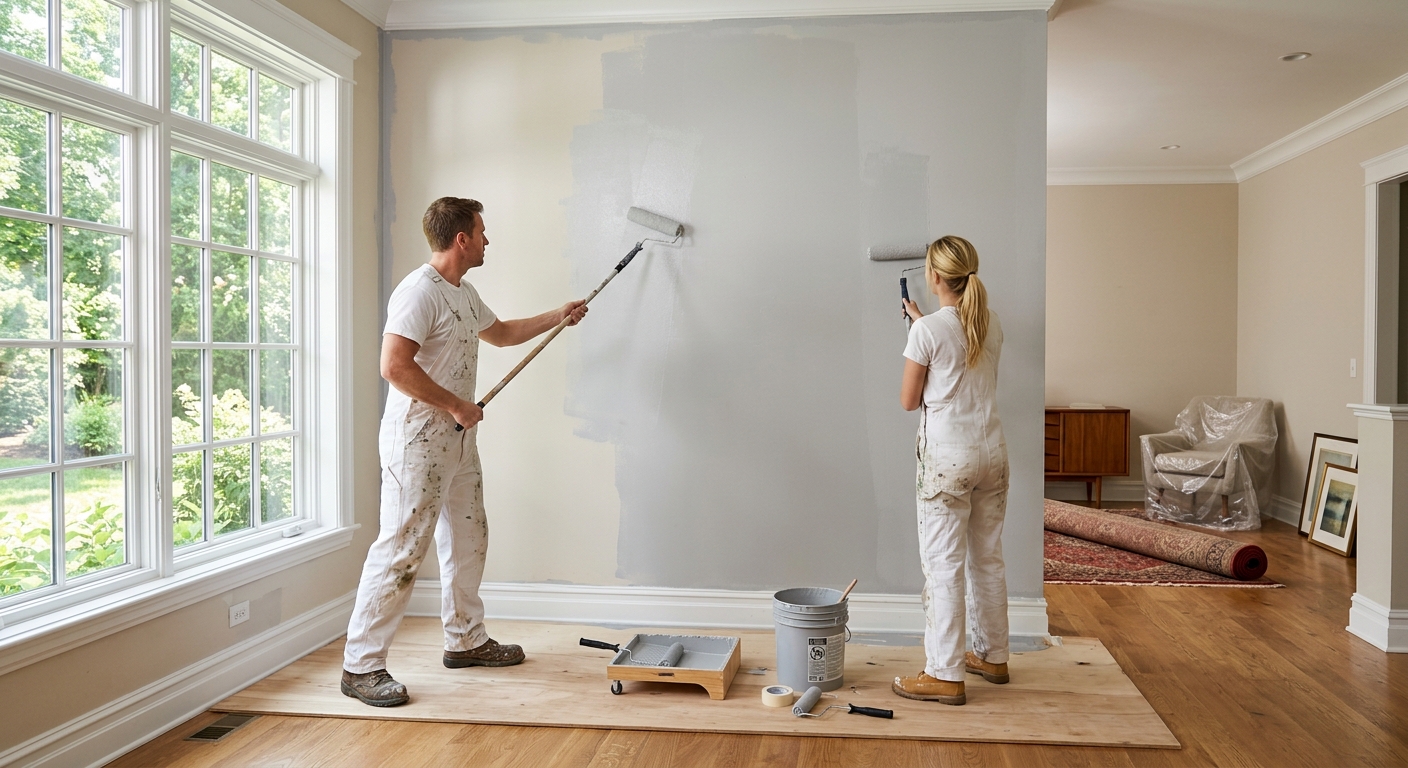
Painting options and costs in Sarnia
Sarnia is a busy painting market because many homeowners are working with older housing stock, not brand-new builds. In fact, 71.0% of dwellings in the area were built before 1981, which usually means more time for scraping, patching, sanding, caulking and priming than people expect. That matters for both interior repainting and for exteriors, where aged substrates can absorb unevenly and show flashing if prep is rushed. (Statistics Canada, 2021 Census). With 21,935 homeowner households in the city’s broader profile (68.1% of households own), there’s steady demand for refreshes as finishes age and families update spaces over time. (Statistics Canada, 2021 Census).
In the Windsor–Sarnia economic region, exterior painting costs are shaped by how short and tightly managed the warm-weather window is. Practically, exterior work runs late spring through early fall, when temperatures and humidity are stable enough for proper curing and dry surfaces. That season compression increases scheduling pressure and can push pricing closer to the top end of typical bands. Interior work is more flexible and often prices differently because it doesn’t depend on rain and surface moisture.
In Sarnia’s Point Edward area (and similarly in older neighbourhood pockets across the city), repainting frequently includes more detailed surface prep due to mid-century construction. If your quote is based only on “paint only,” you’ll often see the gap later at the estimate stage when prep scope is confirmed. The comparison table below shows realistic ballparks for common projects so you can line up scope and pricing before you book.
| Service |
What's Included |
Typical Duration |
Price Range |
| Interior — whole home (walls, ceilings, trim) |
Protect floors/fixtures, patch & sand where needed, prime stained/odd-porosity areas, caulk trim gaps, 2 coats of paint, clean-up and final touch-ups |
5–10 business days |
$1,600–$3,500 |
| Interior — per room (standard bedroom or living room) |
Cut-in work, patch/sand minor defects, spot-prime as needed, 2 coats on walls plus ceiling (if requested), basic prep protection |
2–4 business days |
$800–$1,800 |
| Exterior — full house (siding, trim, soffits) |
Power wash, scrape/sand, caulk joints, spot prime bare areas, 2-coat exterior system, paint soffits & trim, protection of landscaping |
7–15 business days |
$2,500–$6,000 |
| Exterior — trim and accent colours only |
Surface cleaning, sand/spot prep, caulk where needed, prime bare areas, paint trim accents, focused masking |
3–7 business days |
$1,500–$3,800 |
| Kitchen cabinet painting (doors, frames, spray finish) |
Degrease, light sanding, fill/spot prime, spray lacquer/alkyd-style finish (as specified), hardware removal/reinstall, protective top coat |
4–9 business days (plus dry time) |
$900–$2,500 |
| Specialty / faux finish (accent wall, texture) |
Surface preparation for texture adhesion, base coat/primer as required, decorative finish system, sealing where appropriate |
2–6 business days |
$600–$3,000 |
Prices are estimates only and vary by project scope, site access and material selection.
What affects the price of painting in Sarnia
If two contractors quote the “same” paint job in the Windsor–Sarnia region, it’s common to see a 30–50% spread once you compare preparation, coat counts and the finish system. The biggest reason is that older homes need more prep to achieve a smooth, even bond—especially when the previous coating has different sheen, chalking, or unknown products. A second reason is the exterior season: in Ontario, exterior work typically runs roughly late May to early October, when temperatures are high enough for proper application and curing and surfaces can stay dry long enough. Contractors also price summer scheduling because demand tightens in the same few months.
When you’re repainting an older home (71.0% built before 1981 in the local profile), prep can become the largest cost driver. On repainting jobs, surface preparation can run 50–70% of the labour—scraping loose material, sanding edges, caulking cracks, patching drywall or repairing soft wood, and priming to stabilize uneven absorption. If a quote starts close to interior bands (for example, interior per-room work around $800–$1,800 ), but prep is missing, exterior work can quickly rise toward the upper exterior band (such as $2,500–$6,000 ) once proper primer systems and more time are included.
In Sarnia, practical cost swings often come from three concrete issues. First, older trim may need re-caulk and spot-priming for adhesion, not just a color change. Second, multi-storey access (ladders versus lifts/scaffolding) changes labour time. Third, substrate type matters: wood and fibre cement siding typically require different primers and wet-rot/edge checks. In short, the “paint” itself is only part of the story—the chemistry and time spent preparing for Sarnia’s real-world conditions is what you’re paying for.
| Price Factor |
Why It Matters |
Cost Impact |
| Surface prep — scraping, sanding, patching drywall or wood |
Prevents peeling/adhesion failures and creates an even surface for topcoats |
Can add 20–60% to labour on older homes |
| Number of coats — 2-coat system over primer vs. 1 coat over existing |
Coverage and durability depend on proper build and uniform sheen |
Typically $150–$800+ per affected area |
| Paint quality tier — contractor-grade vs. premium (Benjamin Moore, Sherwin) |
Better solids, hiding power and colour stability can reduce rework |
Often $200–$1,200 difference for the full project |
| Ceilings and trim — adds significant time vs. walls-only |
Trim cut-ins, masking and ceiling work increase labour density |
Commonly 10–35% more than walls-only |
| Exterior season window — short season raises summer rates |
Scheduling is compressed late spring to early fall; crews are booked faster |
Can shift totals by 5–25% depending on timing |
| Lead-safe precautions — required for pre-1978 homes with lead paint |
Improves safety and reduces dust spread during scraping/sanding |
Often adds $300–$1,500+ for containment and disposal |
| Surface material — drywall vs. plaster vs. wood vs. stucco |
Different substrates need different primers and adhesion strategies |
Can change material and prep by $200–$1,000 |
| Height and access — multi-storey exterior requires scaffolding or lifts |
Access equipment increases labour, time and setup |
Frequently adds $500–$2,000+ |
Permits & regulations in Ontario
In Ontario, typical residential painting does not require a permit. For most jobs—interior repainting, exterior repainting, trim work, and cabinet refinishing—homeowners generally don’t need to pull a permit. However, there are important health and work-practice expectations when a home is older. In Sarnia, many properties were built before 1978, and health guidelines recommend testing for lead paint before sanding or scraping. If lead is present, contractors should use lead-safe methods such as wet methods to control dust, HEPA vacuuming, proper containment, and correct disposal practices. While this isn’t legally mandated for homeowners to follow personally, it’s standard for professional contractors and affects the cost and timeline of pre-1978 work.
What DOES typically require permits or approvals is not “painting” itself—it’s usually related work like structural changes, large window/door replacements, or any separate renovation that triggers building permits. For straightforward painting, confirm exclusions and scope in the contract: paint prep, surface repairs, caulking, power washing, and disposal.
To verify your contractor in Sarnia step-by-step: (1) check licensing/registration information through the Government of Ontario’s online resources (where applicable for trade requirements); (2) request a certificate of liability insurance and confirm the coverage is active and includes the address/job; (3) ask for proof of WSIB/WCB workers’ compensation coverage (or the equivalent evidence for their staffing). Then get everything in writing: paint brand and sheen, number of coats, surface prep included, disposal details, and the start/completion timeline.
Interior vs exterior painting — getting the best result in Sarnia
In Sarnia, the difference between a long-lasting paint job and premature failure usually comes down to prep details and correct product use for local conditions, not marketing. For interiors, surface preparation is the deciding factor: filling and sanding nail holes, smoothing patch repairs, and priming spots with stains, odour, or uneven porosity. Sheen selection also matters by room—flat/eggshell for many ceilings and low-traffic walls, satin or eggshell for living areas, and semi-gloss/trim paint for trim and frequently cleaned surfaces. Two coats over the right primer almost always outlasts one thick coat because it builds uniform film thickness and reduces holidays.
For exteriors, prep is even more critical in Ontario’s climate. You should expect power washing, scraping loose or failing material, sanding edges, caulking at joints, and priming bare or questionable substrates before topcoats. Caulking before painting isn’t just aesthetic—it helps prevent water ingress behind trim and reduces the chance of future peeling. Primer choice matters by substrate: wood and fibre cement can behave differently, and sometimes an oil-based primer is specified where tannin bleed or staining control is needed. In Sarnia’s humidity swings, correct cure windows and product compatibility can be the difference between fine now and stable next year.
Cabinets are a smart budget alternative to replacement when the box and layout are solid. If replacement is priced into the tens of thousands, painting can keep you closer to cabinet bands like $900 – $2,500, but only if doors are prepped and finished with a system that resists wear. For pre-1978 homes, lead-safe precautions add cost, but it’s part of doing the job correctly.
To make it concrete: if an exterior quote is only slightly higher than another (say a difference of a few hundred dollars), it’s often justified by stronger prep scope—extra scraping and spot-priming—and proper caulking. If the cheaper quote skips those steps, you’ll usually pay later with touch-ups or a shorter service life.
| Project Type |
Key Prep Step |
Recommended Coats |
Price Band |
| Interior — fresh drywall (new construction) |
Seal/prime for uniform absorption and smooth finish |
Primer + 2 topcoats (walls), trim/ceiling as required |
$1,200–$3,000 |
| Interior — repaint (good condition, no repairs) |
Light scuff-sand and spot-prime only where needed |
1 coat top-up + 1 full finish coat (or 2 full coats) |
$800–$2,200 |
| Interior — repaint (patching and priming needed) |
Patch compound prep and stain/odour sealing primer |
Prime patches/stains + 2 topcoats |
$1,200–$3,500 |
| Exterior siding (wood or fibre cement) |
Scrape/sand + caulk joints before topcoats |
Primer as needed + 2 exterior coats |
$2,500–$6,000 |
| Exterior trim and accents only |
Focused sand and spot-prime for adhesion at edges |
Spot prime + 2 coats on trim/accents |
$1,500–$3,800 |
| Kitchen cabinets (spray finish) |
Dacrease/degreae + adhesion prep and primer system |
Primer + 2 finish coats (system-dependent) |
$900–$2,500 |
How to choose a painting contractor in Sarnia
Choosing the right painter in Sarnia is less about picking the lowest number and more about confirming you’re comparing the same scope and protections. Start by verifying Ontario coverage basics. Ask for proof of liability insurance (certificate of insurance that matches the job address) and confirmation they have WSIB/WCB workers’ compensation coverage for their workers. If they can’t provide current documentation, walk away—painting is a job with ladders, dust, and access equipment, and you don’t want to be responsible for an on-site injury.
Then request 2–3 itemised written quotes. You want a labour + materials breakdown, not just a lump sum. Make sure the scope is spelled out: prep steps (scrape/sand/prime), caulking work, whether power washing is included for exteriors, and how disposal is handled. Also clarify if any permits are required for related work (painting itself typically isn’t), and whether lead-safe containment is included for pre-1978 homes.
Warranty matters. Look for a workmanship warranty length that’s in writing, and ask how long product/manufacturer warranties last and what conditions apply. Confirm whether their warranty is transferable if you sell the home. Payment schedule should be conservative—never pay more than 10–15% upfront; the rest should be tied to milestones and a holdback until completion and final touch-ups.
Finally, get a written timeline: start date, weather contingencies for exterior work in the late spring to early fall window, and a completion estimate.
- Confirm liability insurance certificate is current and includes the Sarnia address/project.
- Confirm WSIB/WCB coverage for workers (request proof, not verbal assurance).
- Require the quote to list paint brand, sheen, and the number of coats for each surface.
- Ask what prep is included (scraping, sanding, patching, priming, caulking) and what is excluded.
- For exteriors, confirm power washing is included and how they handle failing paint edges.
- For lead concerns, ask whether they test or follow lead-safe methods for pre-1978 homes.
- Clarify disposal: what gets hauled away (scrapings, bags, plastic, construction debris).
- Confirm furniture/floor protection method and cleanup process (final vacuum/wipe, dust control).
- Get a schedule in writing including weather pause/permit-related contingencies.
- Make sure they specify the accessibility plan (ladders vs. lifts/scaffolding).
- Check warranty terms in plain language, including who covers what and for how long.
- Verify they do not demand large deposits; use milestone payments with a holdback.
Red flags in Sarnia painting contracts: (1) quotes that omit primer or assume “no prep needed,” (2) no written scope for caulking and disposal, (3) refusing to provide insurance/WSIB proof, (4) payment terms asking for a large upfront deposit (beyond about 10–15%), and (5) vague warranty language like “guaranteed” without a stated duration and limits.
Frequently asked questions — painting in Sarnia
How long does exterior paint last here?
In Sarnia, exterior paint lifespan depends heavily on prep and product system because the work happens in a limited warm-weather window (late spring through early fall). On well-prepped siding and trim with proper caulking and 2 coats over the right primer, many homeowners see service life in the multi-year range, but it varies by sun exposure, moisture management, and substrate condition. Because 71.0% of local dwellings were built before 1981, you’ll often need extra scraping, sanding and spot-priming to stabilize aged surfaces before the topcoat can perform. (Statistics Canada, 2021 Census) If a quote tries to cut cost by skipping prep, the paint can fail sooner through peeling or flashing.
Should I paint or replace my cabinets?
In most Sarnia kitchens where the cabinet boxes are structurally sound, painting is a cost-effective alternative to replacement. Cabinet painting can keep you within typical bands like $900 – $2,500, especially when the project is limited to doors/frames with a spray-style finish. Replacement can be significantly higher because it includes new cabinetry, hardware, and usually more construction trades. Painting is best when your layout is fine and doors aren’t warped beyond normal repair. The key is prep: degreasing, sanding, proper primer adhesion and an appropriate finish system. If your cabinets are severely damaged or you’re changing the layout, replacement may still make sense.
How do I prep walls before painting?
For homeowners in Ontario, “prep” is mostly about what you do—or don’t do—before the painter arrives. If you’re painting yourself, start with patching holes, sanding any rough edges, and cleaning dust and grease. Stained or water-damaged spots must be sealed with primer to prevent colour bleed. If you’re repainting shiny surfaces, a light scuff-sand helps the topcoat bond. Don’t skip caulking trim gaps, because air and moisture movement can show through. In older Sarnia homes (many built before 1981), uneven absorption is common, so priming is usually needed more often than people think. A professional quote that includes patching and priming will typically cost more up front but reduces rework.
Do I need to worry about lead paint in an older Sarnia home?
It’s a good question for many Sarnia homeowners because a large share of the housing stock predates modern paint practices—71.0% were built before 1981 in the local profile. (Statistics Canada, 2021 Census) Health guidelines recommend testing for lead paint before sanding or scraping, and lead-safe work practices (wet methods, HEPA vacuuming, containment and correct disposal) if lead is present. While this isn’t something homeowners are “required” to do personally, it is the standard approach professional contractors use for pre-1978 homes where risk may be higher. In practice, lead-safe methods can increase labour and disposal costs, so make sure your quote clearly states whether lead precautions are included if testing is positive.
How long does it take to paint a house?
Timing in Sarnia depends on whether it’s interior or exterior and how much prep is required. Interior whole-home work often takes multiple business days—commonly around a week for smaller layouts and longer for full-home projects with ceilings and trim. Exterior painting is more constrained by weather, so even if the crew is ready, application and curing need stable conditions and dry surfaces. Exterior projects often take 2–3 weeks in real life when you factor in scraping, caulking, priming and multiple coats, plus short weather delays during the late spring to early fall season. The best way to avoid surprises is to ask for a written start date and completion estimate, and confirm what happens if rain interrupts curing.
What's the difference between paint quality tiers?
Paint quality tiers affect hiding power, durability, and how smoothly the finish levels. Premium lines generally contain better-performing solids and binders, which can reduce the number of coats needed for uniform coverage and can improve colour stability under sun exposure—important on exteriors with Sarnia’s seasonal moisture swings. Contractor-grade paints can be perfectly fine when the prep is done right, but you may pay more in labour if additional coats are required to achieve an even look. That’s why quotes vary: two contractors might both say “2 coats,” but one may also include a stronger primer system and better topcoat that resists scuffing and fading. For interiors, staying within typical bands like $800–$3,500 depends on both scope and the quality tier used.