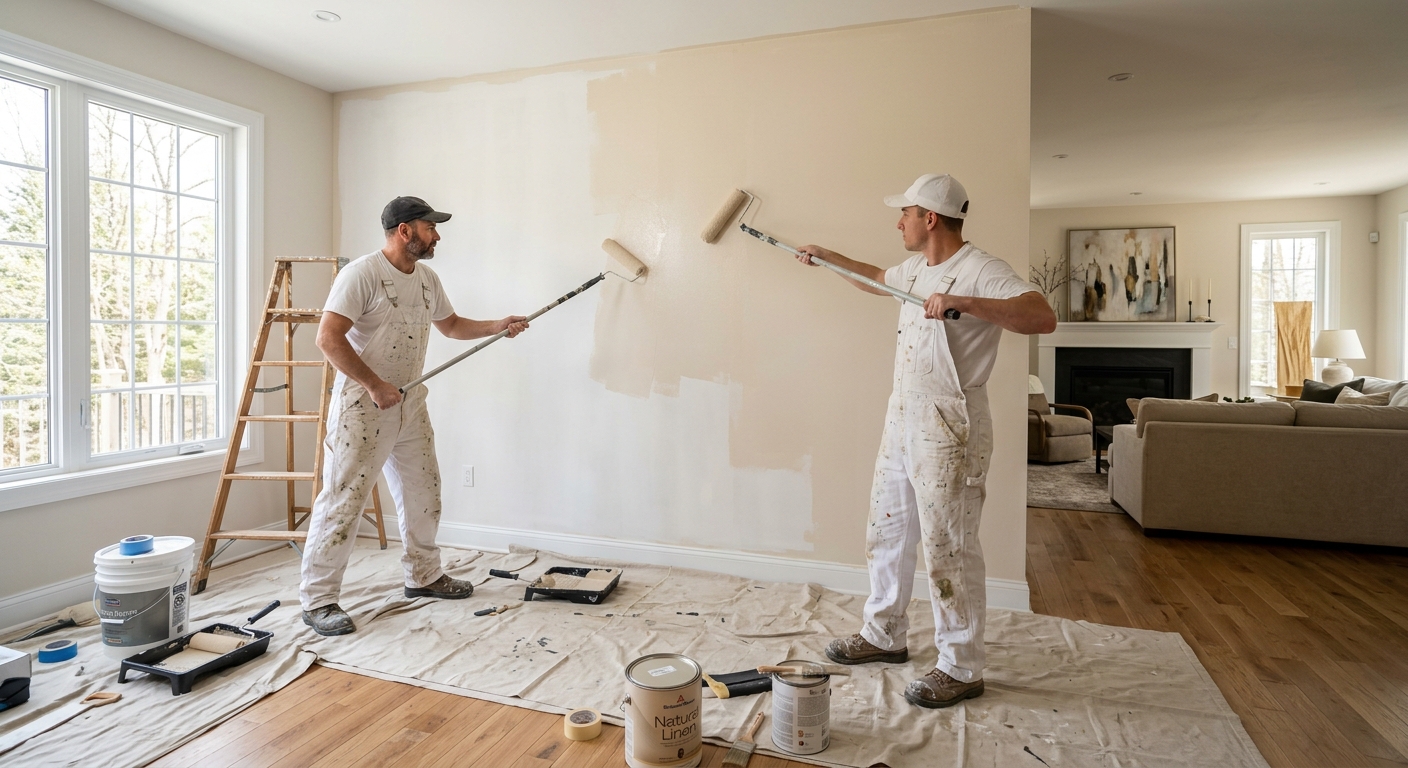
Painting options and costs in Oakville
Oakville homeowners typically choose between a quick interior refresh and a more schedule-driven exterior repaint, and the right option mostly comes down to surface condition and timing. In Oakville’s housing mix, about 27.0% of homes were built before 1981 (Statistics Canada, 2021 Census), which often means more prep on older siding, trim, window surrounds, and eaves—scraping, caulking, patching, and priming. That prep isn’t optional if you want paint to stay adhered through Ontario temperature swings.
Cost in the Greater Toronto Area is also strongly influenced by the short, climate-dependent exterior season. Contractors in Oakville generally work from late May through June and again from September to mid-October, when temperatures stay above roughly 10°C for proper application and curing. In June to August, demand often peaks and ideal “dry windows” are limited, so exterior pricing commonly runs about 10–15% higher during those months. The result is that two identical houses repainted in different weeks can come back with noticeably different totals.
If you live around Oakville’s downtown/Burloak corridor or in the newer Lakeshore and West Oak neighbourhoods where siding projects cluster seasonally, booking sooner usually helps you get your preferred start date. For most homeowners, the best way to compare options is to look at what’s included—especially prep and number of coats—before focusing only on the final line price. See the comparison table below for typical scopes and budgets.
| Service |
What's Included |
Typical Duration |
Price Range |
| Interior — whole home (walls, ceilings, trim) |
Protect floors/furniture, prep and patch, prime where needed, paint walls/ceilings, caulk trim joints, clean up and final touch-ups. Includes labour-based allowances for standard sheen selection. |
5–10 business days |
$3,000–$6,000 |
| Interior — per room (standard bedroom or living room) |
Prep, patch, sand, prime spots as required, paint walls and ceiling, basic trim touch-ups (where applicable), and dust control. |
1–3 business days |
$400–$1,800 |
| Exterior — full house (siding, trim, soffits) |
Power wash, scrape/sand, caulk openings, prime bare spots, paint siding/trim/soffits, protect landscaping, and final clean. Includes standard two-coat system where required. |
7–14 business days |
$3,800–$8,000 |
| Exterior — trim and accent colours only |
Targeted prep on trim/accents, caulking, spot-priming, paint trim and designated features, and protective masking for adjoining surfaces. |
3–7 business days |
$1,500–$3,800 |
| Kitchen cabinet painting (doors, frames, spray finish) |
Deep cleaning/degreasing, sanding, repairs as noted, prime (bonding as required), spray finish (or equivalent controlled application), hardware protection, and reinstallation where included. |
5–9 business days (plus curing time) |
$1,200–$4,000 |
| Specialty / faux finish (accent wall, texture) |
Surface prep suitable for decorative work, controlled application, colour matching, finishing/sealing as specified, and touch-ups. |
1–5 business days |
$600–$3,500 |
Prices are estimates only and vary by project scope, site access and material selection.
What affects the price of painting in Oakville
In Toronto and the broader Ontario market, two contractors can quote the same “paint a house” request and still land 30–50% apart. The gap usually isn’t the topcoat—it’s the hidden labour: surface preparation, masking complexity, access, number of coats, and how much priming is truly required once your existing layers are assessed. For repainting older homes—common in Oakville, where 27.0% of dwellings were built before 1981 (Statistics Canada, 2021 Census)—prep can jump because you may be dealing with multiple paint layers, aged caulking, and worn trim edges that don’t hold paint the same way as newer surfaces.
For exteriors, GTA pricing is tied to the short, climate-bound season. In Ontario, exterior work typically runs late May to early October, because contractors need temperatures above about 10°C and enough time for curing (often 24–48 hours). Contractors often price higher during June–August because peak demand squeezes available crews and “ideal” dry windows. By contrast, coastal BC tends to have a longer calendar but constant moisture and mildew risk, while Alberta can be cost-sensitive to temperature stability and wind-driven drying conditions.
Concrete Oakville examples: (1) If your siding has blistering or failing caulk joints, expect more scraping and caulking—often making the total trend toward the upper end of exterior ranges like $3,800–$8,000 rather than the lower end. (2) If your job includes ceilings plus trim (not just walls), labour usually shifts you upward within interior pricing such as $400–$6,000 depending on whole-home vs. room scope. (3) Higher access—taller fronts, walkouts, or eaves requiring lift work—adds direct crew time and equipment rental, which can move you another step within the band.
| Price Factor |
Why It Matters |
Cost Impact |
| Surface prep — scraping, sanding, patching drywall or wood |
Adhesion and longevity depend on removing loose paint and creating a sound surface before coating. |
Often the largest variable; can swing totals by 20–40% on repaints |
| Number of coats — 2-coat system over primer vs. 1 coat over existing |
Coverage and durability depend on whether existing colour/porosity is fully covered. |
Typically adds 5–25% when moving to a true 2-coat system |
| Paint quality tier — contractor-grade vs. premium (Benjamin Moore, Sherwin) |
Premium lines often improve hide, washability, and long-term appearance. |
May raise material cost modestly but reduce rework risk |
| Ceilings and trim — adds significant time vs. walls-only |
Cutting-in, masking, and careful application take longer—especially around crown and doors. |
Can shift a job by hundreds to thousands, especially in whole-home work |
| Exterior season window — short season raises summer rates |
Limited “ideal” weeks can tighten scheduling and raise hourly demand. |
Commonly 10–15% higher in June–August for exterior work |
| Lead-safe precautions — required for pre-1978 homes with lead paint |
Professional lead-safe methods reduce exposure during scraping/sanding and improve compliance readiness. |
Can add labour/materials; still worth it for safety and quality |
| Surface material — drywall vs. plaster vs. wood vs. stucco |
Different substrates need different primers and prep aggressiveness for bonding. |
Primers and labour differ; stucco/wood repairs often cost more |
| Height and access — multi-storey exterior requires scaffolding or lifts |
Access time and safety requirements increase crew hours and equipment costs. |
Often the difference between a “lift day” and “scaffold week” |
Permits & regulations in Ontario
In Ontario, painting itself typically does not require a permit. Your usual permit triggers are tied to structural work, electrical/plumbing changes, or major renovations—not coating updates. That said, homes built before 1978 may have higher chances of lead paint on trim, windows, and older railings. For those homes, health guidelines strongly recommend testing and using lead-safe work practices if lead is present (or suspected). Professional crews commonly use wet methods to reduce dust, HEPA-vacuum cleanup, plastic containment where appropriate, and proper disposal of waste materials. This is not legally mandated for homeowners in most situations, but it’s standard practice for contractors who do lead-safe work.
What does require permits is outside typical painting scope—for example: reconfiguring load-bearing walls, changing exterior openings, or doing work tied to sprinkler or fire system modifications. If a project includes those trades, your permit requirements come from the related work, not from painting.
To verify contractor readiness in Oakville, ask for: (1) liability insurance certificate showing the contractor is covered for property damage; (2) WSIB/workers’ compensation coverage for employees; and (3) the written quote specifying paint brand, sheen, number of coats, and exactly what prep and repairs are included. Step-by-step: start with the contractor’s insurance certificate (request the current COI and check the expiry date), confirm WSIB status by referencing your contractor’s account details or confirmation letter, then ensure your signed contract clearly states prep scope (scraping/sanding/caulking) and disposal responsibility.
Interior vs exterior painting — getting the best result in Oakville
In Oakville, the difference between a paint job that looks great for years and one that fails early comes down to preparation and correct product/sheen choices for how the space is actually used. For interiors, surface prep matters more than brand: filling and sanding, priming patched areas, and addressing stains before painting. Sheen choice also protects your time—flat finishes hide drywall imperfections but scuff more; eggshell and satin balance cleanability and look for living rooms and hallways; semi-gloss on trim resists marks and wipe-downs. Two proper coats (over a suitable primer when needed) usually outlast one heavy coat because it cures more evenly and reduces visible flashing.
For exteriors, Ontario’s freeze–thaw and rain cycles make surface prep and caulking critical. Caulk should be applied before painting to prevent water ingress pathways around trim joints, and primer selection depends on substrate: oil-based primers may be needed for certain stains and bonding conditions, while latex primers can be appropriate depending on the surface and existing coating stability. GTA product choices are also about durability—paint must handle humidity spikes and occasional cold nights without losing adhesion.
Kitchens are a common decision point. Cabinet painting can be a budget alternative to replacement, but it’s labour-intensive because it requires deep degreasing, controlled sanding, and a coating system that bonds and cures cleanly. For example, a mid-scope repaint typically sits around $1,200–$4,000 versus replacement which is usually far higher; the difference is justified when boxes are solid and you want a specific colour change without demolition.
For pre-1978 homes in Oakville, lead-safe precautions are part of “getting the best result,” because improper dust control can compromise both safety and the cleanliness needed for primer adhesion on exposed trim.
| Project Type |
Key Prep Step |
Recommended Coats |
Price Band |
| Interior — fresh drywall (new construction) |
Seal and prime new drywall thoroughly; sand between coats for uniform texture. |
2 coats finish (often plus primer as required) |
$1,500–$4,500 |
| Interior — repaint (good condition, no repairs) |
Light scuff-sand, clean properly, and spot-prime only where needed. |
2 coats where sheen/colour change requires it |
$400–$3,000 |
| Interior — repaint (patching and priming needed) |
Patch, sand, feather edges, and prime repairs to prevent flashing. |
2 coats finish + primer on patched areas |
$1,000–$6,000 |
| Exterior siding (wood or fibre cement) |
Scrape loose material, caulk joints, power wash, prime bare spots. |
2 coats exterior topcoat over appropriate primer |
$3,800–$8,000 |
| Exterior trim and accents only |
Mask precisely, prep to remove flaking edges, spot-prime then caulk. |
2 coats on trim/accents where coverage demands |
$1,500–$3,800 |
| Kitchen cabinets (spray finish) |
Degrease, sand for bonding, and prime for adhesion prior to finish coats. |
2 finish coats (plus primer) for durability |
$1,200–$4,000 |
How to choose a painting contractor in Oakville
Choosing the right contractor in Oakville is mainly about verification and scope clarity. First, confirm insurance: ask for a current liability insurance certificate and ensure it covers the project location and has no expired dates. Next, verify WSIB/workers’ compensation for anyone working on-site—request proof (or a confirmation document) and confirm the coverage is active. For licensing, painting contractors in Ontario are often not required to hold a “painting licence” the way trades like electrical do, so your best protection is insurance, workers’ compensation, and a detailed scope that holds up in writing.
Then get 2–3 itemised quotes—not just a lump sum. A good quote breaks down labour and materials enough that you can compare prep (scraping, sanding, patching, caulking, priming) and the number of coats. Ask what’s excluded: are windows, landscaping, and disposal included? Is permit pulling included if your project triggers something beyond painting (rare, but happens when renovations are bundled)?
Warranty matters too. Confirm the workmanship warranty length in writing and whether it covers both adhesion and peeling for a stated period. Product/manufacturer warranties can be useful, but workmanship coverage is what you rely on most. Payment schedule is a safety check—never pay more than 10–15% upfront, and hold back a portion until final walkthrough and touch-ups are complete. Finally, insist on a written timeline with a start date and completion estimate, especially for exterior work where rain and temperature windows affect scheduling.
- Request COI (liability insurance) and check the policy expiry date.
- Request WSIB/workers’ compensation proof and confirm coverage is active.
- Get a written scope listing surface prep actions (scrape/sand/patch/caulk/prime) by area.
- Confirm number of coats and whether primer is included for bare or patched areas.
- Ask what sheen is being used by room (flat/eggshell/satin/semi-gloss) and on which surfaces.
- Clarify disposal and cleanup: who removes debris and how masking is handled.
- For exteriors, ask how they manage rain risk and curing time (24–48 hour windows).
- Confirm lead-safe approach for pre-1978 homes if applicable (wet methods/HEPA cleanup).
- Verify how they protect landscaping, driveways, and exterior fixtures (covers, masking, tarps).
- Ensure the quote lists paint brands/lines (not just “paint of similar quality”).
- Set a holdback and keep final payment tied to punch-list completion.
- Ask for a written warranty and what it covers (peeling/adhesion/timeframe).
Red flags I see in Oakville include: quotes that skip surface prep or prime “as needed” without explaining criteria; very low exterior pricing that doesn’t reflect caulking/scraping time; contractors asking for large upfront deposits beyond 10–15%; vague warranty language (“satisfaction guaranteed” with no timeframe); and missing proof of insurance/WSIB coverage. If any of these show up, slow down before you sign.
Frequently asked questions — painting in Oakville
How many coats does an exterior repaint need in Oakville?
Most exterior repaints in Oakville use a two-coat top system, with primer applied to bare or failing spots. The exact number of coats can change when you’re covering darker colours, dealing with chalky/porous surfaces, or correcting areas with heavy patching. Because the exterior season in the GTA is climate-bound (late May–June and again September–mid-October), crews also plan coating schedules around drying and curing—rain or cold snaps can force rework if coverage was rushed. On a typical full-house scope, Oakville pricing often falls within $3,800–$8,000, reflecting the prep and two-coat expectation. A proper assessment of adhesion is what determines primer amount, not a “one-size-fits-all” rule.
What is the best primer for older Oakville homes?
For older Oakville homes—especially those built before 1978—primer choice is driven by substrate and what’s failing. In many repainting scenarios, primers are selected based on whether you have bare wood, patched drywall/wood areas, stained surfaces, or glossy existing coatings that need bonding support. If the exterior has stains from tannins, rust, or previous water intrusion, you’ll often need a stain-blocking primer so the topcoat doesn’t discolour. For prep involving scraping and caulking, the goal is consistent bonding so paint doesn’t lift when humidity spikes. Where lead paint could be present, professionals use lead-safe controls during sanding/scraping. If you’re planning an exterior, it’s normal for costs to sit closer to the higher end when the primer system is more complex, often within $3,800–$8,000 for full houses.
Should I paint or wallpaper my Oakville home?
In Oakville, wallpaper can look fantastic, but it demands a different level of surface consistency than paint. If your walls have patched drywall, minor texture differences, or older plaster movement, paint usually gives better results with less risk—especially when you prep and prime patched areas properly. Wallpaper is also more sensitive to humidity conditions during the install and can be harder to remove cleanly later. Painting, on the other hand, is usually more practical for whole-home timelines because interiors can be scheduled year-round in Ontario, without the strict exterior curing windows. If you’re doing a single room, wallpaper might be worth it for a premium accent look; for broader coverage or frequent updates, paint generally delivers strong value. For budgeting, interior painting commonly ranges from $400–$6,000, depending on whether it’s one room or a whole-home scope.
How do I fix peeling exterior paint in Oakville?
Peeling exterior paint isn’t just a “repaint” problem—it’s usually a prep and moisture/adhesion issue. The fix starts with identifying why it’s peeling: failing caulk joints, trapped moisture behind coatings, chalky paint, or loose layers that weren’t fully removed. In Oakville, the practical approach is scrape back to sound material, sand edges smooth, power wash as needed, then caulk vulnerable joints and prime exposed areas before applying two exterior topcoats. If sections have widespread failure, spot-prime only won’t be enough; the preparation volume drives cost. This is why estimates can differ widely across Toronto: jobs moving into the upper exterior band typically require more scraping and priming time, often aligning with $3,800–$8,000 for full-house repaints. A contractor should also explain the “failure path” so the new coating isn’t set up to peel again.
What colours add the most resale value in Oakville?
Oakville buyers tend to respond best to clean, timeless neutrals and well-balanced trim colours that won’t date quickly. For exterior resale, think classic white/off-white trim with warm greige, light stone greys, or muted taupes for siding; for doors and accents, deep colours like charcoal or a rich blue/green often photograph well and look intentional. Inside, soft warm whites, light greiges, and calm taupes tend to appeal broadly. If you have pre-1980 elements—about 27.0% of homes built before 1981 (Statistics Canada, 2021 Census)—choosing colours that complement older brick/stone and window frames usually reduces the risk of “off” contrast. The key is not just colour trends, but sheen and coverage: a quality two-coat paint system with the right primer prevents patchy flashing so the final look stays consistent.
How much does it cost to paint a house in Oakville?
The total cost depends on whether you’re painting interior only, the full exterior, or a combination, and how much prep is needed. For interiors, typical ranges can run from $400–$6,000 depending on whether you’re doing one room or a whole-home job (ceilings and trim push totals upward). For exteriors, a full-house repaint in the GTA commonly falls around $3,800–$8,000 because scraping, caulking, priming, and two coats are routine expectations. Timing affects exterior pricing too: the short late-May to mid-October working window in Ontario means June–August can be busier, pushing costs up roughly 10–15%. If your home has significant patching or older coatings failing, your quote should clearly show prep allowances so you understand why the price lands where it does.