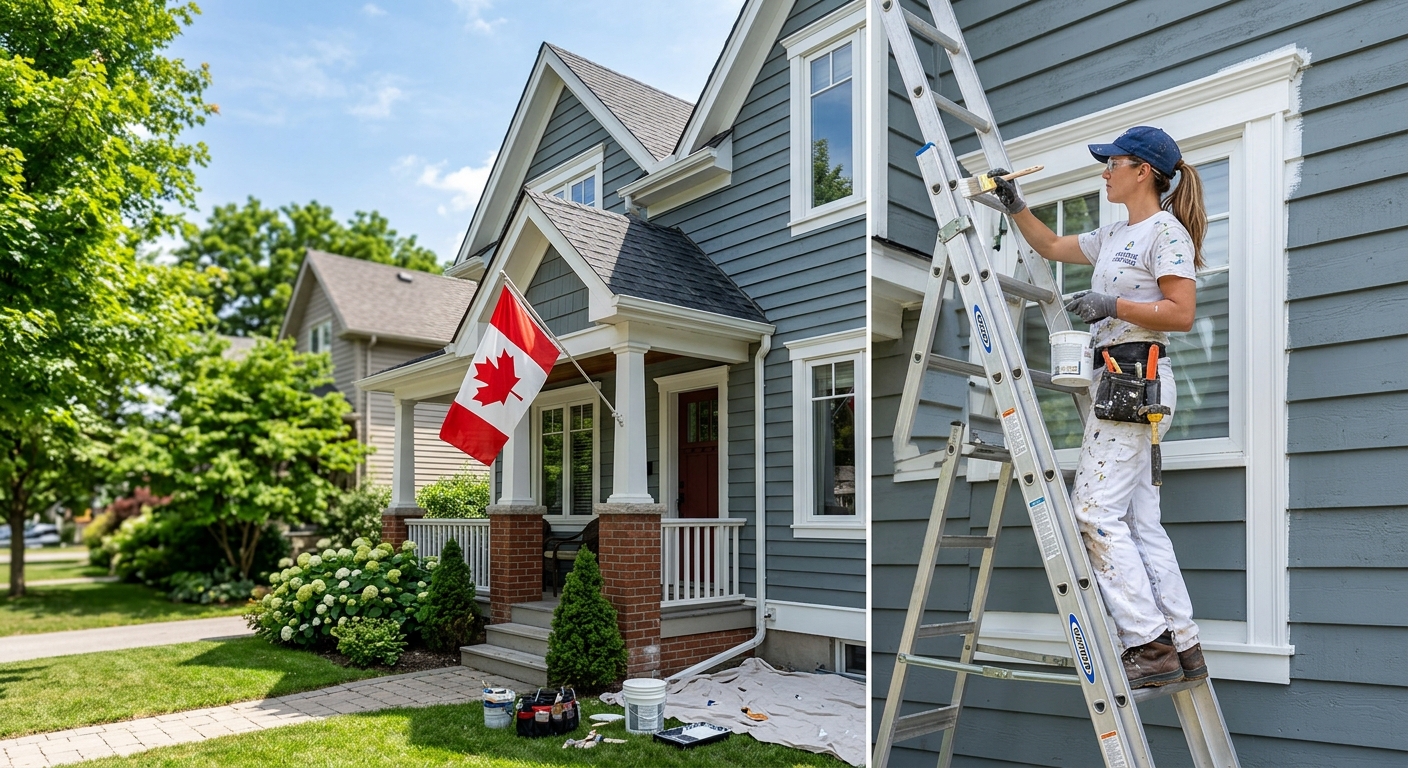
Painting options and costs in King
Painting in King is shaped by two realities: a strong homeowner market (Statistics Canada, 2021 Census) and a housing stock where many homes require extra preparation. With 87.2% of dwellings being single-detached, and 37.9% of homes built before 1981, repainting often means more than “roll and go”—think scraping, sanding, patching, caulking, and priming to bring older trim and siding back to a paint-ready condition. In many King neighbourhoods, that added prep is what separates a durable finish from peeling edges or flashing through within a season or two.
Costs here also reflect Greater Toronto’s short, climate-dependent exterior window. Contractors typically target late May through June and again September to mid-October, when temperatures stay around and above 10°C for proper adhesion and curing. In June–August, limited “ideal” weeks plus peak summer demand often pushes exterior pricing 10–15% higher, especially for full-house work. Interior projects are less season-sensitive, so scheduling can be steadier—but labour still drives cost based on ceilings, trim complexity, and how much furniture masking and protection is needed.
In King—particularly around areas like Nobleton and Schomberg—exterior repaints are especially in demand as homeowners get ahead of rain-season risk and summer schedules. Use the options and bands below as a starting point, then we can tighten the numbers after a quick look at surface condition, substrate (wood, fibre cement, stucco), and colour/trim complexity.
| Service |
What's Included |
Typical Duration |
Price Range |
| Interior — whole home (walls, ceilings, trim) |
Move-in protection, surface prep (patch/sand/caulk as needed), prime where required, paint walls/ceilings, paint interior trim/doors (basic), clean-up |
5–10 days |
$2,200–$6,000 |
| Interior — per room (standard bedroom or living room) |
Protection and masking, prep of minor repairs, prime spot/necessary areas, paint walls and ceiling, paint baseboards/trim (basic) |
1–3 days |
$400–$1,800 |
| Exterior — full house (siding, trim, soffits) |
Power wash, scrape/sand as needed, caulking of exterior joints, spot-priming, paint siding and trim/soffits, final cleanup |
7–18 days |
$3,000–$8,000 |
| Exterior — trim and accent colours only |
Protection, prep of trim (scrape/sand/spot prime), caulking, paint eaves/trim/rail details and accents |
3–8 days |
$1,500–$4,500 |
| Kitchen cabinet painting (doors, frames, spray finish) |
Remove/label doors (if applicable), degrease and prep, sand/prime, spray finish where specified, reinstall hardware after curing, light touch-ups |
4–10 days |
$1,200–$4,000 |
| Specialty / faux finish (accent wall, texture) |
Surface prep for texture lines, specific coating/texture system, custom finish application, protect surrounding surfaces, final blending |
2–6 days |
$600–$5,000 |
Prices are estimates only and vary by project scope, site access and material selection.
What affects the price of painting in King
Two contractors can quote the same King repaint and be 30–50% apart because pricing here is mostly about prep effort, product system, and how the work aligns with the short exterior season. In Greater Toronto, exterior painting is typically feasible from late May to early October, with proper application and curing needing temperatures above about 10°C for at least 24–48 hours and humidity that doesn’t spike during dry time. That limited ideal window concentrates demand, especially in June–August, and it can raise labour rates and scheduling costs.
Older homes (37.9% built before 1981) also matter. On many King single-detached properties, surface prep becomes a large portion of labour: scraping loose paint, sanding for adhesion, patching damaged wood/trim, caulking joints, and priming to lock in stains or prevent bleed-through. On a repaint, prep can account for roughly 50–70% of total labour when there are multiple existing paint layers or any water-related damage that needs correction first.
Concrete examples from King pricing: (1) A full exterior repaint on fibre cement may price lower on adhesion work than a wood facade with peeling edges, because the substrate dictates how aggressively we scrape/sand and how much primer system is required. (2) Adding scaffolding or a lift on a multi-storey elevation increases setup time, which pushes costs toward the upper end of exterior bands (for instance, moving from $1,500–$4,500 for trim/accent-only to $3,000–$8,000 for full-house work). (3) Interior jobs with high ceilings, heavy trim, or lots of built-ins can shift interior quotes upward from the lower $400–$1,800 per-room band toward whole-home pricing because masking and finishing time climbs fast.
When you review a quote, don’t just look at the final number—ask what prep is included and whether the contractor is pricing a 2-coat system over appropriate primer or relying on fewer coats over existing paint.
| Price Factor |
Why It Matters |
Cost Impact |
| Surface prep — scraping, sanding, patching drywall or wood |
Determines adhesion and longevity; older coatings often need more mechanical prep |
Can add 20–60% to labour on repaints |
| Number of coats — 2-coat system over primer vs. 1 coat over existing |
Hides better and reduces flashing, especially with colour changes |
Typically shifts costs by 10–25% |
| Paint quality tier — contractor-grade vs. premium (Benjamin Moore, Sherwin) |
Better pigments and binders improve coverage, scrub resistance and fade resistance |
Materials may move 5–20% depending on product choice |
| Ceilings and trim — adds significant time vs. walls-only |
More cutting-in, masking, and detail work; trim also needs caulking |
Often adds 15–40% for finish-heavy homes |
| Exterior season window — short season raises summer rates |
More demand for the same “ideal weeks” |
Can add 10–15% in June–August |
| Lead-safe precautions — required for pre-1978 homes with lead paint |
Pre-1978 surfaces may contain lead; safe work adds time and cleanup controls |
May add 5–20% if testing/remediation steps are required |
| Surface material — drywall vs. plaster vs. wood vs. stucco |
Different primers and prep methods are needed for each substrate |
Can shift scope by 10–30% |
| Height and access — multi-storey exterior requires scaffolding or lifts |
Setup, protection and safety time increase |
Often adds 10–25% to exterior projects |
Permits & regulations in Ontario
In Ontario, painting typically does not require a permit. You’re generally not pulling permits for interior wall/ceiling or exterior surface coating work on a home. Where regulation intersects with painting is usually through safety practices, not permit approvals—especially for older homes. For King properties built before 1978, health guidelines recommend testing for lead paint before sanding or scraping, and using lead-safe work practices if lead is present (wet methods to reduce dust, HEPA vacuuming, controlled containment, and proper disposal). This is not legally mandated for homeowners, but for professional contractors it’s standard risk-management.
Step one for verifying a contractor is insurance and coverage. Ask for a current certificate of insurance showing liability coverage, plus confirmation of workers’ compensation coverage (WSIB/WCB). Step two is to confirm the contractor’s credentials are appropriate for the work they’re doing and that they’re comfortable documenting the scope. Step three is the paperwork: a written contract should spell out the paint brand and line (if you’ve chosen it), the sheen, the number of coats, and exactly what surface prep is included—scraping, caulking, patching, priming, and cleanup/disposal.
Work that does sometimes require additional approvals is uncommon for routine painting on a typical private home. But if the project includes exterior alterations beyond coating (for example, structural changes, window replacement or work that affects building systems), other permits/approvals could be required. For standard coating and repainting, the focus is scope clarity and safe methods.
Interior vs exterior painting — getting the best result in King
The biggest difference between a paint job that lasts and one that fails early in King is preparation quality and timing relative to Ontario weather. For interiors, surface prep beats “premium topcoat” every time. Filling and sanding before primer, caulking trim gaps, and priming stains or patched areas prevents peeling and uneven sheen. Sheen choice matters by room: flat/eggshell is common for ceilings to hide imperfections, while eggshell or satin is usually better for living rooms and halls because they’re easier to wipe. In practical terms, two coats over the right primer system almost always outlast one thick coat—even if the one-coat approach looks faster on install day.
For exteriors, Ontario’s cycle of freeze, thaw, and rain makes prep non-negotiable. We caulk exterior joints before painting so water doesn’t find pathways behind the coating. Primer selection depends on substrate and condition—oil vs. latex systems are used based on what’s on the surface now and what the new coating needs for adhesion. Unlike coastal regions where constant dampness pushes mildew-resistant products, the GTA’s concern is frost and rain timing plus humidity spikes. That’s why we schedule around forecasted dry windows and only paint when the surfaces can cure properly.
Cabinet painting is a smart alternative to replacement when the frames and doors are sound: prep and degreasing, then priming and a durable finish can refresh your kitchen for a fraction of replacement. For pre-1978 homes, lead-safe precautions should be part of any sanding/scraping plan on trim and railings.
As an example, trim-and-accent-only work might land around $1,500–$4,500, but if the siding is chalky or peeling, that lower option can look patchy later. A full-house repaint closer to $3,000–$8,000 is often justified because it fixes adhesion and coverage issues uniformly rather than treating only the visible areas.
| Project Type |
Key Prep Step |
Recommended Coats |
Price Band |
| Interior — fresh drywall (new construction) |
Prime properly to seal drywall and control absorbency; sand smooth for finish |
Primer + 2 top coats |
$1,000–$4,500 |
| Interior — repaint (good condition, no repairs) |
Light scuff/sanding, spot prime as needed, caulk minor gaps |
1–2 top coats (usually 2 for best uniformity) |
$400–$3,000 |
| Interior — repaint (patching and priming needed) |
Fill, sand, and prime patched areas to prevent flashing |
Primer + 2 top coats |
$800–$5,000 |
| Exterior siding (wood or fibre cement) |
Scrape/sand failing coating, caulk exterior joints, spot prime bare or stained areas |
Primer where needed + 2 top coats |
$3,000–$8,000 |
| Exterior trim and accents only |
Detail prep: thorough sanding/scrape on trim edges, caulk joints, spot prime |
Primer (spot) + 2 top coats |
$1,500–$4,500 |
| Kitchen cabinets (spray finish) |
Degrease and sand thoroughly; prime to prevent peeling and blotching |
Primer + 2 finish coats (sprayed) |
$1,200–$4,000 |
How to choose a painting contractor in King
Choosing a contractor in King comes down to checking three things early: licensing/credentials where applicable, insurance, and an itemised scope. Start by requesting the contractor’s proof of liability insurance (look for a current certificate of insurance) and confirmation of WSIB/WCB coverage for workers. If they can’t provide these documents immediately, that’s a major problem—painting is still work that can create property damage or onsite injuries, and coverage protects you.
Next, get 2–3 written quotes with line items. A good quote breaks out labour and materials separately (paint, primer, caulking, patch materials) and specifies what preparation is included: scraping extent, sanding level, patching drywall/wood repair, and whether priming is spot or full coverage. Ask about what’s excluded: window/door refinishing, rotten wood replacement, disposal fees, pressure-washing costs, and whether the contractor will protect landscaping, brickwork, and eavestrough areas.
Warranty matters. Confirm the workmanship warranty length and what it covers (peeling/blistering related to surface prep or adhesion) and whether any product warranty transfers if you sell the home. Pay with a clear schedule: never more than 10–15% upfront; hold back the remainder until the job is complete, inspected, and the area is cleaned. Also ask for the start date and an estimated completion date in writing, because King exterior timelines depend on temperatures above roughly 10°C and short windows for curing.
- Verify WSIB/WCB coverage (certificate or confirmation) before work begins.
- Verify liability insurance and request proof of coverage dates.
- Get an itemised quote with labour + materials (not one lump sum).
- Confirm brand/line and sheen of paint (and whether primers are specified).
- Clarify surface prep scope: scraping, sanding, caulking, patching, priming.
- Ask whether power washing is included and what surfaces it covers.
- Confirm disposal/cleanup: tarps, paint debris, sanding dust, and waste handling.
- Check if window/door protection and masking is part of the base scope.
- Request a written timeline and the weather-rollback plan for exterior work.
- Confirm warranty terms in writing (workmanship + product coverage).
- Ask about lead-safe practices for pre-1978 homes if sanding/scraping is involved.
- Use a payment schedule with a small deposit and a holdback until final walkthrough.
Red flags in King include: quoting “paint only” without describing prep, refusing to provide insurance/WSIB documentation, using vague wording like “as required” for caulking/priming, demanding large upfront payments (more than 10–15%), and giving an overly broad timeline without weather conditions for exterior curing.
Frequently asked questions — painting in King
How long does it take to paint a house?
In King, the timeline depends on interior vs. exterior, prep condition, and how many trades/starts overlap. For interior whole-home work, many projects take about 5–10 days once protection, prep, patching, and drying time are accounted for. Exterior projects usually take longer because prep includes scraping, caulking, priming and weather windows; full-house exterior painting commonly runs 7–18 days across late spring/early summer and again in September. Home age also matters—since 37.9% of King homes were built before 1981, older trim and multiple paint layers can increase sanding and priming time (Statistics Canada, 2021 Census). A written schedule should include weather holdpoints for curing.
What's the difference between paint quality tiers?
Paint quality tiers mostly affect coverage, durability, and how the finish behaves over time—not just the colour. Contractor-grade paints can work for basic repainting, but premium product lines typically have stronger pigment/binder packages that hide better with fewer coats, resist scrubbing more effectively, and maintain appearance longer in Ontario’s sun and humidity swings. For example, if you’re trying to keep an interior living area consistent, using a proper primer plus the correct topcoat tier can reduce the risk of patchy sheen or flashing. On exteriors, better-quality coatings can also mean improved fade resistance and longer service life when paired with the right prep system. Your contractor should match the paint tier to the substrate and the job (walls, trim, siding).
How do I compare painting quotes?
Compare quotes line-by-line, not by the final number. Ask each contractor to specify paint brand/line, number of coats, primer type (and whether it’s spot-priming vs. full primer), and the exact prep steps: scraping, sanding, patching, caulking, and power washing. Also confirm what’s excluded—such as disposal, minor drywall repairs, damaged wood replacement, or removing hardware. In King, differences in prep scope are a common reason bids vary by 30–50%. As a practical reference, interior room pricing often starts around $400–$1,800 for a standard bedroom/living room, while full-house exterior work often sits around $3,000–$8,000 depending on prep and height/access. If one quote is much lower, check what prep or coatings they likely reduced.
What paint sheen should I use in different rooms?
For a typical King home, sheen choice should balance washability and how well it hides surface imperfections. Ceilings are commonly finished with flat or ceiling paint (low sheen) to mask drywall lines. For walls, many homeowners use eggshell or satin: eggshell is a good compromise for living areas, while satin offers better cleanability for higher-touch rooms like hallways or kitchens (noting kitchens also need good degreasing on prep). Trim and doors are often semi-gloss or satin for durability and easier cleaning. If a room has patched areas or uneven surfaces, a lower-sheen finish may hide them better—but it should still be paired with correct priming to avoid “halo” patches. A reputable contractor will recommend sheen based on usage, not just the trend.
Can I paint my house exterior in spring or fall in King?
Yes—spring and fall can be excellent in King when the weather cooperates, because Ontario’s exterior work is governed by curing conditions. Typically, contractors target late May to early October, using dry forecast windows and aiming for temperatures above about 10°C for proper application and curing (at least 24–48 hours is commonly needed). Spring is often workable after thaw and consistent temperatures, while fall painting in September to mid-October can work well if the forecast stays stable. The key is avoiding paint application right before cold snaps or rain events that can disrupt adhesion and drying. Also, older pre-1981 homes may have more failing caulk joints or peeling edges that require more prep, so the job may take longer than you expect even in good weather.
How do I choose a painting contractor in King?
Start with verification: ask for proof of liability insurance and confirmation of WSIB/WCB coverage. In Ontario, painting itself usually doesn’t need a permit, but safe work practices—especially for pre-1978 homes—are where professionals stand out. For homes built before 1978, recommended lead-safe practices include testing prior to sanding/scraping and using wet methods and HEPA vacuuming if lead is present. Next, request 2–3 itemised written quotes with labour and materials breakdown, specified paint brands/lines, the number of coats, and prep scope (scraping, sanding, caulking, priming, disposal). Confirm workmanship warranty terms and a sensible payment plan: 10–15% upfront is typical, with holdback until final walkthrough. If a quote is close to $1,500–$4,500 for trim/accent-only but doesn’t mention caulking and primer details, treat it cautiously.