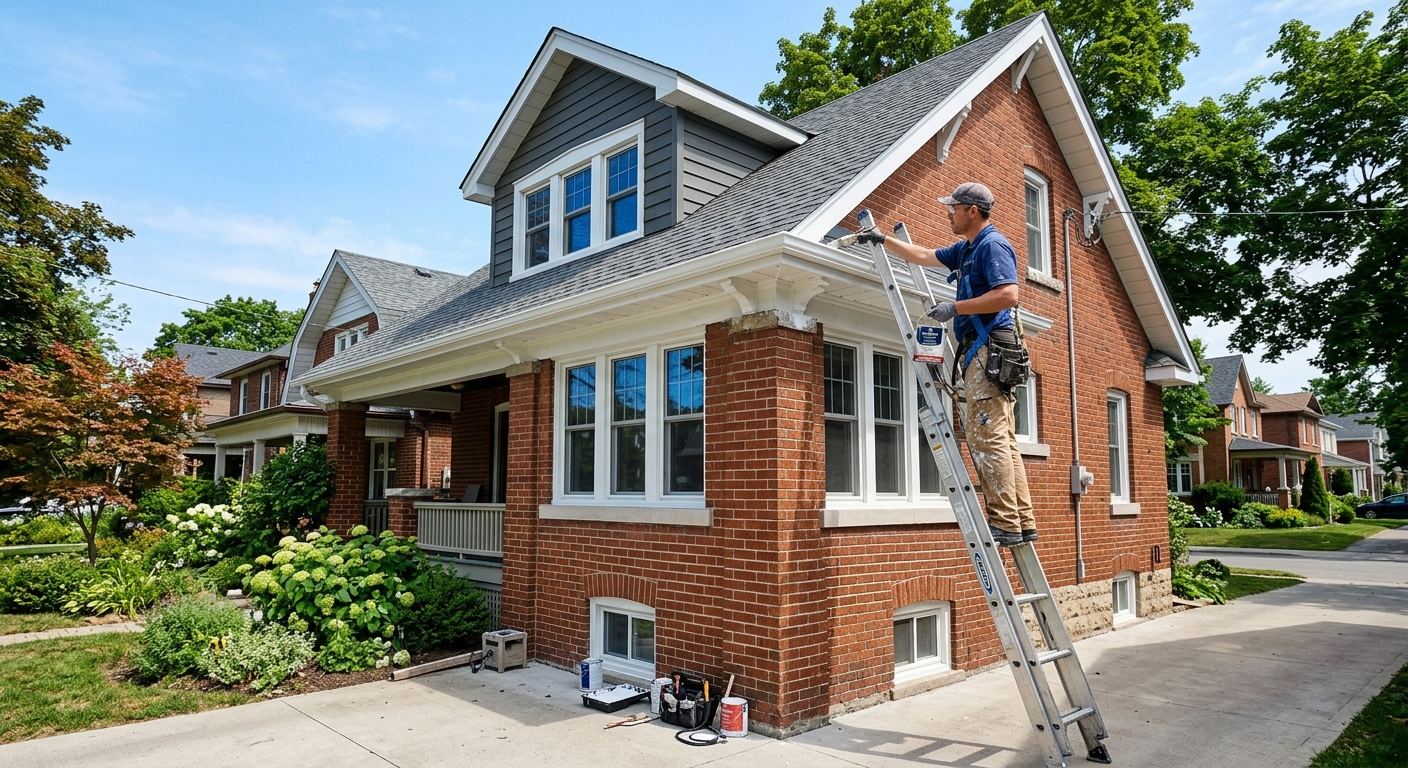
Painting options and costs in Dryden
Dryden homeowners typically have a few solid painting paths, and the right choice comes down to prep needs, timing, and finish expectations. With 7,388 residents and 2,420 homeowner households (Statistics Canada, 2021 Census), most projects here are repaints on long-lived homes—especially since 67.2% of dwellings were built before 1981 (Statistics Canada, 2021 Census). That “older stock” factor matters: older siding, trim, and windows often need more scraping, patching, caulking, and spot-priming before you even start counting colour coats.
In Northwest Ontario, exterior work is tightly constrained by the short warm-weather window (typically late spring through early fall). Rainy days, cooler nights, and fast evaporation affect how long coatings can be worked and how they cure, which compresses scheduling and can raise labour and mobilization costs versus milder regions. Demand also concentrates in summer, so well-qualified crews can book quickly. If you live around McLennan Avenue or the broader residential blocks near the downtown core, you’ll often see contractors in higher demand during the peak season because those streets have frequent access needs, older wood trim details, and recurring repaint cycles.
Below are practical price bands to help you compare options before you request itemized quotes—then we’ll break down why the same scope can land 30–50% apart in the Northwest.
| Service |
What's Included |
Typical Duration |
Price Range |
| Interior — whole home (walls, ceilings, trim) |
Preparation, patching and sanding as needed, caulking, 2-coat wall/ceiling system, primer where required, and paint for accessible trim |
5–10 days |
$4,000 – $8,000 |
| Interior — per room (standard bedroom or living room) |
Prep and protection, patching, primer where needed, 2-coat walls, and paint to trim in the room |
2–4 days |
$900 – $2,500 |
| Exterior — full house (siding, trim, soffits) |
Surface wash, scrape/sand as required, caulking, spot-priming, 2-coat exterior system, and finishing trim and soffits |
1–3 weeks (weather-dependent) |
$3,500 – $10,000 |
| Exterior — trim and accent colours only |
Prep of trim areas, scrape/sand, caulking where needed, prime bare/weathered spots, and 2-coat finish on trim accents |
3–7 days |
$1,200 – $4,500 |
| Kitchen cabinet painting (doors, frames, spray finish) |
Degreasing, full prep and sanding, build-up/spot repair, primer and spray-applied finish, and hardware masking or removal as needed |
5–12 days |
$1,500 – $4,000 |
| Specialty / faux finish (accent wall, texture) |
Surface preparation for the specific technique, test patching, materials and application for the defined accent area |
1–5 days |
$800 – $5,000 |
Prices are estimates only and vary by project scope, site access and material selection.
What affects the price of painting in Dryden
Two quotes for the same “average” repaint can differ by 30–50% across Northwest Ontario and the rest of Ontario because paint price is only part of the job—labour, prep, access, and weather windows do most of the heavy lifting. In our region, the exterior painting season is tightly climate-bound. On most Northwest schedules, you’re typically working late May to early October, and application conditions matter: temperatures must be comfortably above 10°C and rising during painting, and surfaces need to be dry enough to cure correctly. Coastal British Columbia often has a longer calendar but higher humidity and frequent rain, so coatings, mildew-resistant products, and staging for curing still drive costs upward—just for different reasons.
In Dryden specifically, older homes mean more surface prep. Scraping failed coatings, sanding, patching wood or drywall, and spot-priming bare or weathered areas can easily become 50–70% of the labour on a repaint. For example, if you choose a full exterior repaint within the $3,500–$10,000 band, the difference between “paint and go” and “true prep first” often shows up in time spent on caulking and priming. Similarly, interior whole-home work that lands in the $4,000–$8,000 range usually reflects whether trim is included and how much repair and primer is needed, not just the number of rooms.
Concrete local examples: (1) older wood trim that’s rough or splitting usually costs more because it needs more sanding and feathering, and sometimes spot-priming multiple times; (2) if your exterior has multiple paint failures—bubbling, peeling edges, or chalky powder—budget more prep time and more primer. (3) multi-storey facades or tight driveways that limit equipment access can add scaffolding/lift days, which show up quickly in the final number.
| Price Factor |
Why It Matters |
Cost Impact |
| Surface prep — scraping, sanding, patching drywall or wood |
Determines adhesion and how long the new coating will last |
Often the largest cost driver; can add 40–70% to labour on repaints |
| Number of coats — 2-coat system over primer vs. 1 coat over existing |
Coverage, colour uniformity, and durability depend on the correct coat build |
Switching to a true primer+2-coat system can increase cost but reduces callbacks |
| Paint quality tier — contractor-grade vs. premium (Benjamin Moore, Sherwin) |
Premium lines often provide better hiding, easier brushing/spraying, and longer-life binders |
Materials may move up $300–$1,200 on typical jobs; prep largely remains the same |
| Ceilings and trim — adds significant time vs. walls-only |
Cut-in work, masking, and additional coats for trim increase labour time |
Can add 20–40% to interior labour totals |
| Exterior season window — short season raises summer rates |
Weather and curing limits compress demand and raise scheduling pressure |
Late-summer bookings can be priced higher due to limited crew availability |
| Lead-safe precautions — required for pre-1978 homes with lead paint |
Safer handling and containment procedures reduce exposure risk |
May add time and cost for containment, HEPA cleanup, and additional primer steps |
| Surface material — drywall vs. plaster vs. wood vs. stucco |
Different substrates need different primers and sanding methods |
Wrong primer can cause failure; correct matching reduces rework costs |
| Height and access — multi-storey exterior requires scaffolding or lifts |
Access affects safety, equipment rental, and workflow speed |
Can add $500–$2,500+ depending on height and site constraints |
Permits & regulations in Ontario
In Ontario, painting typically does not require a municipal permit for homeowners or contractors. The “permit-like” requirements that come up are usually not about painting itself—they’re about safe work practices and insurance documentation. For homes built before 1978, health guidelines recommend considering lead paint testing before sanding or scraping, and using lead-safe methods if lead is present. That usually means wet methods to reduce dust, HEPA-filtered vacuuming, proper containment and disposal, and careful cleanup. While this is not legally mandated for homeowners in the same way as regulated trade work, it’s standard professional practice for contractors to protect occupants and workers.
What DOES require a permit (or other approvals) is uncommon for straightforward painting. Painting itself typically does not trigger permitting; however, changes that involve structural alterations, changes to fire separations, or any electrical/mechanical work are different and may require permits. If your scope includes things like repairing/replacing damaged building components that affect building envelope performance, check with the building department for that portion.
Step-by-step for Dryden homeowners: (1) confirm the contractor’s Ontario licence/registration status using the relevant Ontario business and professional registry (where applicable for the trade), (2) ask for a current certificate of liability insurance showing the policy is active and sufficient, (3) verify WSIB/WCB coverage (workers’ compensation) with proof of coverage, and (4) insist on a written contract that clearly states paint brand/line, sheen, number of coats, and the prep tasks included (scraping/sanding/priming/caulking/disposal).
Interior vs exterior painting — getting the best result in Dryden
In Dryden’s Northwest Ontario climate, the best-looking job isn’t the one with the fanciest brand—it’s the one with the right prep and the right system for the surface and environment. For interiors, surface prep is king: filling dents, sanding smooth, and priming repairs prevent flashing, peeling, and uneven sheen. Sheen choice matters by room: flat/eggshell hides imperfections, but semi-gloss and satin are typically more forgiving in higher-touch areas. Also, two coats over a properly primed surface almost always outlast one “heavy” coat, because the paint film builds consistently and bonds evenly.
For exteriors, prep and moisture management drive longevity in our weather swings. Scrape loose material, sand feather edges, wash, and address failed coatings before finish paint. Caulking is not optional—good exterior caulk joints before painting help prevent water ingress behind trim and siding, which is a common trigger for peeling. Primer selection also changes by substrate: wood may need a bonding primer; older, chalky or weathered areas benefit from the correct adhesion primer; and fibre cement/other surfaces may require different primer compatibility. In Ontario, the focus is usually temperature stability and dry-cure windows; Coastal BC’s mildew-resistant strategies exist there due to humidity, but Northwest jobs mainly fail when coatings can’t cure properly or when moisture pathways aren’t sealed. For older pre-1978 homes, lead-safe precautions are essential during scraping/sanding.
Budget decisions should be practical. For example, choosing cabinet painting (within the $1,500–$4,000 band) instead of replacing kitchen cabinetry can be a justified value move—provided the doors are prepped properly and the finish is sprayed and cleared for durability. If the box/frames are severely damaged, repainting won’t fix structural issues; that’s when replacement (or selective replacement) becomes the better long-term choice.
| Project Type |
Key Prep Step |
Recommended Coats |
Price Band |
| Interior — fresh drywall (new construction) |
Seal drywall and spot-prime joints to prevent flashing |
Primer + 2 coats |
$4,000 – $8,000 (whole home typical) |
| Interior — repaint (good condition, no repairs) |
Light scuff-sand and clean; caulk minor gaps |
1–2 coats as needed; usually 2 for best uniformity |
$900 – $2,500 (per room typical) |
| Interior — repaint (patching and priming needed) |
Prime repaired areas to match absorption before topcoat |
Primer + 2 coats on patched zones (often 2 overall) |
$1,100 – $3,000 (per room typical) |
| Exterior siding (wood or fibre cement) |
Scrape and feather failing paint, then prime bare/weathered spots |
2-coat system over primer |
$3,500 – $10,000 (full house typical) |
| Exterior trim and accents only |
Degrease, scrape, sand, and caulk edges before finish coats |
2 coats on properly primed trim |
$1,200 – $4,500 |
| Kitchen cabinets (spray finish) |
Degrease and sand thoroughly; prime for adhesion |
Primer + 2 finish coats (spray) |
$1,500 – $4,000 |
How to choose a painting contractor in Dryden
Choosing well in Dryden means verifying three things up front: insurance, workers’ compensation, and a clear written scope. For liability insurance, ask for a current certificate showing the policy is active and that the contractor’s coverage is appropriate for painting work on occupied properties. For WSIB/WCB, confirm they carry workers’ compensation coverage and provide proof of coverage—this protects you if there’s an injury on site. If you’re comparing contractors, insist on itemized quotes, not just a lump sum.
Get 2–3 itemised written quotes with a breakdown of labour and materials for each major task: surface prep (scrape/sand/repair), priming, caulking, number of coats, trim/ceiling coverage, and cleanup/disposal. Pay close attention to what’s excluded: will they remove/reattach hardware, protect landscaping, include pressure washing or just brushing, and repair failing caulk or rot? Also confirm whether disposal of paint chips is included and how they protect windows, doors, and flooring from drips and overspray.
Warranty matters too: ask for a workmanship warranty length and what it covers (adhesion failure due to incorrect prep, peeling caused by missed prep, etc.). Ask about the manufacturer warranty on product and whether it transfers to you. For payment scheduling, never pay more than 10–15% upfront; hold back a portion until you’ve confirmed the job is complete and cleaned. Get the start date and completion estimate in writing, especially for exterior jobs where weather can shift timelines.
- Ask for certificate of liability insurance (active policy) and verify coverage amounts.
- Request proof of WSIB/WCB coverage and confirm it’s current.
- Compare itemized labour + materials—not only totals—across quotes.
- Confirm the prep scope: scraping, sanding, patching, priming, and caulking tasks.
- Clarify the coat count (primer + 2-coat system) and sheen selections by surface.
- Ensure cleanup/disposal is included (paint chips, sanding dust, masking removal).
- Verify protection plan for floors, landscaping, windows, and vents.
- Ask whether hardware is removed or masked and who handles reinstallation.
- Request a written schedule with weather contingency for exterior work.
- Confirm warranty terms in writing (workmanship and product coverage details).
- Keep upfront payment to 10–15% and hold back until final walkthrough.
- Require lead-safe handling approach for pre-1978 trim areas if applicable.
Red flags I see in Dryden include: quotes that “sand later” (no detailed prep), no written warranty, skipping itemized labour/materials, asking for large upfront payments, and unclear insurance/WSIB documentation. If a contractor won’t put scope, coat counts, and surface prep specifics in writing, that’s a high-risk sign.
Frequently asked questions — painting in Dryden
Can I paint my house exterior in spring or fall in Dryden?
You can often paint in spring or early fall in Dryden, but success depends on temperature and curing time. Northwest Ontario exterior painting is typically practical from late May through early October, when surfaces can stay warm enough to apply and cure properly. If nights drop quickly or the surface stays damp from fog or rain, coatings can fail early (blistering, poor adhesion, or peeling). Spring work is best after consistent dry weather and warmer day temps; fall work is best only when you can secure a multi-day window with day temperatures staying comfortably above 10°C and rising during application. For pre-1978 homes (which are common in Dryden), plan prep conservatively, especially if scraping is needed.
How do I choose a painting contractor in Dryden?
Start by verifying coverage and then comparing written scopes. Ask each contractor for a current certificate of liability insurance and proof of WSIB/WCB coverage; don’t accept verbal assurances. Next, request 2–3 itemised quotes showing labour and materials, including the prep tasks (scraping, sanding, patching, caulking, and spot-priming) and the exact coat plan. For a full exterior, compare whether they’re building a true 2-coat system over primer—this is what keeps most work in the $3,500 – $10,000 exterior range realistic. Finally, confirm warranty terms and the payment schedule (keep upfront to 10–15% and hold back until completion). In older Dryden neighbourhoods, lead-safe practices for pre-1978 trim are also a key selection factor.
How many coats does an exterior repaint need in Dryden?
Most exterior repaints in Dryden should be planned as a primer plus a 2-coat finish system, because it supports even coverage and long-term adhesion through our weather swings. If existing coating is sound and compatible, some contractors may reduce scope—but if there are peeling edges, chalking, or bare wood spots, those areas require spot-priming and consistent finish coats. The total number of coats can vary slightly depending on substrate condition and the product’s coverage, but the standard outcome for a durable job is 2 finish coats over primer where prep demands it. This is one reason good exterior quotes within the $3,500 – $10,000 band often come from prep differences, not paint cost alone.
What is the best primer for older Dryden homes?
There isn’t a single “best” primer for every older home in Dryden—it depends on what’s underneath and what failed. For pre-1978 homes (common locally), the key is first dealing with the condition: whether the surface is chalky, peeling, bare wood, or previously painted with coatings that need adhesion work. Typically, contractors use an adhesion/bonding primer for difficult-to-coat surfaces and spot-priming for bare or weathered areas after scraping and sanding. If the surface is contaminated (chalk, loose paint dust, or water-soluble grime), primer won’t perform unless the prep is correct. A quality primer selection is one reason thorough prep can push exterior projects toward the higher end of the $3,500 – $10,000 range—but it reduces premature peeling callbacks.
Should I paint or wallpaper my Dryden home?
In Dryden, painting is usually the safer, more forgiving choice for most homeowners—especially if you have older walls that may have minor cracks, uneven texture, or previous patchwork. Wallpaper can look great, but it demands a very consistent wall surface, and moisture management still matters. If you’re dealing with plaster/drywall joints that have been repaired, paint often hides small variations better with the right primer and fill/sand plan. That said, wallpaper may be a good option for a single accent wall if your goal is a specific pattern and you’re ready for meticulous prep. Many homeowners prefer paint for whole-home timelines, because the faster refresh can be scheduled within the limited windows professionals manage for exterior work and because interior prep is generally easier to control.
How do I fix peeling exterior paint in Dryden?
Peeling exterior paint must be fixed by removing the failure and preparing the edges—simply painting over the peeling areas will usually fail again. In Dryden, the weather swings and freeze-thaw cycles can lift compromised coatings, so prep is critical: scrape off loose material, sand feather edges, wash the surface, then spot-prime bare or weathered zones before applying finish coats. Caulking is also important around trim and joints to prevent water ingress that drives re-peeling. If your home is pre-1978, ensure lead-safe practices are followed during scraping/sanding (professional contractors typically use containment and HEPA cleanup). For a full exterior repaint, homeowners commonly see pricing around $3,500 – $10,000, mainly because prep and priming time determine how long the finish will last.