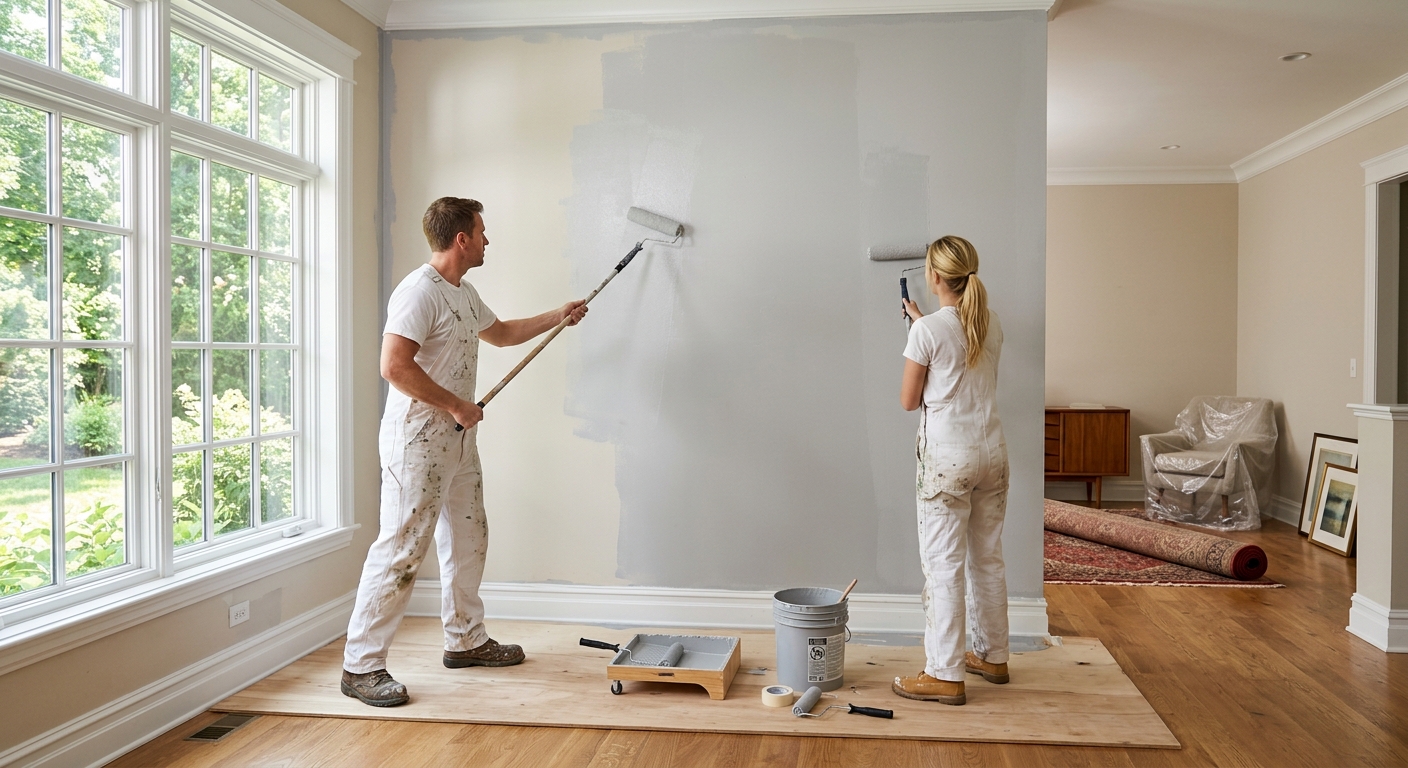
Painting options and costs in Brantford
Brantford homeowners usually have a few clear choices when it comes to painting scope, but the final cost depends heavily on prep and the condition of the surface. With 62.8% of homes in the wider Brantford area built before 1981, many projects start with older drywall, aged trim, and weathered siding—often meaning more scraping, patching, sanding, and priming than people expect. That matters because Hamilton–Niagara Peninsula jobs are also shaped by a four-season, continental climate: exterior work is constrained to a late spring–early fall window, when temperatures stay warm enough for proper adhesion and curing and when rain doesn’t keep interrupting drying. In practice, this tight window compresses scheduling demand, so exterior pricing can push toward the higher end of the local range during peak summer, especially for multi-storey homes that need lifts or scaffolding.
Inside, painters can usually work longer into the year because drying times and lighting conditions are more predictable. Even so, demand still rises in summer, and older housing stock is common—so “walls and ceilings” can quickly expand into trim work, caulking repairs, or spot-priming. In neighbourhoods like West Brant, where many residents update long-lived family homes, you’ll often see repaint schedules tied to spring renovations and summer home maintenance.
Below is a practical comparison of common painting options and typical durations to help you translate a quote into apples-to-apples decisions.
| Service |
What's Included |
Typical Duration |
Price Range |
| Interior — whole home (walls, ceilings, trim) |
Protect floors/furnishings, prep and spot-prime, paint walls and ceilings, caulk where needed, paint trim/doors (standard trim profile), clean-up |
5–12 days |
$2,000–$5,500 |
| Interior — per room (standard bedroom or living room) |
Prep, patching (minor), sand, prime as required, paint walls and ceiling, basic trim touch-ups |
1–3 days |
$500–$1,800 |
| Exterior — full house (siding, trim, soffits) |
Surface wash/degrease (as required), scrape/sand, caulking, prime bare spots, paint siding, trim, soffits/eaves, weatherproof touch-ups |
1–3 weeks |
$3,500–$8,000 |
| Exterior — trim and accent colours only |
Prep and prime accents/trim, caulk where needed, paint fascia/eaves/window trim/doors (excludes siding repaint) |
3–7 days |
$1,500–$4,500 |
| Kitchen cabinet painting (doors, frames, spray finish) |
Degrease, remove/label hardware as agreed, sand, prime, spray coats, light re-assembly, hardware reinstall (if provided) |
5–10 days |
$1,200–$4,500 |
| Specialty / faux finish (accent wall, texture) |
Surface prep, basecoat, specialty technique, clear/topcoat as needed, optional colour matching |
2–7 days |
$1,000–$6,000 |
Prices are estimates only and vary by project scope, site access and material selection.
What affects the price of painting in Brantford
Even when two Brantford homeowners describe the “same” job, quotes across the Hamilton–Niagara Peninsula and Ontario can diverge by 30–50%. The usual driver isn’t the topcoat—it’s how much prep, caulking, priming, and labour the job demands after you factor in older surfaces and local weather interruptions. On the exterior side, Ontario’s exterior season runs roughly late May to early October, and painters must apply paint when temperatures are warm enough and surfaces stay dry enough for curing. Coastal BC may offer a longer window, but high humidity and frequent rainfall can make exterior timing more delicate; Alberta can be longer in some stretches, but you still plan around temperature swings. In Southern Ontario, demand concentrates quickly in summer, so scheduling pressure can raise rates.
Older homes throughout this region also increase prep intensity. With 62.8% of homes built before 1981, it’s common to find chalky paint, failing caulk lines, and worn wood trim that needs scraping and patching before coating. In many repainting projects, surface prep can become the biggest labour line item—often 50–70% of total labour. For example, a siding repaint that starts near the $1,500–$8,000 exterior band can move toward the higher end if we uncover widespread caulk failure or damaged fascia that must be repaired and primed thoroughly. Conversely, an interior refresh in a well-maintained home may stay close to the lower end of the $500–$5,000 interior band because prep is quicker and fewer surfaces need primer.
Concrete Brantford scenarios that change cost fast: (1) whether you need scaffolding/lifts due to height and rooflines, (2) how much trim and door glazing requires masking and precision cut-ins, and (3) whether rain delays push exterior work into peak scheduling days. Those details are why like-for-like quotes matter.
| Price Factor |
Why It Matters |
Cost Impact |
| Surface prep — scraping, sanding, patching drywall or wood |
Prep controls adhesion and smoothness; old paint and defects must be corrected before coating |
Often +20% to +60% depending on condition |
| Number of coats — 2-coat system over primer vs. 1 coat over existing |
Coverage and hide depend on primer use, stains, and substrate porosity |
Can change cost by +10% to +35% |
| Paint quality tier — contractor-grade vs. premium (Benjamin Moore, Sherwin) |
Better pigments and durability can reduce rework and improve stain blocking |
Materials +5% to +25% (labour often dominates) |
| Ceilings and trim — adds significant time vs. walls-only |
Cutting in, masking, and leveling/feathering adds labour |
Typically +15% to +40% |
| Exterior season window — short season raises summer rates |
Weather and scheduling constraints compress availability |
Often +10% to +30% in peak weeks |
| Lead-safe precautions — required for pre-1978 homes with lead paint |
Testing/containment/disposal increases labour and materials if lead is present |
Can add +10% to +50% depending on findings |
| Surface material — drywall vs. plaster vs. wood vs. stucco |
Different substrates absorb differently and require different primers/feathering |
Varies widely; +10% to +40% |
| Height and access — multi-storey exterior requires scaffolding or lifts |
Access work takes time and affects safety requirements |
Often +15% to +45% |
Permits & regulations in Ontario
In Ontario, painting itself generally does not require a permit for residential work. Where homeowners need to be careful is with surface preparation on older homes. For properties built before 1978, health guidelines recommend testing for lead paint before sanding, scraping, or using power tools. If lead is present, professional lead-safe work practices are typically used: wet methods to reduce dust, HEPA vacuuming, contained work areas when appropriate, and proper disposal of debris and filters. This isn’t usually mandated for homeowners in the same way it is for licensed/regulated trade activities, but it is standard practice for contractors because lead-contaminated dust is the main risk.
What DOES require permits in Ontario is not painting paint itself—it’s situations like structural repairs that trigger building permits, work that changes building systems (like some electrical/plumbing), or regulated abatement activities depending on scope. For typical painting, you should focus on contractor compliance and documentation rather than a paint permit.
To verify a contractor in Brantford, do these steps: (1) confirm licensing/credentials through the relevant Ontario business listings and the contractor’s company details, (2) ask for a current certificate of insurance (liability) showing it includes your address/project, (3) request proof of workers’ compensation coverage (WSIB), and (4) insist on a written contract listing paint brand, sheen, number of coats, and prep/disposal scope. For lead-risk homes, ask whether they plan testing, what containment looks like, and whether they provide documentation for their lead-safe approach.
Interior vs exterior painting — getting the best result in Brantford
The difference between a long-lasting paint job and a premature failure in Brantford is mostly preparation, not “which brand is best.” For interiors, I look first at the surface: filling, sanding, priming spots, and creating a consistent substrate. A wall can look fine at a distance but fail if it’s chalky, porous, or unevenly sealed. Sheen choice matters too: in hallways and family rooms, a washable finish (often eggshell or satin depending on wall texture) tends to hide scuffs better than flat paint, while bathrooms and trim may benefit from higher performance coatings. Two coats over a properly applied primer almost always outlast one thick coat—especially when switching colours or covering stains.
For exteriors in Ontario’s four-season conditions, prep is even more critical. Caulking before painting helps prevent water ingress behind trim and along joints; painting over failed caulk without removing/repairing it is a common reason for early peeling. Primer selection also matters: different substrates (bare wood, older latex-over-latex, masonry, fibre cement) need appropriate primer systems to lock down chalking and improve adhesion. While mildew-resistant products are a bigger focus in wetter climates, our region still benefits from coatings designed to handle moisture and early-season humidity—particularly near the Niagara Escarpment and Lake Ontario influence.
Cabinet painting is where budgeting can make sense: repainting can cost materially less than replacement. For example, if replacing mid-range kitchen cabinets would push beyond the typical painting specialty band, a spray-finish cabinet job commonly lands in the $800–$4,500 cabinet/trim range—often a justified alternative when boxes are sound and doors are the main issue. For pre-1978 homes, interior work that involves sanding or scraping should also follow lead-safe practices.
| Project Type |
Key Prep Step |
Recommended Coats |
Price Band |
| Interior — fresh drywall (new construction) |
Prime bare drywall and feather joints before finish coats |
2 coats over primer |
$800–$3,200 |
| Interior — repaint (good condition, no repairs) |
Clean, lightly sand, spot-prime any marks |
2 coats |
$500–$2,200 |
| Interior — repaint (patching and priming needed) |
Patch, sand smooth, prime repaired areas and stains |
2 coats (with primer where required) |
$900–$4,000 |
| Exterior siding (wood or fibre cement) |
Scrape loose paint, caulk joints, prime bare/repair areas |
2 coats over primer |
$3,500–$8,000 |
| Exterior trim and accents only |
Mask carefully, prep edges, prime bare spots, caulk trim lines |
2 coats over primer |
$1,500–$4,500 |
| Kitchen cabinets (spray finish) |
Dhesegrease and degloss, sand thoroughly, prime for adhesion |
Primer + 2 finish coats |
$1,200–$4,500 |
How to choose a painting contractor in Brantford
Start by verifying the contractor’s compliance and track record in Ontario. For licensing and eligibility, ask for the company details and check business listings tied to the contractor’s legal name. Next, request a certificate of liability insurance that lists your address/project and shows adequate coverage for residential work. Then ask for proof of WSIB (workers’ compensation). If a contractor can’t provide these documents quickly, treat that as a major warning sign—painting is labour-intensive and site accidents can become expensive fast.
Get 2–3 itemised written quotes rather than lump sums. A strong quote breaks labour and materials by line items: prep scope (scrape/sand/patch/prime), number of coats, surface protection/masking, trim detail work, caulking, and clean-up/disposal. Pay attention to what’s excluded—common exclusions include window/door hardware removal, extensive drywall repair, lead-safe testing/containment (for older homes), and furniture moving (especially in older Brantford layouts).
Warranty matters in real life. Ask for the workmanship warranty length (how long they’ll return for defects), whether it covers peeling/flaking caused by prep failures, and whether product/manufacturer warranty is separate. Also confirm if warranties are transferable if you sell your home.
On payment schedule: avoid large upfront payments—generally keep it to 10–15% upfront, then use holdback until completion and touch-ups are signed off. Finally, insist on a written timeline with an expected start date and completion estimate that reflects Brantford’s weather realities.
- Provide insurance certificate and WSIB proof before work begins
- Use an itemised quote with labour + materials breakdown (not only totals)
- Clearly lists paint brand, line, and sheen (flat/eggshell/satin/semi-gloss)
- States exactly how many coats, and where primer is required
- Specifies surface prep scope (scrape/sand/patch/caulk) and what counts as “minor repair”
- Includes protection (floors, landscaping, electrical fixtures) and clean-up/disposal
- Addresses lead-safe testing/containment approach for pre-1978 homes
- Shows how colour matching will be handled (swatches, prior sample approval)
- Names who supplies caulking, primers, patching compounds, and removal of peeling paint
- Provides a written start date, weather contingency plan, and completion estimate
- Includes a workmanship warranty in writing, with defect handling process
- Keeps upfront payment within 10–15% and confirms holdback terms
Red flags I see in Brantford: a contractor who only offers a single “cash price” without line items, refuses to provide insurance/WSIB documentation, won’t specify prep steps or number of coats, pressures you to pay most of the balance up front, or dismisses lead-safe precautions for pre-1978 homes when sanding/scraping is involved.
Frequently asked questions — painting in Brantford
How much does interior painting cost per room in Brantford?
In Brantford, most homeowners budgeting for a single room (like a standard bedroom or living room) should expect interior-per-room pricing roughly in the $500–$1,800 range. The swing up or down usually comes from prep: whether the walls need patching and priming, how much trim/door work is included, and whether there are visible stains or texture differences that require extra sanding and sealing. If your job stays in the “repaint good condition” category, it often sits closer to the lower end. If repairs are needed (cracks, holes, uneven drywall joints) and primer is required, the cost moves toward the middle of the band. In older Brantford homes—there are many pre-1981 builds (Statistics Canada, 2021 Census)—prep time can expand quickly, which is why itemised quotes matter.
When is the best time for exterior painting in Brantford?
The best time for exterior painting in Brantford is during the late spring to early fall window when surfaces can stay dry and temperatures are suitable for curing. In practical terms, many exterior projects are scheduled from late May through early October, with painters aiming for stretches of warm, stable weather. If rain or cool evenings repeatedly interrupt drying, adhesion and the final finish can suffer—so reputable crews plan around forecast patterns, not just calendar dates. Because the season is shorter here than in some parts of Ontario, summers can be busy; getting on the schedule early often helps manage cost. Interior projects can be scheduled more flexibly if weather is poor, but exterior typically follows the weather window.
How many coats of paint do I need?
For most repainting jobs in Brantford, you should plan on a 2-coat system when switching colours, covering stains, or working with surfaces that need primer. The key is not simply “two coats”—it’s whether the correct primer is used in the right places. For interiors, two finish coats over properly primed repairs usually produces better uniformity and durability than one thick coat. For exteriors, a two-coat system over primer is the typical expectation as well, especially when you have scraped areas, weathered wood, or repaired caulk lines. If you’re quoted only one coat, ask what primer coverage is included and whether the existing coating is in excellent condition.
What paint is best for Brantford's climate?
Brantford’s climate—four-season and moisture-influenced—means exterior coatings need durability, good adhesion, and the right system for the substrate. For most homes, that translates to correct primer selection plus an exterior topcoat designed for Ontario conditions, with mildew resistance as a practical benefit when humidity is high near the Escarpment and Lake Ontario influence. On the interior side, the “best” paint depends on room use and sheen: washable finishes like eggshell or satin tend to handle daily scuffs better than flat, especially in hallways and family areas. Also, choose product quality that matches your prep level—because even premium paint won’t perform well if chalky surfaces or failed caulking aren’t addressed first. If you’re comparing quotes, ask which brands and lines are being used and whether they align with your substrate and sheen needs.
How long does exterior paint last here?
Exterior paint longevity in Brantford commonly lands in the mid-range when prep is solid and conditions are favourable—think several years to beyond a decade depending on substrate condition, workmanship, and product system. The biggest determinants are whether scraping removes loose/chalking paint, whether caulking and flashing details prevent water ingress, and whether primer is correctly matched to wood/stucco/fibre cement. Homes built before 1981 (Statistics Canada, 2021 Census) often have older trim profiles, more caulk joints, and more variable surface condition, so timelines can be shorter if prep is rushed. If you’re considering a repaint near the lower end of the exterior band (for example, $3,500–$8,000 for a full exterior), make sure the quoted prep and caulking scope are included—because that’s what protects the investment.
Should I paint or replace my cabinets?
In many Brantford kitchens, painting cabinets (often spray-finish for doors) is a smart alternative when the cabinet boxes are structurally sound and doors are the main visual problem—warping, fading, or outdated colour. Cabinet painting typically falls in the $1,200–$4,500 range depending on quantity, prep difficulty, and whether hardware is removed/labelled. Replacement can be dramatically more expensive and involves demolition, disposal, and longer disruption. The deciding factors are: door condition (are they delaminating?), box stability, and whether there’s heavy grease or moisture damage that would require more intensive prep. If your cabinets are solid but dated, painting is often the cost-effective route; if the frames are failing or the layout is changing, replacement becomes more reasonable.