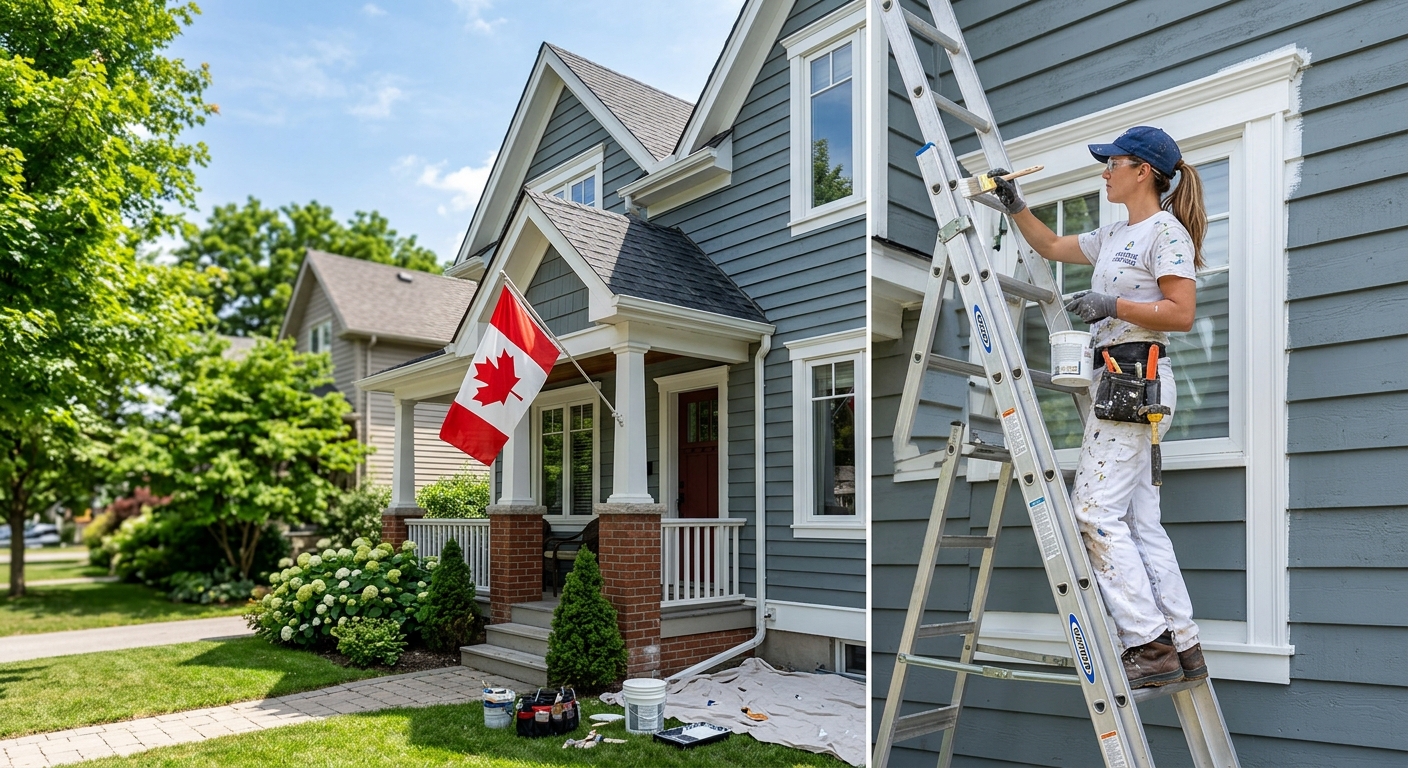
Painting options and costs in Bolton
Bolton homeowners usually have a few paint paths—refreshing interiors, updating trim, or tackling a full exterior repaint—and the costs are mainly driven by preparation and timing. In Bolton’s housing mix (part of the wider Toronto economic region), many homes are older; pre-1980 properties are common, and that typically means extra labour for scraping, sanding, patching, caulking and priming, plus careful handling around older trim, railings and window areas. For context, Bolton’s population is 26,795 (Statistics Canada, 2021 Census), and that steady local demand keeps crews booked during the short “ideal” exterior windows.
In the Greater Toronto Area, exterior painting is tightly climate-dependent. Contractors typically aim for late May through June and again September into mid-October, when temperatures stay above about 10°C for proper adhesion and curing. Demand spikes in June–August can push exterior pricing 10–15% higher, especially for full-house jobs with scaffolding, detailed trim work and multiple paint layers.
Within Bolton, interior repainting is in steady demand around the downtown/Highway 50 corridor and surrounding established neighbourhoods where homeowners often renovate between school-term moves and before summer events. If your goal is a true “like-new” look, budgets often land closer to the higher end of local bands once prep is included; if you’re doing targeted areas, you can stay nearer the lower end. Use the table below to compare typical scopes, durations and pricing, then we’ll break down what moves the needle for your specific surfaces.
| Service |
What's Included |
Typical Duration |
Price Range |
| Interior — whole home (walls, ceilings, trim) |
Protect flooring, prep and patch as needed, sand, prime stains/spots if required, 2 coats on walls/ceilings, caulk and paint trim/doors, cleanup and final touch-ups |
5–10 working days |
$2,000–$6,000 |
| Interior — per room (standard bedroom or living room) |
Prep and spot patch, sand, 2 coats on walls (and 1 coat where ceilings are already in good condition unless specified), caulk edges, paint trim as scheduled |
1–3 working days |
$400–$1,600 |
| Exterior — full house (siding, trim, soffits) |
Pressure wash as appropriate, scrape/sand loose material, caulk joints, prime bare spots, 2-coat exterior system, paint trim/soffits and accessory areas, final cleanup |
3–8 working days (weather-dependent) |
$2,800–$8,000 |
| Exterior — trim and accent colours only |
Mask and protect surfaces, prep trim/accent areas, scrape/sand, prime bare metal/wood as required, 2 coats on trim/accent colours, cleanup |
1–4 working days (weather-dependent) |
$1,500–$4,800 |
| Kitchen cabinet painting (doors, frames, spray finish) |
Full degrease/clean, hardware removal, scuff/sand, prime (including bonding primer where needed), spray finish, re-install and touch-ups |
4–10 working days |
$1,200–$4,000 |
| Specialty / faux finish (accent wall, texture) |
Surface assessment and prep, base coat and specialized texture/faux technique, protective topcoat as specified, cleanup and final inspection |
2–6 working days |
$600–$5,000 |
Prices are estimates only and vary by project scope, site access and material selection.
What affects the price of painting in Bolton
In Bolton (and across the Toronto market), two contractors can quote the same “two-coat paint job” and still differ by 30–50%. The gap usually isn’t the paint—it’s prep time, how much masking/protection they plan, how they handle older surfaces, and whether the quote assumes the same level of repairs. A full repaint on a pre-1980 home often needs scraping, sanding and caulking before any finish coat, and that prep can account for 50–70% of labour on repainting projects.
Exterior pricing is also influenced by the region’s short, climate-bound window. In Ontario, the practical exterior season is roughly late May to early October, when temperatures are above about 10°C and rising so coatings can adhere and cure properly during application. Rain and humidity spikes don’t just slow crews—they can force additional priming or re-coating, which is why June–August can run 10–15% higher in the GTA when demand is concentrated into limited “ideal” weeks. Unlike coastal BC, the GTA’s main constraints are frost, rain and humidity fluctuations rather than year-round dampness, so product selection focuses on adhesion and durability for our freeze-thaw transitions.
Concrete examples from Bolton: if your siding has blistering or peeling at transitions (under eaves, near windows, at trim edges), expect extra scraping and spot-priming—costs can climb toward the exterior band of $2,800–$8,000 instead of stopping near $1,500–$4,800 for trim-only work. If you have high-access soffits or a multi-storey layout, scaffolding/lift time adds labour and coordination. And if you’re repainting older wood or metal with multiple paint layers, the sanding and caulking time can add hundreds to the labour line even before a drop of finish paint is sprayed.
| Price Factor |
Why It Matters |
Cost Impact |
| Surface prep — scraping, sanding, patching drywall or wood |
Prep quality determines adhesion; failing to clean, feather or patch leads to early peeling or flashing through |
Large: can be 50–70% of labour on repainting |
| Number of coats — 2-coat system over primer vs. 1 coat over existing |
Coverage and uniform sheen require a full system; “one coat” often means more touch-ups later |
Medium: typically shifts labour/material by 15–30% |
| Paint quality tier — contractor-grade vs. premium (Benjamin Moore, Sherwin) |
Higher solids and better hide reduce rework; premium lines often flow and level more cleanly |
Medium: can move price by 5–20% depending on sheen and coverage |
| Ceilings and trim — adds significant time vs. walls-only |
Ceilings need extra protection and edging; trim needs caulking, sanding and careful cut-ins |
Large: adds labour hours on interior and exterior |
| Exterior season window — short season raises summer rates |
Limited “ideal” weeks concentrate demand; schedule pressure can increase mobilization cost |
Medium to large: often 10–15% during peak weeks |
| Lead-safe precautions — required for pre-1978 homes with lead paint |
If lead is present, contractors use wet methods, HEPA vacuuming and proper disposal to reduce exposure |
Medium: adds containment and cleanup time |
| Surface material — drywall vs. plaster vs. wood vs. stucco |
Absorbency and substrate chemistry change primer choice, adhesion needs and prep method |
Medium: substrate can change prime/patch time significantly |
| Height and access — multi-storey exterior requires scaffolding or lifts |
Access affects safety, setup time and the ability to prep uniformly along edges and trim lines |
Large: can add mobilization and extended labour days |
Permits & regulations in Ontario
For most painting work in Ontario, you do not need a permit. Repainting interiors, painting exteriors, and updating trim are generally “normal home improvement” tasks that don’t require municipal permits. Where the rules change is around specific hazardous-material precautions—not the permit process. For homes built before 1978, health guidelines recommend testing for lead paint before sanding or scraping, and following lead-safe work practices if lead is present (wet methods, HEPA vacuuming, proper bagging/disposal and containment where needed). This is not legally mandated for homeowners in the same way it is for regulated workplace scenarios, but it’s standard professional practice for contractors to protect occupants and workers.
Instead of permits, you should focus on contractor compliance: confirm they carry liability insurance and WSIB/WCB workers’ compensation coverage. Then insist on a written contract that clearly states the paint brand and sheen, the number of coats, and the exact surface preparation included (pressure washing where appropriate, priming requirements, caulking, and how prep waste/disposal is handled).
Step-by-step for Bolton homeowners: (1) Ask for a copy of their WSIB/WCB clearance or coverage confirmation and check it matches the contractor’s legal name. (2) Request their certificate of insurance for general liability and verify the coverage amount and expiry date. (3) Verify their Ontario business details and contact information align with the quote and contract paperwork. (4) Confirm the job scope in writing before payment—this avoids disputes about exclusions like rotten wood replacement, advanced repairs, or lead-related containment.
Interior vs exterior painting — getting the best result in Bolton
The difference between a paint job that looks great for years and one that fails early in Bolton is usually preparation, not “brand vs brand.” For interiors, surface prep matters most: filling and sanding patch edges, priming stains or repaired drywall properly, and cleaning off dust before coats. Sheen choice is also critical by room—flat/fuller matte hides wall imperfections, while eggshell and satin handle higher touch areas better. In practical terms, two coats over a proper primer consistently outlast one thick coat, because proper primer controls absorption and helps topcoat bond evenly.
For exteriors, the climate makes prep non-negotiable. In Ontario, coatings experience freeze-thaw, rain cycles and humidity swings during the season; caulking before painting helps prevent water ingress behind trim and at joint lines. Primer selection depends on substrate (wood, fibre cement, existing coating condition, and whether metal needs bonding). A “thin primer” approach can lead to adhesion failure, especially around window frames and soffits where moisture is more frequent. Unlike BC, you don’t usually need a mildew-focused strategy for year-round dampness—but you do need a system that can handle our rain/humidity spikes and cure reliably during work windows.
Cabinet painting is a common budget alternative to replacement: it can deliver a near-renovation look without demolition and with faster turnaround. For example, if replacing kitchen cabinets would run well beyond typical painting budgets, a spray-finish cabinet project often lands in the cabinet band of $1,200–$4,000. If your exterior is failing at trim edges, correcting prep and sealing those joints is money well spent—skipping scraping/priming can make a “trim and accents” plan of $1,500–$4,800 far more expensive after rework.
| Project Type |
Key Prep Step |
Recommended Coats |
Price Band |
| Interior — fresh drywall (new construction) |
Prime to control absorption and raise the surface uniformly before finish coats |
Primer + 2 finish coats |
$800–$2,500 |
| Interior — repaint (good condition, no repairs) |
Wash/sand lightly, spot prime only for stains or scuffs, then feather edges |
1–2 coats finish (usually 2 for best uniformity) |
$400–$1,800 |
| Interior — repaint (patching and priming needed) |
Patch, sand, then prime repairs and any nicotine/marker/stain areas |
Prime repairs + 2 finish coats (or 2 system where coverage requires) |
$600–$2,800 |
| Exterior siding (wood or fibre cement) |
Scrape and feather loose paint, caulk joints, and prime bare spots and problematic areas |
Primer where required + 2 exterior coats |
$2,800–$8,000 |
| Exterior trim and accents only |
Mask precisely and prep edges to stop water tracking and adhesion failures at caulk lines |
Prime required areas + 2 finish coats |
$1,500–$4,800 |
| Kitchen cabinets (spray finish) |
Degrease thoroughly and bond-prime to prevent peeling; scuff-sand between steps |
Bond primer (where needed) + 2 spray coats (system varies by product) |
$1,200–$4,000 |
How to choose a painting contractor in Bolton
Start by verifying compliance and coverage. In Ontario, painting contractors should be able to provide proof of liability insurance (so you’re not exposed if something is damaged) and WSIB/WCB workers’ compensation coverage (so you’re not responsible if a worker is injured). For Bolton homeowners, the practical check is simple: ask for their certificate of insurance and confirm it’s current and issued in the correct legal business name; request their WSIB/WCB clearance or coverage documentation and verify the status aligns with their quote. If you can’t get clear documentation up front, that’s a major warning sign.
Next, get 2–3 itemised written quotes—not just a lump sum. You want a labour + materials breakdown (paint brand/line, primer type, number of coats, prep tasks, and any allowances). Read the scope carefully for exclusions such as rotten wood replacement, advanced drywall repairs, furniture moving beyond standard masking, disposal/haul-away, and whether pressure washing is included for exterior work. Ask how they handle delays caused by rain or humidity so you understand whether costs change.
For warranty, request two parts: a workmanship warranty (how long they guarantee prep and application) and the manufacturer/product warranty terms. Also confirm whether the warranty is transferable if you sell your home. For payments, never pay more than 10–15% upfront; hold back a portion until completion and final touch-ups. Finally, get the start date and a completion estimate in writing, with weather contingencies noted for exterior work.
- Ask for liability insurance certificate and confirm coverage limits and expiry date.
- Request WSIB/WCB clearance/coverage confirmation before work begins.
- Require an itemised quote: labour hours, materials, primers and number of coats.
- Confirm what prep includes (scraping, sanding, patching, caulking, priming bare spots).
- Ask whether pressure washing is included for exteriors and how they handle runoff and masking.
- Clarify disposal: who removes paint chips, sanding debris and drop cloths.
- Check warranty: workmanship length, what it covers, and how to make a claim.
- Verify payment schedule: 10–15% upfront max; holdback until final walkthrough.
- Get sheen and paint line specified (flat/eggshell/satin/semi-gloss) for interiors.
- Confirm lead-safe approach if your home is pre-1978 (testing, containment, HEPA cleanup).
- Ask for a written schedule with weather contingencies for exterior curing windows.
- Review samples for colour matching before the first coat is applied.
Red flags in Bolton: (1) they won’t provide insurance/WSIB documents; (2) they quote exterior work without describing scraping/priming/caulking; (3) they ask for large upfront payments; (4) they skip writing sheen, paint brands and coat counts into the contract; (5) they promise “guaranteed completion” regardless of rain/humidity for exterior curing.
Frequently asked questions — painting in Bolton
Can I paint my house exterior in spring or fall in Bolton?
Yes—spring and fall can work well in Bolton, but timing matters. Exterior painting in the Greater Toronto Area is most successful when temperatures are consistently above about 10°C and can stay favourable for curing for at least 24–48 hours. Many contractors aim for late May through June and again from September into mid-October, because rain and humidity spikes can slow drying and affect adhesion. Spring is often doable if the site dries quickly and there’s a stable forecast; fall can be great if you schedule early enough to avoid cool nights and heavy dew. If your quote is priced at the exterior band of $2,800–$8,000, confirm their weather contingency plan—tight scheduling can reduce the “ideal-week” risk.
How do I choose a painting contractor in Bolton?
Choose based on documentation, scope clarity and how they manage prep—not just the lowest number. In Ontario, ask for proof of liability insurance and WSIB/WCB coverage, and verify the names and expiry dates match the company on the contract. Then request 2–3 itemised written quotes showing labour and materials, including primer type, surface prep steps (scraping, sanding, caulking), and the number of coats. For pre-1980 and especially pre-1978 homes common around Bolton, a professional should also discuss lead-safe precautions if lead is suspected. A strong contract spells out what’s included (pressure washing, disposal, repairs) and the start/completion timeline. For reference, interior whole-home projects often land anywhere from the low end of the interior market up toward $2,000–$6,000 depending on prep and trim scope.
How many coats does an exterior repaint need in Bolton?
Most exterior repaints in Bolton use a 2-coat top system, with primer where required. If the existing coating is in good condition and the surface is properly cleaned and lightly abraded, you still typically get 2 finish coats to achieve uniform colour and durability. Where bare wood is exposed, where adhesion is questionable, or where previous peeling was scraped back, primer is added before the 2 finish coats. Caulking is also critical: joints and cracks should be sealed prior to painting so water can’t track behind the coating. Because Ontario’s exterior work window is short, proper prep and coating sequence protect the finish during curing. Your contractor should explain their exact system and where primer is mandatory so the cost reflects real preparation—not shortcuts.
What is the best primer for older Bolton homes?
There isn’t one universal “best” primer—primer choice depends on the surface and why it’s failing (peeling, staining, bare wood, chalking, or different substrates). In older Bolton homes, extra prep is common due to multiple paint layers and weathered surfaces. If you’re dealing with previously painted wood or areas scraped to bare substrate, a bonding primer suited for adhesion over the existing surface is often needed. If there are stains, tannin bleed, or water marks, stain-blocking primer may be required before finish coats. For pre-1978 homes, confirm how your contractor handles lead-safe precautions before sanding/scraping; this affects prep methods even when the primer is correct. A good contractor will specify primer type in writing as part of your quote rather than assuming a single product for everything.
Should I paint or wallpaper my Bolton home?
Painting is usually the safer, faster choice in Bolton because it’s easier to control moisture-related issues and it’s generally less labour-intensive to repair later. Wallpaper can look beautiful, but it requires excellent wall prep—any cracks, uneven patching or imperfect drywall edges can telegraph through. For interiors, sheen selection and wall condition matter: paint (especially with proper primer and patching) tends to be more forgiving and easier to refresh in future. If your walls have lots of small imperfections, paint with the right primer and a good fill/sand process often wins on practicality. If you’re updating a single accent wall, wallpaper can be considered; otherwise, for whole-home work, interior painting budgets commonly range from $400–$6,000 depending on room count and ceiling/trim scope. A contractor should assess your walls before recommending either option.
How do I fix peeling exterior paint in Bolton?
Peeling exterior paint must be addressed by correcting the cause and restoring proper adhesion—just painting over peeling areas won’t last. In Bolton, the typical approach is: scrape and remove loose paint back to sound edges, sand/feather the boundaries, clean the surface, address failed caulking at joints, then prime bare spots and problematic areas before applying the full exterior top coats. If the peeling is widespread, the contractor may need to identify whether moisture is getting in at trim/window locations or whether chalking/adhesion issues are present across larger sections. Because the exterior season is short in Ontario, you also want a crew that can work efficiently in the late May–June or September–mid-October windows so coatings cure properly. If you’re budgeting for a full repaint, prices often sit in the $2,800–$8,000 band depending on prep and height/access.