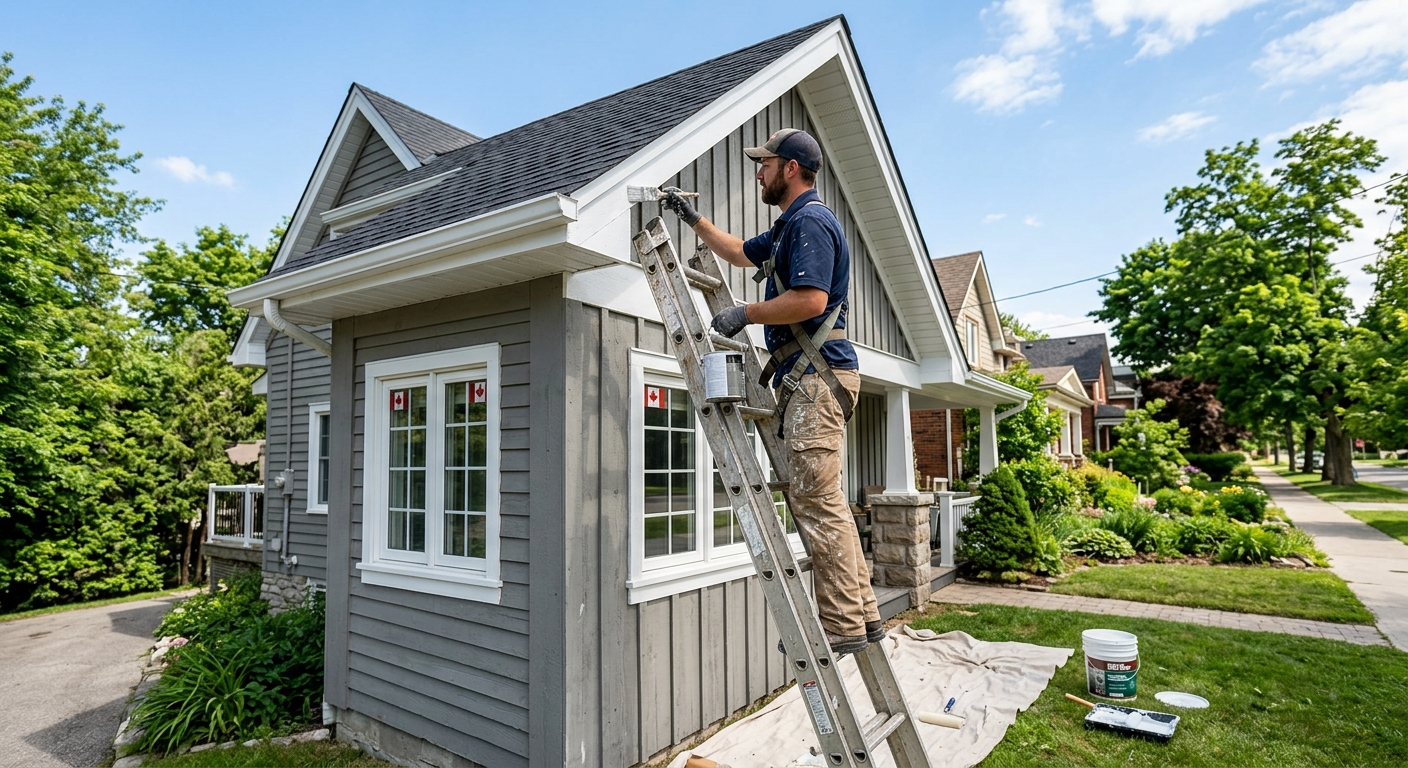
Painting options and costs in South Surrey
South Surrey homeowners typically get a wider range of painting results—and quotes—than they expect, mainly because so many properties were built in the mid-century to 1990s era and need a bit more than “roll and paint.” According to the 2021 Census, South Surrey’s population is 77,170 (Statistics Canada, 2021 Census), and that steady owner base supports a busy trades market in neighbourhoods like Grandview Heights and Morgan Crossing. On older homes, exterior repaints and interior refreshes often include scraping failing coatings, patching settlement cracks, stain-blocking nicotine or wood tannins, and upgrading primers for better adhesion and mildew resistance. For pre-1978 homes, contractors may also use lead-paint–safe practices, adding time for containment, HEPA cleanup, and disposal.
In the Lower Mainland–Southwest, the biggest cost driver isn’t so much freezing weather—it’s rain, humidity, and the way damp shoulder seasons stretch drying times. That means painters plan around dry windows, re-mobilize between weather gaps, and use high-adhesion, mildew-resistant systems suited to coastal BC siding and trim. Interiors are less seasonal, so you can often shift crew time indoors into fall and winter, which helps keep interior pricing more stable within the region’s overall rates. If you’re comparing options, the table below shows the most common project types and what’s generally included before you start selecting paint brands, sheens, and finish levels.
| Service |
What's Included |
Typical Duration |
Price Range |
| Interior — whole home (walls, ceilings, trim) |
Protective masking, caulking as needed, prep for minor repairs, two full coats on walls/ceilings, primer where required, paintable trim and doors as scoped |
4–10 business days |
$2,500–$7,500 |
| Interior — per room (standard bedroom or living room) |
Prep and patching for small nail/screw holes, one primed area allowance, two coats on walls, cut-in to ceiling edges, trim spot prep and two coats to matched finish (as scoped) |
1–3 business days |
$650–$2,200 |
| Exterior — full house (siding, trim, soffits) |
Scrape/sand failing areas, caulking, spot-priming, two-coat exterior system, attention to mildew-prone zones, coverage for trim, soffits and accessible surfaces |
5–14 business days (weather-dependent) |
$6,500–$13,500 |
| Exterior — trim and accent colours only |
Surface prep on trim, caulking and spot-priming, two coats on trim/accents, masking and cleanup to protect siding |
2–7 business days (weather-dependent) |
$1,200–$4,800 |
| Kitchen cabinet painting (doors, frames, spray finish) |
Degreasing, sanding/scuffing, bonding primer, spray finish on doors (where applicable), professional masking, two to three finish coats depending on sheen and coverage |
5–15 business days (includes dry/cure cycles) |
$2,500–$6,800 |
| Specialty / faux finish (accent wall, texture) |
Surface prep specific to texture/faux system, base coat(s), specialty application, protective topcoat where required |
1–8 business days |
$700–$5,000 |
Prices are estimates only and vary by project scope, site access and material selection.
What affects the price of painting in South Surrey
Even when two homeowners describe the same “paint the house” job, quotes in the Lower Mainland–Southwest can differ by 30–50% compared with other parts of British Columbia due to prep intensity, product choice, access, and scheduling risk. In our region, exterior painting is tightly bound to dry, workable stretches. Coastal BC doesn’t shut down like an extreme-cold climate, but the combination of rain and humidity means painters must time application and drying carefully, then re-mobilize crews between weather windows. On the interior side, crews can often keep working year-round—so interior pricing usually holds steadier than exterior pricing.
Older homes across South Surrey also raise labour demand: scraping failed coatings and caulking before paint can easily account for 50–70% of total labour on a repainting job, especially where prior patching or chalking has occurred. If your budget is closer to a mid-band interior repaint (for example, $300–$8,000 overall for most interiors depending on size and trim scope), you may still see the majority of the cost shift to prep and primer rather than the topcoat. Exterior projects can land anywhere from a trim-focused job to a full-house repaints, commonly spanning the lower to upper portions of the exterior range (including $1,200–$15,000 depending on siding condition, height, and weather scheduling).
Concrete examples from South Surrey: (1) fibre cement or older wood siding with failing caulk lines usually triggers more scraping and re-priming, adding days; (2) tall or multi-storey façades in areas like Grandview Heights often require lifts or scaffolding, which raises labour and material handling; (3) properties with nicotine staining or tannin bleed typically need stain-blocking primer, which adds product cost and additional coats to avoid ghosting.
| Price Factor |
Why It Matters |
Cost Impact |
| Surface prep — scraping, sanding, patching drywall or wood |
Poor adhesion causes peeling and blistering; prep is where durability is won or lost |
Often +15% to +40% |
| Number of coats — 2-coat system over primer vs. 1 coat over existing |
BC humidity and coastal exposure increase the need for even film build |
Often +10% to +30% |
| Paint quality tier — contractor-grade vs. premium (Benjamin Moore, Sherwin) |
Premium coatings can improve coverage and long-term colour stability |
Often +5% to +20% |
| Ceilings and trim — adds significant time vs. walls-only |
Cutting in, masking, and extra coats for trim increase labour |
Often +10% to +35% |
| Exterior season window — short season raises summer rates |
Rain risk pushes scheduling pressure and can increase crew mobilization costs |
Often +10% to +25% |
| Lead-safe precautions — required for pre-1978 homes with lead paint |
Containment, HEPA vacuuming, and disposal add time and compliance steps |
Often +15% to +45% |
| Surface material — drywall vs. plaster vs. wood vs. stucco |
Different substrates require different primers, bonding, and sanding approaches |
Often +5% to +30% |
| Height and access — multi-storey exterior requires scaffolding or lifts |
Safe access increases labour time and safety setup |
Often +10% to +35% |
Permits & regulations in British Columbia
In British Columbia, painting itself generally does not require a permit for typical residential work. For homes built before 1978, health guidance recommends testing for lead paint before sanding or scraping, and using lead-safe work practices if lead is present. This isn’t something homeowners are legally required to do on their own, but it is standard professional practice for contractors: wet methods to control dust, HEPA vacuuming, proper bagging/disposal, and containment to protect people and nearby finishes. If you’re budgeting for older homes in South Surrey, keep in mind that lead-safe precautions can meaningfully increase labour time and cleanup.
What typically does not require a permit: interior repainting, exterior painting for existing coatings, spot priming, caulking, and normal preparation like sanding and patching. What may require additional approvals is outside the scope of routine painting (for example, major exterior structural alterations or regulated remediation), but straightforward “paint and prepare” work is generally permit-free.
Step-by-step for homeowners: (1) Ask for the contractor’s proof of liability insurance—request a certificate of insurance and ensure it lists your address or at least your property interest as appropriate. (2) Confirm workers’ compensation coverage through their WCB account number and documentation; in BC this is handled through workers’ compensation coverage for employees. (3) Verify whether their business is properly registered and in good standing via the provincial business listings, where applicable. (4) Get a written contract that specifies paint brand/product line, sheen, number of coats, and exactly what prep is included (repairs, caulking, sanding, stain blocking).
Interior vs exterior painting — getting the best result in South Surrey
In South Surrey’s coastal Lower Mainland–Southwest climate, the difference between a long-lasting paint job and a premature failure is almost always the prep and coating system—not the marketing label. For interiors, start with surface prep: filling, sanding, and priming are what prevent flashing, peeling at patch seams, and uneven sheen. Then choose the right sheen by room use: flat is better at hiding wall imperfections, eggshell is a common compromise for living spaces, satin handles washability in higher-traffic areas, and semi-gloss on trim stands up to scuffs. A well-primed surface with two coats of topcoat almost always outlasts a one-coat “thick layer,” because the coverage and film build stay consistent over different wall conditions.
For exteriors, the same principle applies—prep first, then the right primer and topcoat. Caulking before painting helps prevent water ingress behind trim and keeps paint from cracking and peeling around joints. Substrate matters: wood and fibre cement often need bonding and adhesion primers, while patching areas need feathering and spot priming to keep sheen and colour uniform. Because BC’s humidity can promote mildew, mildew-resistant products and correct surface cleaning are part of getting paint to hold. If you’re comparing options, a cabinet refresh can be a practical alternative to replacement: a typical spray-finish kitchen cabinet project in South Surrey is often in the $2,000–$8,000 range, which can be far more cost-effective than full cabinet replacement—especially when your boxes are still solid.
For pre-1978 homes, lead-safe precautions can affect both scheduling and prep time; that’s a cost difference that’s usually justified because it prevents unsafe dust and protects your long-term finish.
| Project Type |
Key Prep Step |
Recommended Coats |
Price Band |
| Interior — fresh drywall (new construction) |
Prime bare drywall and patch joints to prevent flashing |
Primer + 2 full topcoats |
$900–$3,500 |
| Interior — repaint (good condition, no repairs) |
Clean, de-nib, caulk minor gaps, light sand for adhesion |
2 full topcoats (primer only if needed) |
$550–$2,600 |
| Interior — repaint (patching and priming needed) |
Patch and prime repairs to blend sheen and prevent ghosting |
Primer on repairs + 2 full topcoats |
$650–$4,200 |
| Exterior siding (wood or fibre cement) |
Scrape loose coating, caulk, spot-prime bare and weathered areas |
Primer/spot prime + 2 exterior topcoats |
$6,500–$13,500 |
| Exterior trim and accents only |
Feather prep at transitions and spot-prime before finish |
2 exterior topcoats |
$1,200–$4,800 |
| Kitchen cabinets (spray finish) |
Degrease, scuff, and bond-prime for long-term adhesion |
Bond primer + 2–3 finish coats |
$2,500–$6,800 |
How to choose a painting contractor in South Surrey
Choosing the right contractor in South Surrey starts with verifying three things: licensing/registration where required, liability insurance, and workers’ compensation coverage. In practice, you should ask for (1) a current certificate of liability insurance and confirm it’s active on the job dates; (2) proof of workers’ compensation coverage for their employees (WCB coverage documentation), so you’re not exposed if someone is injured on your property; and (3) business legitimacy details (business registration information and a clear address/phone for the company). A reliable contractor should also be comfortable walking you through prep steps for coastal BC—scraping, caulking, primer selection, and mildew-resistant systems—rather than selling only paint “brands.”
Next, get 2–3 written quotes that are itemised. You want a labour + materials breakdown (including prep, primer types, caulking, and disposal or clean-up) rather than a single lump sum. Read the scope carefully: is permit pulling included if required for a particular component? Is surface cleaning included? Does the quote include disposal of sanding debris and paint waste?
Warranty matters too. Ask for the workmanship warranty length and whether it transfers to future owners (common for resale support). Payment should be staged: never pay more than 10–15% upfront, and hold back until the job is substantially complete and punch-list items are addressed. Finally, insist on a written timeline with a start date and completion estimate—exterior jobs in South Surrey are sensitive to rain windows, so a good contractor will explain how they schedule around weather and drying time.
- Ask for proof of active liability insurance (certificate of insurance).
- Confirm workers’ compensation coverage for their employees (WCB documentation).
- Request a signed written contract that lists paint brand/product line and sheen.
- Verify the quote includes surface prep details: scraping, sanding, patching, stain-blocking (if needed).
- Confirm caulking scope (where and whether it’s included before painting).
- Check for disposal/cleanup language (paint waste, sanding debris, drop cloth cleanup).
- Ask for the number of coats by surface and how primer is handled.
- Get an itemised labour and materials breakdown (not just a lump sum).
- Confirm warranty terms for workmanship and whether it’s transferable.
- Review payment schedule; limit upfront to 10–15% and hold back until completion.
- Ask how they manage exterior timing around rain/humidity windows.
- Request references or recent photos of comparable South Surrey exteriors/interiors.
Red flags in South Surrey: (1) quotes that skip prep (“we’ll just paint over it”); (2) no proof of liability insurance or unclear workers’ compensation coverage; (3) vague scope that doesn’t specify primer type, caulking, or number of coats; (4) very low pricing that matches only a subset of surfaces (for example, trim excluded); (5) no written contract, timeline, or warranty in plain language.
Frequently asked questions — painting in South Surrey
How do I fix peeling exterior paint in South Surrey?
Peeling exterior paint in South Surrey usually means the previous coating has lost adhesion—commonly from moisture intrusion, poor prep, or failing caulk lines in wet, humid coastal conditions. The fix is not just scraping the loose paint and repainting. A professional will scrape back to sound edges, feather the transition, clean and treat mildew-prone areas, re-caulk joints before painting, then spot-prime bare or weathered spots with the correct primer for the substrate (wood or fibre cement). If the home is pre-1978, lead-safe work practices are a key part of the process when lead paint is present. Weather timing is also critical; painting must be scheduled around dry windows so surfaces can dry and primers can cure properly.
What colours add the most resale value in South Surrey?
For resale in South Surrey and the broader Lower Mainland–Southwest, broadly appealing neutrals tend to perform best because they photograph well and match many buyer preferences. Popular choices include warm whites, soft greiges, and muted taupes for walls, with crisp whites or light warm off-whites for trim. For a modern curb appeal boost, you can add a darker accent (like charcoal or deep navy) on entry doors or select trim, but keep the rest of the façade balanced. Avoid highly saturated colours on large exterior surfaces unless you plan for more frequent updates to maintain colour. If you’re staying within a typical exterior budget—often from the trim range around $1,200–$4,800 up to larger full-home repaints—keeping colour selections cohesive can reduce the chance of costly patching or rework due to mismatched sheen or coverage.
How much does it cost to paint a house in South Surrey?
In South Surrey, the cost to paint a house depends mainly on surface condition, prep, height/access, and whether you’re doing full exterior work or trim-only. For many homes, a full exterior painting scope commonly falls in the broader exterior band of $6,500–$13,500, while a trim and accent refresh is often closer to $1,200–$4,800. Interior-only projects vary widely by home size and how much trim and ceiling work is included, and many homeowner bids land within the broader interior band of $300–$8,000. Coastal BC weather also affects scheduling: rain and humidity can slow drying and require re-mobilizing crews between dry windows, which is why detailed prep and clear timelines in the contract matter.
How much does interior painting cost per room in South Surrey?
Per-room interior painting in South Surrey typically depends on wall condition, the amount of trim, ceiling height, and whether patching and priming are needed. If the room is in good condition with minimal repairs, homeowners often see pricing toward the lower end of the per-room range; if there are patch repairs, stains, or uneven drywall that needs prime-and-blend, the cost rises accordingly. For a standard bedroom or living room, a common professional estimate is in the $650–$2,200 band. The biggest difference isn’t usually the paint itself—it’s prep time (sanding, caulking, priming repairs) and cut-in detail around trim and ceilings. Ask your contractor to explain how many coats are included and where primer is required so you can compare quotes fairly.
When is the best time for exterior painting in South Surrey?
The best time for exterior painting in South Surrey is when you can get consistent dry days and low rainfall impact. In coastal Lower Mainland–Southwest conditions, scheduling around rain and humidity is more important than chasing summer heat. Crews typically aim for dry windows so surfaces can clean, dry, and properly cure between coats. Because the region’s damp shoulder seasons can extend, exterior work is often more weather-managed than in cold-climate provinces—meaning you may start later or finish in phases. If you have mould-prone areas, planning around a dry stretch is especially important so cleaning solutions and primers perform as intended. Your contractor should provide a realistic weather plan in writing, including how they handle delays and re-mobilization costs between weather windows.
How many coats of paint do I need?
Most durable residential painting systems in South Surrey use two coats of topcoat, but the number of layers in total depends on whether primer is required and what condition the surface is in. For interiors, properly primed surfaces are usually topcoated twice; fresh drywall and heavily repaired walls typically require primer plus two finish coats to avoid flashing and patch outlines. For exteriors, the standard approach is spot-prime where bare or weathered surfaces exist, then apply two exterior topcoats over the properly prepared substrate. If you’re comparing estimates, pay attention to whether the quote includes primer where needed—skipping primer or reducing to one finish coat over an unprepared surface is one of the most common causes of early peeling. In practical budgeting terms, interior projects can still fall within $300–$8,000 depending on sheen and trim scope, but the coat system is what drives long-term performance.