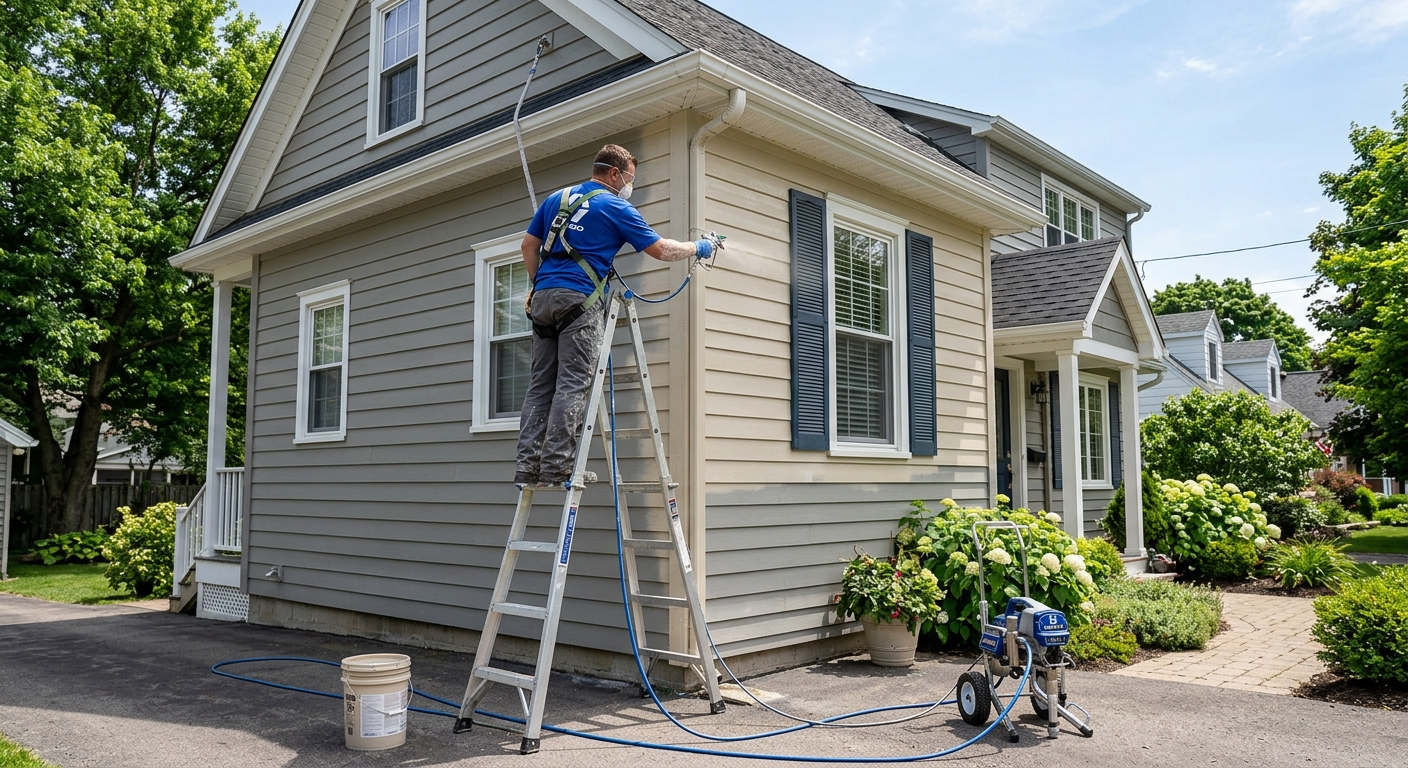
Painting options and costs in Peachland
Peachland is where homeowners want a clean, bright look that still holds up to Southern Interior BC’s seasonal swing. With 5,789 residents and about 2,200 homeowner households (81.8% of households own), a lot of repainting work happens when schedules open up—especially on homes in the Okanagan Lake area and around the village core where road access and shoreline humidity can affect drying times. Pricing also changes because Peachland housing stock is older: 33.1% of homes were built before 1981, which often means more patching, caulking, and sanding, plus extra attention to trim coatings if pre-1978 paint layers are encountered.
In the Thompson–Okanagan, exterior painting costs are strongly shaped by demand peaks. The region’s exterior work is typically concentrated into a late spring–early fall window when surfaces can dry reliably and temperatures stay workable. That short, busy period can tighten contractor availability in summer, pushing rates toward the top end of the exterior bands when jobs are urgent or schedules overlap. On the other hand, interiors can be planned year-round, which usually makes interior timelines and costs more predictable.
For budget planning, it helps to compare common scopes side-by-side. Below are typical Peachland ranges for interior, exterior, cabinets, and specialty work—so you can see where your dollars usually go before you request an itemised quote.
| Service |
What's Included |
Typical Duration |
Price Range |
| Interior — whole home (walls, ceilings, trim) |
Protect floors/fixtures, prep & patch, caulking as needed, sand/tape, prime where required, 2-coat finish on walls/ceilings, paint trim where scoped, basic touch-ups and clean-up |
5–12 business days |
$3,200–$6,000 |
| Interior — per room (standard bedroom or living room) |
Prep & patch, tape edges, prime bare/damaged areas, 2-coat finish on walls, optional trim coating as included, clean-up |
1–3 business days |
$600–$1,800 |
| Exterior — full house (siding, trim, soffits) |
Pressure wash or power clean (as appropriate), scraping/sanding loose paint, caulking, spot-priming, 2-coat exterior system, protect landscaping/railings, final clean-up |
7–18 business days |
$6,000–$12,000 |
| Exterior — trim and accent colours only |
Scrape/sand as needed, caulking and spot-priming for trim areas, 2-coat finish on trim/accents, protection and clean-up |
2–8 business days |
$1,200–$4,500 |
| Kitchen cabinet painting (doors, frames, spray finish) |
Full cabinet prep, degrease, sanding degloss, prime, spray/roll finish, hardware masking, light touch-ups, re-install of doors |
5–15 business days (dry time dependent) |
$3,000–$5,000 |
| Specialty / faux finish (accent wall, texture) |
Surface prep, base coat(s), specialized application, sealing/clear coat if required, full clean-up |
2–7 business days |
$900–$3,500 |
Prices are estimates only and vary by project scope, site access and material selection.
What affects the price of painting in Peachland
In Peachland and across the Thompson–Okanagan, the same “two rooms of walls” or “repaint the siding” can land 30–50% apart between quotes because painters price risk and preparation differently. In other parts of Canada, those swings can be even wider—crew availability, labour cost, and product requirements vary by region. For example, exterior work in Ontario and Alberta is often limited to a late spring–early fall stretch when temperatures are reliably above freezing and rising during application; in the Thompson–Okanagan, that same seasonal compression concentrates bookings, especially in summer. Coastal BC can have a longer calendar, but humidity and intermittent rain mean contractors often specify mildew-resistant primers and topcoats and schedule carefully to avoid blistering or adhesion failures.
Prep is the big driver. Across older neighbourhoods in the area where homes were commonly built before 1981, scraping loose paint, sanding, patching drywall, and caulking before painting can account for roughly half the labour on a repainting job. In practical dollars, that’s why an exterior repaint can move from the lower band toward the middle band: if surface prep expands, a job can shift by hundreds to thousands quickly. To keep numbers grounded, an exterior trim-only job might sit closer to the lower side of the $800–$12,000 exterior band, while a full house repaint with significant scrape/prime work often lands well into the $6,000–$12,000 range.
In Peachland specifically, two cost examples come up often: (1) sun-chalking and fading require extra sanding before priming to avoid peeling later; (2) slope/lot access near the lakeside means scaffolding or lift setup can be more time-consuming than in flatter areas. Homes with multiple previous layers can also require more dry time between coats because each surface must fully cure before the next application.
| Price Factor |
Why It Matters |
Cost Impact |
| Surface prep — scraping, sanding, patching drywall or wood |
Bond depends on sound material; prep removes failing paint and restores adhesion |
Can add $500–$3,000 on typical repaints depending on condition |
| Number of coats — 2-coat system over primer vs. 1 coat over existing |
More coats are needed when primer is required or when coverage is reduced |
Typically $300–$1,500 difference |
| Paint quality tier — contractor-grade vs. premium (Benjamin Moore, Sherwin) |
Premium lines often cover better and resist mildew/fading longer |
Materials may vary by $200–$900 but can reduce repaint risk |
| Ceilings and trim — adds significant time vs. walls-only |
Detail work increases cutting-in, masking, and drying management |
Often $400–$1,800 depending on scope |
| Exterior season window — short season raises summer rates |
More demand during late spring–early fall tightens scheduling and crew availability |
Urgent summer work can raise $300–$2,000 versus off-peak |
| Lead-safe precautions — required for pre-1978 homes with lead paint |
Responsible handling increases labour: containment, HEPA vacuuming, disposal steps |
Can add $600–$2,500 if lead-safe procedures are needed |
| Surface material — drywall vs. plaster vs. wood vs. stucco |
Different substrates need different primers and sanding/degloss methods |
Often $250–$1,200 difference |
| Height and access — multi-storey exterior requires scaffolding or lifts |
Time, equipment and safety add real labour hours |
Can add $500–$3,500 |
Permits & regulations in British Columbia
In British Columbia, painting itself does not require a permit for typical residential work (interior or exterior). Where regulation comes into play is around safe work practices. For homes built before 1978, health guidelines recommend testing for lead paint before sanding or scraping. If lead is present, contractors typically follow lead-safe practices such as wet methods to control dust, HEPA vacuuming, and proper disposal. This isn’t generally something that homeowners are required to do by law for personal projects, but it is standard professional practice—especially when trim or exterior coatings are likely to be older.
Work that typically DOES require permitting is not painting-related; it’s usually tied to other categories like structural renovations, window replacements, or major exterior changes (for example, certain permit-triggering exterior alterations). Painting alone—priming, caulking, and applying interior/exterior coatings—usually doesn’t require a permit in BC.
To verify a contractor in Peachland, take these steps in order:
- Confirm they carry liability insurance: ask for a certificate of insurance and ensure it’s current.
- Ask for WSBC/WCB coverage for workers: request proof of workers’ compensation coverage before work starts.
- Use their business information to check licensing/credentials where applicable through provincial registries or the contractor’s official profile—then verify it matches the company name on the insurance documents.
- Request a written contract that lists the paint brand/line, sheen, number of coats, and the exact prep responsibilities (pressure washing, scraping, sanding, caulking, priming).
- Look for a clear start date and completion estimate so scope creep is less likely.
Interior vs exterior painting — getting the best result in Peachland
In Peachland’s Thompson–Okanagan climate, the difference between a long-lasting paint job and a premature failure is usually not the brand you pick—it’s whether the surface was prepared to accept the coating and whether the right coating system was applied at the right time. For interiors, start with surface prep: filling small dents, sanding glossy patches, taping cleanly, and priming repaired areas. Then choose sheen based on how the room is used. Kitchens and hallways tolerate more cleanability, so satin or semi-gloss is often a better fit than flat paint. In practice, two coats applied over a proper primer almost always outlast one heavy coat because the film build becomes more uniform and less likely to thin out on edges.
For exteriors, prep is even more critical in BC conditions. Caulking before painting helps prevent water ingress behind trim and seams; if caulk is applied incorrectly or painting happens before the caulk cures, you can trap moisture. Primer selection matters by substrate: wood benefits from a primer system made for exterior wood, while certain masonry or problematic areas may require block or stain control depending on staining sources. In BC, mildew-resistant products are a common requirement in damp microclimates, including shaded eaves and north-facing walls.
Cabinet painting is a smart budget option to avoid replacement. For the same household, cabinet repainting can cost a fraction of a full kitchen refresh; however, it demands meticulous degreasing and finishing to avoid peeling or “grit” in the clear topcoat. For pre-1978 homes, if older trim coatings are encountered, lead-safe precautions (containment and HEPA vacuuming when needed) protect your household and the crew.
Where price differences are justified: if your exterior is failing due to peeling on an older substrate, paying for full prep (scrape, sand, caulk, prime) is the reason an exterior project can sit closer to the mid–upper exterior band (often within the $800–$12,000 range). Skipping prep to chase a lower number is usually where savings disappear after one to two seasons.
| Project Type |
Key Prep Step |
Recommended Coats |
Price Band |
| Interior — fresh drywall (new construction) |
Prime drywall properly and sand any raised grain before finish |
Primer + 2 finish coats |
$1,200–$3,800 |
| Interior — repaint (good condition, no repairs) |
Degrease, light scuff-sand, and spot-prime if colour change requires it |
1–2 finish coats depending on coverage |
$600–$2,400 |
| Interior — repaint (patching and priming needed) |
Fill, sand, caulk, and prime repairs so patches match the wall |
Primer on patches + 2 finish coats |
$900–$3,200 |
| Exterior siding (wood or fibre cement) |
Scrape/sand loose areas, clean, caulk, then prime affected spots |
Primer where needed + 2 exterior finish coats |
$6,000–$12,000 |
| Exterior trim and accents only |
Remove failing coating, spot-prime, and caulk joints before paint |
Spot primer + 2 finish coats |
$1,200–$4,500 |
| Kitchen cabinets (spray finish) |
Degrease, sand degloss, prime for adhesion, then sand lightly between coats if needed |
Primer + 2 topcoats (or premium system with scuff/undercoat steps) |
$3,000–$5,000 |
How to choose a painting contractor in Peachland
Choosing a painter in Peachland comes down to verifying coverage, reading the scope, and confirming the schedule in writing. Start with licensing/credentials where applicable, then ask for proof of liability insurance and workers’ compensation coverage. You want the insurance certificate to match the company doing the work, and you want workers’ compensation coverage in place before a crew starts. If a contractor can’t provide current documentation, that’s a major signal to keep looking.
Next, request 2–3 itemised written quotes that break down labour and materials rather than a single lump sum. Itemisation matters because prep drives cost: ask how they’ll handle scraping, sanding, caulking, pressure washing/power cleaning (if required), and spot-priming. For exteriors, confirm whether disposal is included and whether a lead-safe approach will be used if pre-1978 coatings are involved. Make sure the quote clearly states paint brand/line, sheen, and the number of coats, including primer.
For warranty, look for a workmanship warranty length (how long they stand behind adhesion and workmanship), and a product/manufacturer warranty explanation. Ask if warranties are transferable when you sell the home. For payment, never pay more than 10–15% upfront—hold back the balance until the final walkthrough. Finally, get a start date and a completion estimate in writing so the job is planned around BC weather and drying time rather than constant delays.
- Ask for certificate of liability insurance and confirm the coverage is active.
- Request proof of workers’ compensation coverage for their crew.
- Verify the company name on insurance matches the quote and contract.
- Get an itemised estimate: labour hours, prep steps, and materials line items.
- Confirm scope exclusions (for example, rot repair, drywall replacement, or plaster cracks).
- Ensure paint brand/line, sheen level, and number of coats are written in the contract.
- Ask how they’ll handle peeling edges and failing caulk/trim joints.
- For exteriors, confirm pressure washing vs. other cleaning methods and what’s included.
- Confirm disposal and site clean-up practices.
- Require a written schedule with start date and completion target.
- Limit upfront payment to 10–15% and use milestone-based progress payments.
- Request a workmanship warranty in writing before payment changes hands.
Red flags in Peachland: (1) a quote that skips surface prep and only mentions “paint and roll,” (2) no written scope stating primer/caulking/patching responsibilities, (3) unwillingness to show insurance/coverage paperwork, (4) pressure to pay a large deposit upfront, and (5) vague warranties like “we guarantee it” without a clear time period and terms.
Frequently asked questions — painting in Peachland
Can I paint my house exterior in spring or fall in Peachland?
Yes, but timing is the difference between a durable finish and a failure. In Peachland and the broader Thompson–Okanagan, exterior work is typically planned when surfaces can dry properly and temperatures are workable. Spring is often fine once the rainiest stretches have eased, but you still need a dry window for prep and application—especially around shaded eaves and north-facing walls. Fall can work only if the contractor can meet curing needs before cooler, damp nights. If your job is tight, it may be priced closer to the exterior band upper end (often near $6,000–$12,000 for full-house scope) because scheduling around short weather windows can require more crew coordination.
How do I choose a painting contractor in Peachland?
Start with documentation: ask for current liability insurance and proof of workers’ compensation coverage, and verify the company name matches the contract. Then request 2–3 itemised quotes that separate labour, prep steps, and materials—so you can compare apples-to-apples. Read the scope carefully: confirm pressure washing/cleaning method, scraping/sanding responsibilities, caulking inclusion, primer type requirements, and disposal. In BC, painting doesn’t usually require a permit, so the key is safe work practices and clear contract terms. If your home is older (33.1% of Peachland homes were built before 1981, Statistics Canada, 2021 Census), ask how they handle pre-1978 paint layers. A reputable contractor should explain lead-safe approach if encountered.
How many coats does an exterior repaint need in Peachland?
Most properly prepared exterior repaints use a 2-coat finish system, with primer applied to bare or problem areas (peeling edges, patches, and previously sanded sections). The exact number can vary if the existing coating is sound and the colour change is modest, but “two coats over correct primer” is the reliable standard for long-term adhesion. In Peachland’s lake-influenced humidity and shade patterns, drying and curing consistency matter—especially on trim and soffits. That’s why a full-house repaint often falls in the higher exterior ranges, commonly $6,000–$12,000, when scraping, caulking, spot-priming, and thorough system application are included.
What is the best primer for older Peachland homes?
There isn’t one single “best” primer for every older home; the right choice depends on substrate and what the existing coating is doing. For Peachland homes built before 1978, the first question is whether older trim or exterior coatings contain lead—contractors should test or use lead-safe work methods before sanding or scraping. If lead-safe practices are needed, primer selection continues after preparation is controlled. Practically, good primers for older exteriors typically include systems designed for bonding to weathered wood or fibre cement and for spot-priming scraped areas. A contractor should specify the primer brand/line in writing and explain why it’s suitable for your siding type and the condition of current paint.
Should I paint or wallpaper my Peachland home?
For most Peachland homeowners, painting is the simpler route for consistent results—especially where walls have patchwork or seasonal movement. Wallpaper can look great, but it adds complexity around prep (surface smoothness, seam alignment, and removal later). In BC’s moisture swings, if walls have any dampness issues, wallpaper can trap problems or make it harder to inspect and correct them. Paint is often more forgiving because you can prime properly and choose washable sheens by room. If you’re considering upgrades in a space like a hallway or kitchen, painted finishes with satin or semi-gloss are usually more practical. Budget-wise, interior painting often ranges widely from $250–$6,000 depending on whole-home scope, prep needs, and trim inclusion—often making painting the more predictable choice.
How do I fix peeling exterior paint in Peachland?
Peeling exterior paint is almost always a prep-and-system problem, not just a “patch and paint” problem. The right fix is to remove loose material back to sound edges, then scrape and sand to create a stable surface. After cleaning, caulk any failing joints or cracks and spot-prime affected areas with the appropriate primer for the substrate. Only then should you apply the full 2-coat exterior system. In Peachland, the lake area can mean more humidity and longer damp cycles around soffits and shaded walls, so timing matters—paint should only go on when surfaces are clean and dry and can cure properly. If your home has older layers (pre-1978 risk), ask whether the contractor will use lead-safe work practices during scraping and sanding.