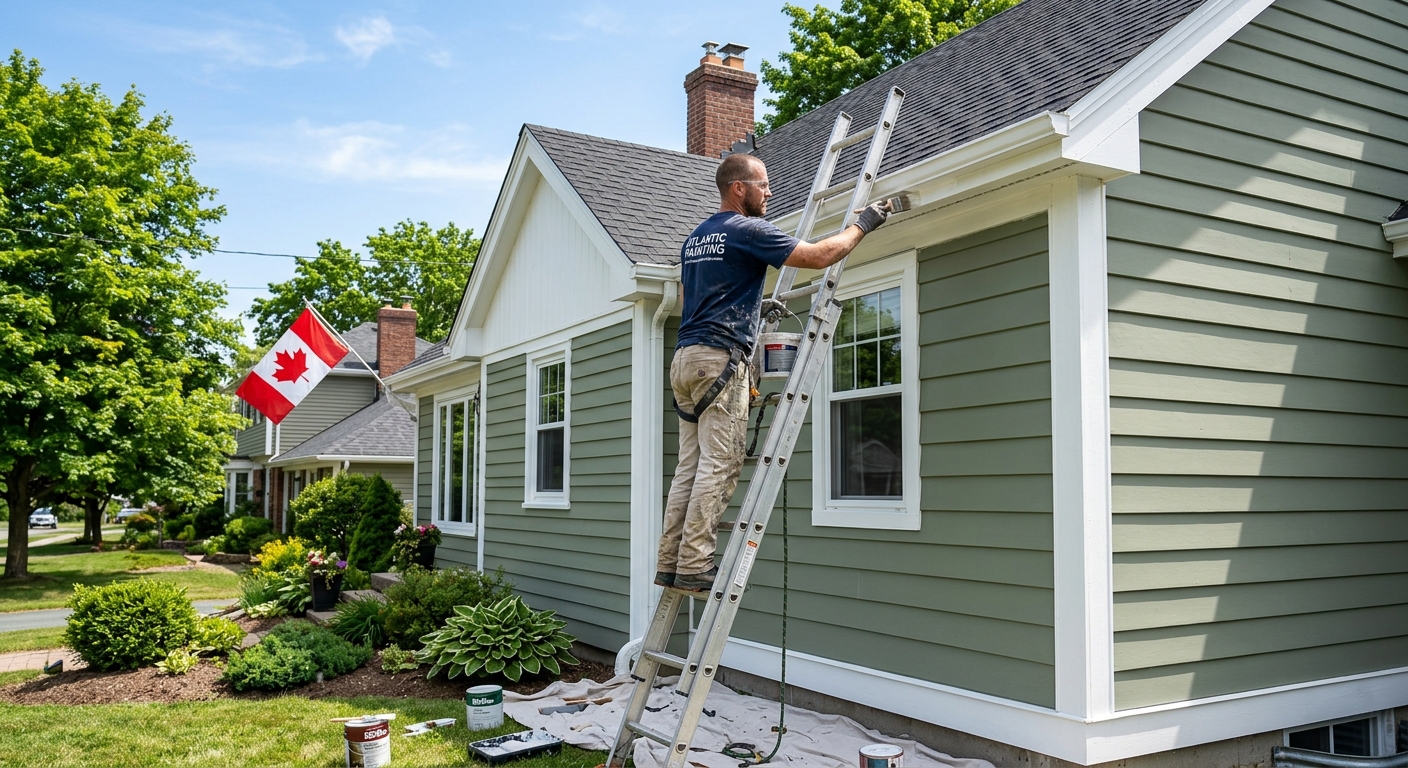
Painting options and costs in Cranbrook
Cranbrook homeowners have a lot of choice when it comes to paint, but the real difference is how the job is scoped—especially for the older housing stock common across the Kootenay. In Cranbrook, 56.3% of homes were built before 1981 (Statistics Canada, 2021 Census), which usually means more surface prep on a repaint: scraping loose material, addressing cracks, patching failing caulk lines, and priming bare spots to prevent “flashing” or re-peeling. It can also raise lead-safe considerations if original coatings are disturbed on pre-1978 areas, which professionals plan around from day one.
Cost is also heavily affected by the Kootenay climate. Cranbrook sits in a continental interior pattern with cold, snowy winters and a short, warm, dry stretch in the growing season. Exterior painting is therefore most cost-effective when scheduled for the May–September window, when surfaces are warm enough to apply and cure properly. When summer demand is tight, availability can narrow and pricing often trends toward the upper end of local exterior ranges.
In busy spots like the neighbourhoods along the downtown core and near Cassiar Avenue, you’ll often see faster scheduling for smaller facades, but full exterior projects still need careful weather planning. That’s why quotes can vary even before you pick the brand. Below is a realistic comparison of typical options and budget ranges, so you can line up apples-to-apples when you request your bids.
| Service |
What's Included |
Typical Duration |
Price Range |
| Interior — whole home (walls, ceilings, trim) |
Prep, patching/sanding, caulking, spot-priming, 2-coat paint (walls/ceilings) and 2-coat finish on trim/doors, dust protection, clean-up and jobsite protection |
5–10 days |
$2,500–$5,800 |
| Interior — per room (standard bedroom or living room) |
Prep, patching/sanding, caulking, spot-priming as needed, 2-coat paint on walls and 2-coat trim/door where included, basic protection and clean-up |
1–3 days |
$700–$2,200 |
| Exterior — full house (siding, trim, soffits) |
Power-wash (or equivalent cleaning), scrape/sand to sound edges, caulking at vulnerable joints, primer where required, 2-coat system for siding and trim, attention to flashing areas, surface-specific cleanup |
2–4 weeks (weather-dependent) |
$3,500–$7,000 |
| Exterior — trim and accent colours only |
Cleaning, scrape/sand loose coating, spot-priming, caulking where needed, 2-coat finish on specified trim/accents; siding typically excluded |
1–2 weeks (weather-dependent) |
$1,500–$3,800 |
| Kitchen cabinet painting (doors, frames, spray finish) |
Degreasing/decontamination, finish removal or bonding prep (as required), sanding/scuffing, sanding sealer/primer, sprayed doors/drawer fronts, brushing-touchup for frames, hardware prep, curing time planning |
7–14 days |
$2,000–$4,800 |
| Specialty / faux finish (accent wall, texture) |
Surface prep, priming and base coat, application of specialty or texture effect, seal/coats for washability, masking, and final clean-up |
2–6 days |
$600–$3,000 |
Prices are estimates only and vary by project scope, site access and material selection.
What affects the price of painting in Cranbrook
It’s common to see quotes for the “same” painting job differ by 30–50% across Kootenay and British Columbia. The biggest driver is rarely the paint—it’s the prep time and the logistics needed to make coatings last through Cranbrook’s temperature swings, freeze-thaw cycles, and dry indoor air. On exterior work in the Kootenay region, the usable season is tightly climate-bound: most façade repainting should be scheduled for late spring through early fall when temperatures are steady (roughly above 10°C) and surfaces can dry and cure well. In coastal BC, companies may have a longer calendar, but higher humidity and rain force extra planning and mildew-resistant product choices; in Cranbrook, the lower ambient moisture can help drying, but labour demand still peaks when the weather window opens.
Prep is also a cost multiplier on older homes. With 56.3% of dwellings built before 1981 (Statistics Canada, 2021 Census), many jobs start with more labour: scraping failing paint, sanding rough edges, repairing deteriorated caulk lines, and priming bare or chalky areas. Prep can account for roughly 50–70% of labour on a repainting job, pushing exterior pricing toward the higher end of local bands (for example, $1,500–$7,000 for exterior depending on scope).
Two real Cranbrook examples: (1) a trim-and-accent refresh on a simple bungalow typically stays nearer $1,500–$3,800 because siding is excluded; (2) a full house repaint with multiple wall elevations and required caulking usually moves closer to $3,500–$7,000 because time stacks up quickly with corners, soffits, and hard-to-reach areas.
| Price Factor |
Why It Matters |
Cost Impact |
| Surface prep — scraping, sanding, patching drywall or wood |
Determines adhesion and long-term durability; fixes uneven texture and failing coatings |
+10% to +40% |
| Number of coats — 2-coat system over primer vs. 1 coat over existing |
Coverage and uniformity; colour change and stains often require a primer or extra coat |
+5% to +25% |
| Paint quality tier — contractor-grade vs. premium (Benjamin Moore, Sherwin) |
Sheen stability, stain blocking, and how well the film covers with fewer passes |
Material-only +2% to +12%; labour may drop with better coverage |
| Ceilings and trim — adds significant time vs. walls-only |
Ceilings require careful cutting-in and protection; trim demands more detail work |
+10% to +35% |
| Exterior season window — short season raises summer rates |
Weather constraints compress scheduling; crews cost more when the calendar is tight |
+8% to +30% |
| Lead-safe precautions — required for pre-1978 homes with lead paint |
Special containment, wet methods/HEPA vacuuming, and disposal add time and compliance steps |
+5% to +20% |
| Surface material — drywall vs. plaster vs. wood vs. stucco |
Different adhesion needs; plaster and stucco often need special primers and curing awareness |
+5% to +30% |
| Height and access — multi-storey exterior requires scaffolding or lifts |
Safety planning and time to protect landscaping/entryways |
+10% to +45% |
Permits & regulations in British Columbia
In British Columbia, painting work typically does not require a building permit for standard interior or exterior re-painting. That said, homes built before 1978 can contain lead-based paint. While homeowners aren’t usually required to test or follow lead-safe procedures as a legal mandate, professional best practice is to test suspected coatings before scraping or sanding. If lead is present, contractors plan lead-safe work practices—such as wet methods to reduce dust, HEPA-filtered cleanup, and proper disposal of debris—because those steps protect workers and occupants in a way that “dry sanding” cannot.
Beyond permits, you should expect a professional contractor to carry the right coverage: liability insurance and workers’ compensation coverage (WCB) for employees. Always request proof before work begins. You should also get a written contract that clearly states what paint brand/line is being used, sheen selections, number of coats, and exactly what prep (power-washing, scraping, priming, caulking, repairs) is included.
To verify a contractor in Cranbrook step-by-step: (1) confirm their licence/registration status through the applicable provincial registry, (2) ask for a current certificate of liability insurance naming you as the interested party if required, (3) request proof of WCB coverage, and (4) check that their written scope includes what they’re removing or sanding and how waste is handled.
Interior vs exterior painting — getting the best result in Cranbrook
In Cranbrook’s interior climate, two things matter most for avoiding premature failure: prep and correct sheen. For interior painting, filling and sanding (followed by primer where needed) is more important than chasing a “fancy” topcoat. Cracks around trim, nail pops, and uneven drywall seams are what show through fastest once the temperature swings and winter dryness set in. Sheen choice also affects durability and appearance—flat/eggshell is often best for low-traffic ceilings and bedrooms, while semi-gloss or satin is usually more practical for trim and higher-touch walls like hallways. And regardless of product, two coats applied over a proper primer always outlast a single thick coat because the film builds evenly and dries to a more stable surface.
For exteriors in British Columbia, the same rule is even stricter: surface prep drives the results. After cleaning, caulking should be completed before painting so joints seal and don’t become water inlets during freeze-thaw cycles. Primer type matters by substrate—some wood, stucco, or previously painted surfaces bond best with specific primers—so “one primer fits all” isn’t a great plan. Mildew-resistant formulations are typically part of exterior readiness in BC, but in the Kootenay’s drier interior air, the key is still curing conditions and adhesion.
Cabinet painting can be a smart budget alternative to replacement. For example, if replacing kitchen cabinets would be much higher, a sprayed cabinet project often fits around the cabinet painting band ($2,000–$4,800) with a clean, factory-like finish—provided the prep is thorough. For older, pre-1978 areas, lead-safe precautions should be planned when sanding or scraping is required, not added at the end.
| Project Type |
Key Prep Step |
Recommended Coats |
Price Band |
| Interior — fresh drywall (new construction) |
Seal and prime bare drywall, sand lightly for uniform texture, caulk gaps at trim lines |
Prime + 2 finish coats |
$900–$2,800 |
| Interior — repaint (good condition, no repairs) |
Clean and degloss, spot-prime if needed, minimal patch sanding |
2 finish coats |
$700–$2,200 |
| Interior — repaint (patching and priming needed) |
Patch, sand smooth, spot-prime repairs and any stain/marker bleed-through |
Prime repairs + 2 finish coats |
$900–$2,900 |
| Exterior siding (wood or fibre cement) |
Scrape to sound edges, caulk vulnerable joints, prime bare spots, ensure proper cure before recoating |
Primer + 2 finish coats (site-dependent) |
$3,500–$7,000 |
| Exterior trim and accents only |
Remove loose coating, prep feather edges, caulk where needed, spot-prime bare or weathered areas |
Spot-prime as required + 2 finish coats |
$1,500–$3,800 |
| Kitchen cabinets (spray finish) |
Degrease thoroughly and use bonding prep so the finish won’t lift; careful masking and cleaning between steps |
Primer/sealer + 2 sprayed finish coats (typically) |
$2,000–$4,800 |
How to choose a painting contractor in Cranbrook
Start by verifying British Columbia coverage and credentials. Ask for (1) proof of current registration/licensing for the trade they’re operating under, (2) a certificate of liability insurance, and (3) workers’ compensation coverage (WCB) showing they have coverage for their employees. In practice, the easiest method is to request documents before signing—review dates, confirm the contractor’s legal name matches the paperwork, and keep copies for your records.
Next, get 2–3 itemised written quotes. You want a breakdown that separates labour and materials, and clearly states what prep is included (scraping, sanding, priming, caulking, repairs). Avoid “lump sum only” quotes when possible, because they make it harder to compare apples to apples—especially in Cranbrook where weather and access can create extra labour.
Read exclusions carefully: is permit pulling required or included (usually not for standard painting), is disposal included, and are you paying extra for scaffolding/lifts? Confirm warranties: a workmanship warranty should state the length and what it covers. Product/manufacturer warranties may differ and typically require the correct surface prep and specified application.
Payment schedule matters. Never pay more than 10–15% upfront. Hold back a portion until the job is complete, cleaned, and touch-ups are done. Finally, demand a written timeline with a start date and estimated completion—especially for exterior work, where scheduling is weather-dependent.
- Request licence/registration details and confirm the contractor name matches their paperwork.
- Ask for current liability insurance certificate (expiry dates included).
- Verify WCB coverage before work begins.
- Get itemised quotes: prep labour, painting labour, materials, and any disposal fees separated.
- Confirm what prep is included (power-wash, scraping, sanding, caulking, patching, priming).
- Ask for paint brand/line and sheen selections in writing.
- Confirm number of coats and whether primer is included for bare or patched areas.
- Clarify access and safety: ladders vs. staging/scaffolding/lifts included or extra?
- Check how colours are matched and whether undertones are tested on-site.
- Request a written workmanship warranty length and any limits.
- Use a payment schedule capped at 10–15% upfront with holdback until completion.
- Get a weather-aware schedule for exterior work and ask how delays are handled.
Concrete red flags in Cranbrook: (1) quotes that don’t mention prep scope or priming, (2) no proof of liability insurance or WCB coverage, (3) an upfront payment request beyond 10–15%, (4) “we’ll just roll it on” language for failing exterior coatings, and (5) no written timeline or warranty terms.
Frequently asked questions — painting in Cranbrook
Can I paint my house exterior in spring or fall in Cranbrook?
Cranbrook exterior painting is best planned around workable curing conditions in the Kootenay interior climate. Spring work can go ahead only after surfaces thaw, are clean, and can dry quickly; fall is similar—temperatures must still support proper drying and recoat timing. In practice, most reliable exterior schedules concentrate on the May–September window because crews need warm, relatively dry conditions for adhesion and film formation. If a contractor proposes a fall date, ask what temperature range they use for application and how they handle dew/frost risk. For a typical exterior trim and accents job ($1,500–$3,800), weather delays can be especially expensive, so your quote should clearly state what happens if the season window closes.
How do I choose a painting contractor in Cranbrook?
Choose a contractor by verifying coverage and comparing itemised scopes, not just price. In Cranbrook, confirm they can provide proof of liability insurance and workers’ compensation coverage (WCB), and request their registration/licensing details through the applicable provincial resources. Then get 2–3 written quotes that break down labour and materials and list prep steps (scraping, sanding, patching, priming, caulking) rather than using vague wording. A strong exterior bid should address seasonality and include weather-aware scheduling. For older homes—56.3% built before 1981 (Statistics Canada, 2021 Census)—ask how they plan for lead-safe precautions if they encounter older coatings. If a quote is the “low number” but skips priming or disposal, it usually costs more in repairs later.
How many coats does an exterior repaint need in Cranbrook?
Most Cranbrook exterior repaints use a 2-coat finish system, with primer where required by the substrate condition. The exact number can change if you’re converting colours, sealing repairs, or painting over areas with different absorption or chalking. If the existing coating is still firmly bonded, you may need primer only on bare or patched spots; if coatings are failing or heavily weathered, a more complete primer/base approach is common before two finish coats. Because Cranbrook’s repaint season is compressed by weather, contractors who plan recoats carefully usually produce more uniform results and reduce risk of premature peeling. As a budgeting guide, full exterior work often lands in the $3,500–$7,000 range depending on prep intensity, while trim-and-accent-only projects typically fall around $1,500–$3,800.
What is the best primer for older Cranbrook homes?
For older Cranbrook homes, the “best” primer is the one matched to the surface and the condition—not a one-size product. If the exterior has chalky areas, failing edges, or bare wood/fibre cement spots after scraping, the contractor should use a primer designed for bonding and sealing those conditions. Where repairs or caulking have been done, primer helps unify absorption so the finish coat doesn’t flash. For pre-1978 properties, ask how they handle lead-safe work practices if sanding or scraping is required; that impacts workflow even before primer is selected. A reputable contractor should identify what they’re priming (and why) in the written scope. Your quote should show whether primer is included for bare spots and patched areas.
Should I paint or wallpaper my Cranbrook home?
In Cranbrook and across British Columbia, both can work, but the practical choice is usually about prep, durability, and your surfaces. Painting is typically more forgiving on walls with minor patching or unevenness—especially when the job includes correct filler/sanding and spot-priming. Wallpaper can look great, but it can telegraph imperfections and may not bond well if moisture control isn’t addressed. Since Cranbrook winters bring dry indoor air and humidity swings, any wall system still depends on good prep and sealed surfaces. If you’re repainting an older home with repaired drywall seams, painting is often a simpler path within typical interior budgets (interior whole-home estimates can run roughly $2,500–$5,800). If you’re considering wallpaper in a high-touch area, ask about moisture resistance and how seams will be handled.
How do I fix peeling exterior paint in Cranbrook?
Peeling exterior paint usually isn’t fixed by “spot painting” alone. The right approach is to remove all loose, failing coating back to sound edges, then sand/feather the perimeter so the new film can bond. Next, address the root cause—often cracked caulking, water ingress at joints, or a surface contamination/adhesion problem—then prime bare or repaired areas and caulk before the finish coats. Because Cranbrook’s freeze-thaw cycle can stress weak joints, caulking is a critical step, not an afterthought. If the home is pre-1978, ask the contractor about lead-safe precautions before scraping or sanding. A professional scope for a full exterior repaint can land in the $3,500–$7,000 range depending on how much coating must be removed and how complex access is.