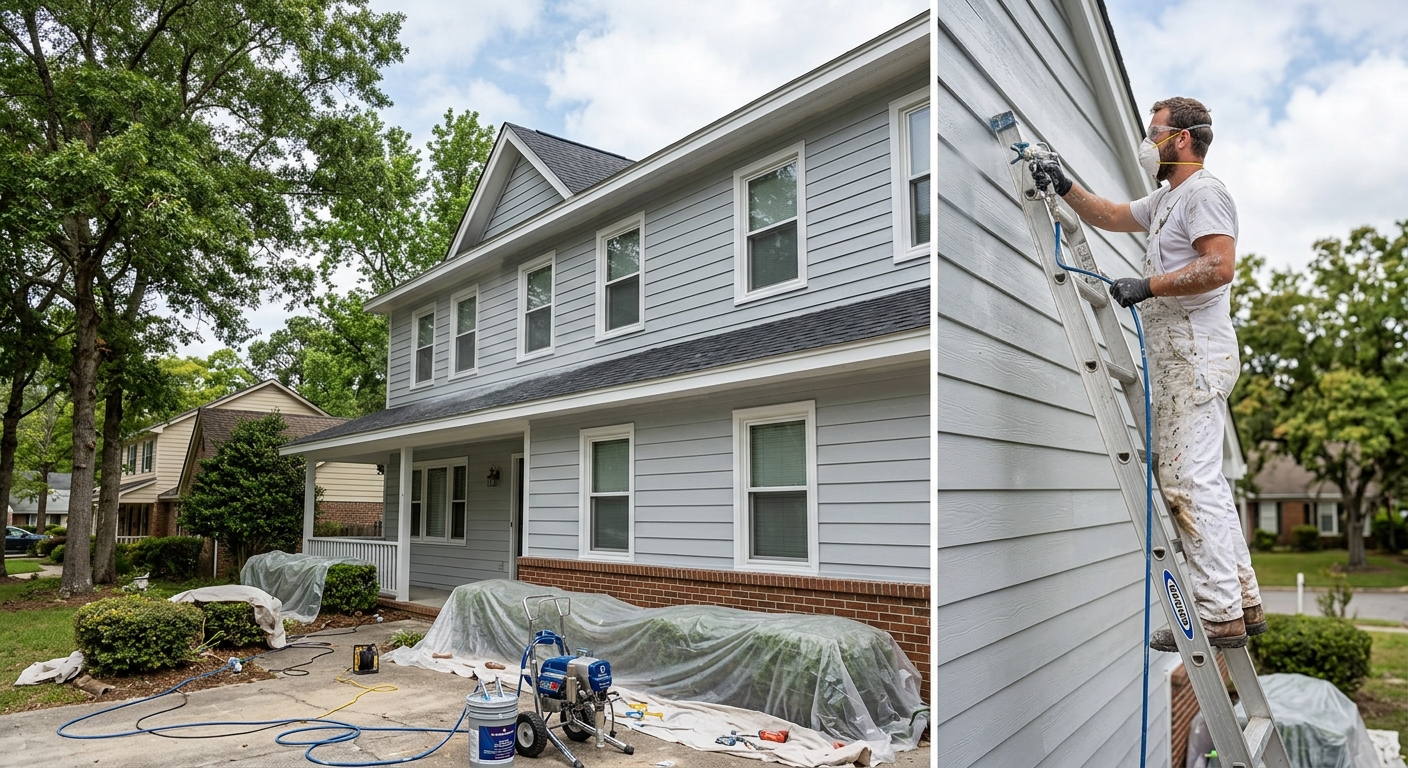
Painting options and costs in Colwood
Colwood homeowners usually have a clear picture of what they want, but the total cost of painting can swing quite a bit by project type—especially with Colwood’s older housing stock. In 2021, Colwood had 18,961 residents, and the housing profile includes 42.2% of homes built before 1981, which often means more time spent on scraping, patching, caulking, and priming on both exteriors and older interiors. If your home is pre-1978, professional lead-safe practices (testing planning and dust control) may be required as a standard of care for contractors.
On Vancouver Island and the Coast, exterior painting is tightly weather-windowed. Crews aim for late spring through early fall when temperatures are roughly 10°C to 30°C and humidity is manageable; coastal rain, morning dew, and frequent damp surfaces make scheduling and cure times more critical than in many inland regions. That shorter, reliable season also concentrates demand—particularly around popular areas like the Royal Bay neighbourhood and nearby Colwood core—so booking earlier typically improves both availability and pricing certainty.
Interior work is less season-bound, but labour rates and detailed finishes still reflect the same regional realities. For budgeting, you can use the bands below: interior painting commonly lands around $2,000 – $6,500 for a whole home, while exterior projects more often run from $3,500 – $12,000 depending on prep and scope. Use the table to compare service levels before you request itemised quotes.
| Service |
What's Included |
Typical Duration |
Price Range |
| Interior — whole home (walls, ceilings, trim) |
Protection, patching, sand/fill, caulking where needed, primer as required, 2-coat finish, basic trim detailing, cleanup |
4–10 days |
$3,800 – $6,500 |
| Interior — per room (standard bedroom or living room) |
Prep, patching, prime as required, 2-coat finish, masking and cleanup; ceilings included |
1–3 days |
$2,000 – $4,200 |
| Exterior — full house (siding, trim, soffits) |
Power wash (where appropriate), scraping/sanding, caulking, spot repairs, priming, 2-coat exterior system, protection and cleanup |
1.5–4 weeks |
$5,500 – $12,000 |
| Exterior — trim and accent colours only |
Surface prep and primer on trim, caulking as needed, 2-coat finish on selected areas, protection and cleanup |
1–2 weeks |
$3,500 – $7,800 |
| Kitchen cabinet painting (doors, frames, spray finish) |
Degrease, sanding/scuffing, bonding primer (as required), spray-ready prep, 2-coat finish, hardware handling, light touch-up |
1–2.5 weeks |
$2,200 – $5,000 |
| Specialty / faux finish (accent wall, texture) |
Design/colour prep, base coat system, texture/faux application, protective topcoat, detailed cleanup |
2–7 days |
$800 – $4,500 |
Prices are estimates only and vary by project scope, site access and material selection.
What affects the price of painting in Colwood
Even when two homeowners describe the “same” painting project in Colwood, bids can vary by 30–50% across Vancouver Island and Coast versus other regions in British Columbia. The reason isn’t just brand preference—it’s labour availability during the narrow exterior window, how much prep your surfaces need, and whether the contractor is pricing for weatherproofing and durability, not just coverage. For example, interior work often ranges within $2,000 – $6,500 depending on ceilings, trim, patching volume, and sheen selection, while exteriors commonly fall within $3,500 – $12,000 due to the time cost of prep and the need for a proper exterior system.
On Vancouver Island and the Coast, exterior painting is tightly climate-bound. Crews typically schedule late spring to early fall when temperatures stay roughly between 10°C and 30°C and humidity is manageable. Coastal BC’s marine climate means more frequent rain, morning dew, and higher humidity; that leads to careful forecast timing and the use of mildew-resistant, high-quality coatings. Shorter seasons concentrate demand into a few months, which increases summer scheduling pressure and can push labour rates higher. On top of that, older homes—42.2% built before 1981—often require more surface prep: scraping failing paint, sanding rough trim, patching weathered areas, caulking joints, and priming thoroughly. In many repainting jobs, prep alone can be 50–70% of labour.
Concrete examples in Colwood: a fibre-cement or wood siding repaint with heavy peeling and failing caulk usually comes in higher than an exterior trim refresh on a house with sound surfaces. Multi-storey homes in areas with limited access may require lifts or more extensive protection, raising costs. Conversely, a quick interior refresh in good condition—walls already smooth and uniform—can land nearer the lower end of interior room pricing.
| Price Factor |
Why It Matters |
Cost Impact |
| Surface prep — scraping, sanding, patching drywall or wood |
Prep determines adhesion and long-term appearance; older surfaces often need more stabilization |
Can shift total price by $1,000–$4,000+ |
| Number of coats — 2-coat system over primer vs. 1 coat over existing |
Proper coverage needs full dry/cure between coats; existing paint may not be consistent |
Typically +10% to +30% for the correct system |
| Paint quality tier — contractor-grade vs. premium (Benjamin Moore, Sherwin) |
Higher-quality coatings cover and resist mildew/fading better in damp coastal conditions |
Often +$200–$900 in materials; can reduce callbacks |
| Ceilings and trim — adds significant time vs. walls-only |
Trim work requires more cutting-in, sanding, caulking and careful sheen matching |
Can add $400–$2,500 depending on detail |
| Exterior season window — short season raises summer rates |
Weather planning affects crew scheduling; delays can mean higher labour costs |
Often +5% to +25% in peak months |
| Lead-safe precautions — required for pre-1978 homes with lead paint |
Dust control increases setup time and requires proper cleanup/disposal practices |
Can add $300–$1,500+ |
| Surface material — drywall vs. plaster vs. wood vs. stucco |
Different substrates need different primers and patching methods to prevent flashing/peeling |
Can add $250–$1,200+ |
| Height and access — multi-storey exterior requires scaffolding or lifts |
Access affects safety, protection, and labour time; it also changes the way coatings are applied |
Often +$800–$3,000+ |
Permits & regulations in British Columbia
In British Columbia, painting generally does not require a permit for typical interior or exterior repainting. However, for homes built before 1978, health guidelines strongly recommend considering lead paint testing before sanding, scraping, or aggressive prep. If lead is present, lead-safe work practices are the standard approach professionals follow: wet methods to reduce airborne dust, HEPA vacuuming, containment where needed, and proper disposal of debris. This is not typically “a homeowner permit requirement,” but it is the practical responsibility standard contractors apply to protect occupants and neighbours—especially important in close-in communities around Colwood.
What DOES require a permit is usually tied to broader work beyond painting (for example, major structural changes, certain window/door alterations, or some mechanical/plumbing modifications). Pure painting and typical caulking/priming and coating work generally does not trigger permitting in BC. Still, a good contractor should clearly list what they will do and what they are not responsible for.
Step-by-step verification for a Colwood contractor:
- Ask for a copy of their certificate of insurance and confirm liability coverage matches the project size.
- Request WSIB/WCB workers’ compensation coverage proof (or the applicable exemption documentation, if truly applicable).
- Get a written contract that specifies paint brand/line, sheen levels, number of coats, prep inclusions (scraping/caulking/priming), and surface-repair responsibility.
- Request evidence of lead-safe procedures for pre-1978 homes (method statement, dust control plan).
Finally, confirm the start date, completion estimate, and warranty terms in writing—so weather delays and scope changes are handled transparently.
Interior vs exterior painting — getting the best result in Colwood
In Colwood, the difference between a long-lasting job and premature failure is usually the same thing: prep discipline and correct system choices for coastal humidity and temperature swings. Interiors don’t face rain exposure, but they do face daily wear, cleaning, and uneven surface conditions. For interior painting, surface prep matters more than brand alone: filling and sanding to remove roughness, priming repaired areas, and caulking where joints open up. Sheen choice also drives real-world durability—flat or matte is often used on low-touch ceilings, eggshell or satin for many living areas, and semi-gloss on trim for cleanability. And the durability rule still holds: two coats over a proper primer consistently outlasts a single “thick” coat, because hiding and adhesion are achieved through the system, not thickness.
Exteriors in Vancouver Island’s marine climate depend on a similar discipline, but with extra sensitivity to moisture. Proper cleaning and surface preparation, caulking before painting to prevent water ingress, and choosing the right primer for the substrate are key. A premium mildew-resistant exterior coating helps manage damp conditions, and the exterior application needs to be timed so coats can dry and cure properly. Primer compatibility matters—oil vs. latex primers can change adhesion on different substrates like older wood or areas with inconsistent previous coatings.
Cabinet painting is often a strong budget alternative to replacement: you’re paying for preparation and fine spray application rather than new cabinetry. For a realistic example, homeowners who choose exterior trim and accents only (often in the $3,500 – $7,800 band) may save money versus a full-house repaint ($5,500 – $12,000), but only if the underlying siding coating is still sound and caulking/repair needs are modest.
And for pre-1978 homes, expect lead-safe precautions for sanding/scraping to be planned and priced—this is part of doing it right on older Colwood properties.
| Project Type |
Key Prep Step |
Recommended Coats |
Price Band |
| Interior — fresh drywall (new construction) |
Prime bare drywall and seal patch areas for uniform absorption |
Primer + 2 finish coats |
$2,500 – $6,500 |
| Interior — repaint (good condition, no repairs) |
Wash/scuff and spot-prime any stains or sheen changes |
2 finish coats (primer only if needed) |
$2,000 – $4,800 |
| Interior — repaint (patching and priming needed) |
Full sanding of patches, then spot-prime to prevent flashing |
Primer + 2 finish coats (patched areas may require additional prep) |
$3,000 – $6,500 |
| Exterior siding (wood or fibre cement) |
Scrape and caulk, then prime properly before topcoat |
2-coat exterior system (primer + 2 where needed) |
$5,500 – $12,000 |
| Exterior trim and accents only |
Detail prep: caulking joints and spot-priming bare or sanded areas |
2 finish coats (primer where the substrate is exposed) |
$3,500 – $7,800 |
| Kitchen cabinets (spray finish) |
Degrease thoroughly and sand/scuff for bonding |
Bonding primer + 2 finish coats (sprayed) |
$2,200 – $5,000 |
How to choose a painting contractor in Colwood
Choosing the right painter in Colwood comes down to verifying coverage, getting itemised scope, and confirming how the contractor handles prep, weather risk, and warranty. Start with licensing/registration expectations in BC where applicable: ask for proof of any required business registration and confirm you’re working with a contractor who can provide their documentation without delay. Then verify insurance: request a certificate of liability insurance and check that coverage is active and relevant to residential work. Next, confirm workers’ compensation coverage—request proof of WSIB/WCB coverage or the correct exemption documentation if applicable.
For quotes, avoid “lump sum only.” Ask for 2–3 itemised written quotes that break out labour and materials, including prep steps (scraping, sanding, patching, caulking), primer inclusions, number of coats, and disposal/cleanup. Clarify exclusions such as lead-safe procedures for pre-1978 homes, rotten wood replacement (if found), or repairs required beyond minor patching.
Warranty should be stated clearly: workmanship warranty length, what’s covered (peeling, adhesion failure, finish defects), and whether any product/manufacturer warranty transfers to you as the homeowner. Payment scheduling matters too—never pay more than 10–15% upfront, and request a holdback until the job is complete and final walkthrough notes are addressed. Finally, ask for a written timeline with start date and an estimated completion window; in coastal conditions, it should also reference how weather delays are managed.
- Request certificate of liability insurance and confirm the policy is current.
- Request proof of WSIB/WCB workers’ compensation coverage (or proper exemption documentation).
- Ask whether they carry lead-safe practices for pre-1978 homes and how they control dust.
- Get itemised quotes: labour hours, prep scope, primer type, paint line, and coatings system.
- Confirm number of coats and whether primer is included (not “2 coats of paint”).
- Ask what prep is included: scraping/pressure wash (where appropriate), sanding levels, and caulking responsibility.
- Clarify disposal: who removes and how debris is handled.
- Ensure site protection is included (floors, landscaping, gutters/fixtures cover-up as needed).
- Confirm warranty terms in writing and what voids coverage.
- Verify colour/finish sheen schedule (eggshell vs satin vs semi-gloss) in the contract.
- Ask for scheduling approach and how forecast/rain delays affect timelines.
- Confirm payment schedule: 10–15% max upfront and holdback until completion.
Red flags in Colwood: (1) quotes that skip or minimize exterior prep steps like caulking and primer, (2) no documentation for insurance/WSIB/WCB, (3) vague warranty language or “no warranty on adhesion,” (4) pressure for large upfront payments, and (5) unwillingness to put the paint brand/line, sheen, and number of coats in writing.
Frequently asked questions — painting in Colwood
What paint is best for Colwood's climate?
In Colwood and the wider Vancouver Island and Coast region, the “best” paint is the one designed for damp coastal conditions and timed application. For exteriors, I recommend a mildew-resistant, high-quality exterior coating paired with the correct primer for your substrate (wood, fibre cement, stucco, or previously coated surfaces). Because coastal BC weather brings morning dew and humidity, the system needs to dry and cure properly between coats, which is why contractors plan around late spring to early fall windows. For interiors, many homeowners choose washable finishes (often eggshell or satin) in living areas and semi-gloss on trim for easier cleaning. With older homes—42.2% built before 1981—priming repaired areas and spot-priming stains is just as important as the topcoat selection (Statistics Canada, 2021 Census).
How long does exterior paint last here?
Exterior paint life in Colwood depends mainly on prep quality and how well the coating system matches your surfaces. On a properly prepared repaint with correct caulking, primer selection, and two-coat application timed for manageable humidity and temperatures, many homes see several years of strong performance before visible fading or minor wear. If prep is rushed—insufficient scraping, missed failing caulk lines, or primer skipped in problem areas—coastal moisture can accelerate peeling and adhesion issues. That’s why a full exterior project (often in the $5,500 – $12,000 range) can feel higher than expected: a lot of the value is time spent getting the surface stable before paint goes on. If your home has heavy peeling or older joints, the longer-lasting solution is usually the properly primed system rather than spot touch-ups.
Should I paint or replace my cabinets?
In many Colwood kitchens, painting cabinets is a smart alternative to replacement because it refreshes the look without the time and disruption of a full remodel. Cabinet painting (commonly in the $2,200 – $5,000 range for spray-finish work) can deliver a very clean finish when surfaces are degreased thoroughly, sanded for bonding, and coated with a primer plus two durable finish coats. Replacement usually makes sense if cabinets are structurally damaged, have warped box frames, or if the layout needs to change significantly. For homes in damp coastal regions, cabinet finish longevity also improves when the prep is done properly and the coating system is suited for kitchens. If you’re considering it, ask for a short review of cabinet condition—doors, hinges, and box stability—so you can choose the most cost-effective option.
How do I prep walls before painting?
For homeowners, the safest approach is to prep lightly and let the contractor handle the paint-ready stage. Before painting, walls generally need dust removal, patching of holes, smoothing of rough areas, and caulking of edges where joints have opened up. If you have loose paint, crumbling texture, or visible moisture damage, don’t sand aggressively—especially in pre-1978 homes—because that can increase dust and the risk of disturbing hazardous material. Professionals typically wash or degrease where needed, sand to promote adhesion, then apply spot primer to prevent flashing (different sheen and patch boundaries). If you want to reduce prep cost, you can remove wall hangings, secure loose items, and clear furniture from the working area. Just avoid DIY scraping of suspect coatings if your home is older.
Do I need to worry about lead paint in an older Colwood home?
It’s a valid concern for older Colwood homes because your home’s build age increases the chance of lead-containing paint. The local profile shows 42.2% of homes built before 1981, and lead exposure risk is most associated with older coatings. In British Columbia, painting typically does not require a permit, but health guidelines recommend testing for lead paint before sanding or scraping when you suspect older layers. For professional contractors, lead-safe work practices are standard of care when lead is present: wet methods, HEPA vacuuming, containment as needed, and proper disposal. Homeowners aren’t always “legally required” to do testing, but for a safe, high-quality job, I recommend asking your contractor how they’ll handle lead-safe prep if the paint tests positive. If you’re unsure of your paint age, include this in the scope so it’s handled correctly.
How long does it take to paint a house?
Timing depends on interior vs exterior, the condition of surfaces, and the weather window. In Colwood, exterior painting is the one that can stretch out—because crews need drying time and at least a full day above about 10°C for proper curing, and coastal humidity/rain can interrupt schedules. A full exterior repaint commonly takes 1.5 to 4 weeks depending on prep volume, number of elevations, and access. Interiors are often faster: a whole-home interior project typically lands around 4 to 10 days for walls, ceilings, and trim, while individual rooms may take 1 to 3 days. If your project includes older-home lead-safe prep or extensive repairs, that can add time. If you want a smoother schedule, book early and confirm your contractor’s plan for forecast-driven changes in British Columbia.