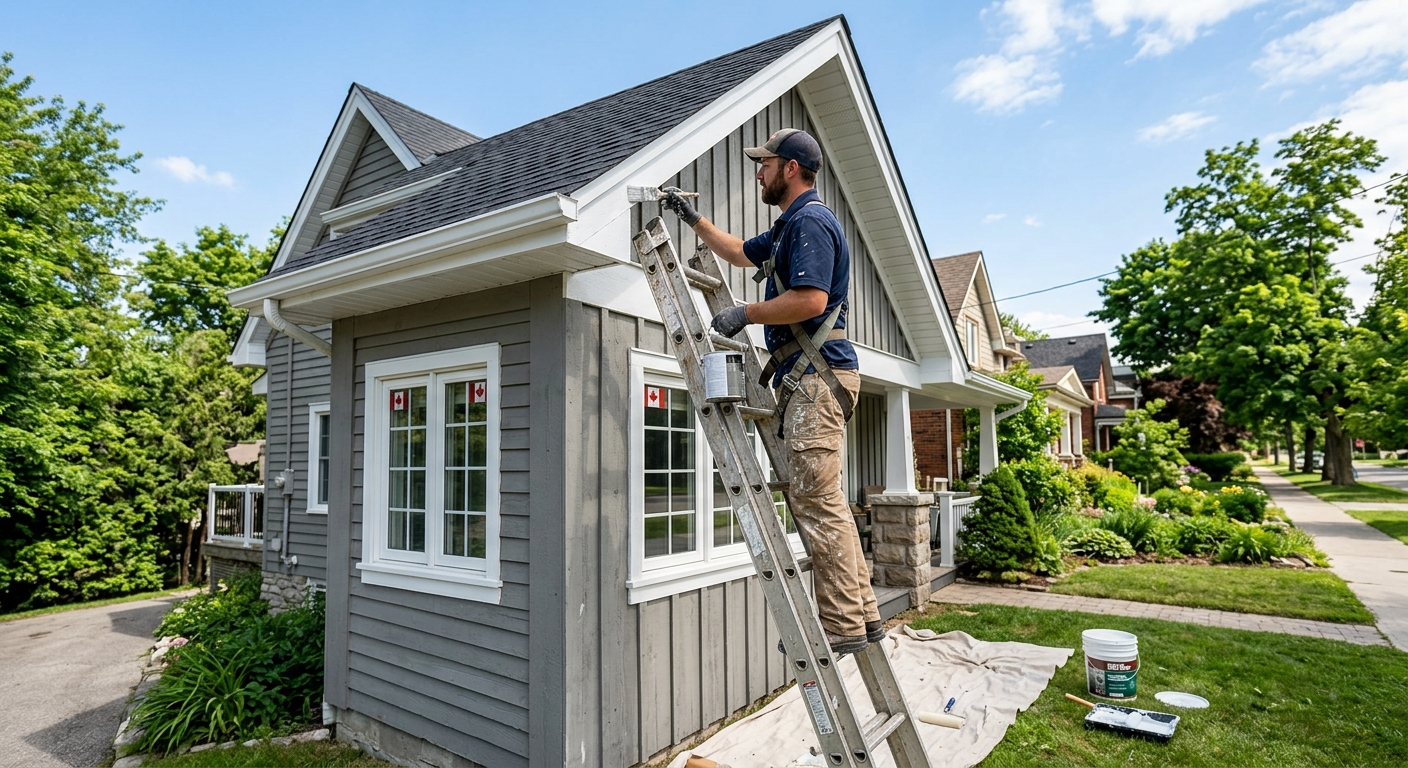
Painting options and costs in Midnapore
In Midnapore, Alberta, the “same” paint job can land at very different totals because prep work, access, and weather timing swing contractor schedules. Midnapore is a compact community with about 6,480 residents (Statistics Canada, 2021 Census), and most requests we see are either full interior repaints or the short, high-demand exterior season work. Calgary-area housing also includes a meaningful share of older stock, which often means more scraping, patching, caulking, and priming before the first top-coat—especially on trim and siding where prior DIY paint may not bond consistently. If your home is pre-1978, lead-safe precautions are standard practice for pros (even when not legally required for homeowners), and that can add time and materials.
Pricing is also shaped by Alberta’s temperature swings and the Calgary region’s tight exterior window. In our area, exteriors are typically scheduled from about mid-May to late September, when daytime highs reliably stay above 10°C and surfaces can dry properly. Because the workable season is weather-dependent, peak slots book quickly, so exterior quotes often firm up compared with shoulder-month projects. Interiors are less season-sensitive, but labour still rises with ceiling heights, trim density, and the complexity of repairs.
Demand is especially strong around Midnapore’s main residential corridors and cul-de-sacs, where families tend to repaint between selling and moving seasons. Use the estimates below as a starting point, then we’ll narrow the range once we confirm prep, coatings, and access.
| Service |
What's Included |
Typical Duration |
Price Range |
| Interior — whole home (walls, ceilings, trim) |
Surface prep (fill/sand where needed), caulking of gaps, prime if required, 2-coat system on walls/ceilings, paint trim/doors, dust protection and cleanup |
3–8 days |
$2,000–$6,500 |
| Interior — per room (standard bedroom or living room) |
Prep, spot-prime where needed, 2-coat walls (and ceiling if requested), paint door trim/baseboards, basic protection and cleanup |
1–3 days |
$400–$1,600 |
| Exterior — full house (siding, trim, soffits) |
Pressure wash/degrease as required, scrape/sand, patch and caulk, stain-block where needed, prime bare spots, 2-coat exterior system with flexible coating where appropriate, protection and cleanup |
5–14 days (weather-dependent) |
$4,500–$9,000 |
| Exterior — trim and accent colours only |
Surface prep on trim only, prime as needed, 2-coat application on selected exterior areas, caulking and cleanup |
2–6 days |
$2,500–$5,800 |
| Kitchen cabinet painting (doors, frames, spray finish) |
Degreasing, sanding/flatting, bonding primer where required, spray finish doors (and frames if accessible), hardware handling as agreed, multi-step coats for durability, cleanup |
4–10 days |
$2,200–$5,200 |
| Specialty / faux finish (accent wall, texture) |
Prep and priming for the chosen effect, base coat + specialty technique, topcoat for protection, protection and cleanup |
1–5 days |
$600–$4,000 |
Prices are estimates only and vary by project scope, site access and material selection.
What affects the price of painting in Midnapore
In the Calgary region, it’s common for the same paint scope to swing by about 30–50% depending on prep depth, product selection, and how much access work is needed. One quote may assume “paint-ready” surfaces; another includes the reality we see in older neighbourhoods—flaking paint, uneven drywall finishing, cracked caulk lines, and stain bleed-through. Exterior work is especially sensitive to schedule because the season is tightly climate-bound: in Alberta, contractors need temperatures above 10°C and proper drying time, typically from late May to early October. Coastal BC generally has a longer usable season, but higher humidity and frequent rain mean more timing restrictions and mildew-resistant product requirements. Here in Midnapore, freeze–thaw cycles plus strong UV and occasional hail push us toward better acrylics and flexible exterior coatings, which can raise material costs but reduce premature peeling.
Older homes around Calgary often require extensive prep—scraping, patching, caulking, and priming can represent 50–70% of total labour on a repaint. In practice, that prep can move a home from a mid-range interior total toward the upper end of the $400–$8,000 interior band, and from a lower exterior estimate toward the top of $2,500–$9,000. For example, if your exterior has bare spots plus failing caulk at joints, the job becomes more than “top-coating”—it turns into a multi-step coating system. Conversely, if your siding is well-bonded and caulk lines are intact, labour can drop quickly, and trim-only accents may stay closer to the lower end.
In Midnapore specifically, another cost driver is access: garages with narrow sides, multi-storey fronts, and dense landscaping can require more protection, careful staging, and additional time—so two homes with the same square footage can price differently.
| Price Factor |
Why It Matters |
Cost Impact |
| Surface prep — scraping, sanding, patching drywall or wood |
Poor adhesion and visible imperfections usually come from insufficient prep, not the paint brand |
Often increases labour the most; prep can be 50–70% of repaint labour |
| Number of coats — 2-coat system over primer vs. 1 coat over existing |
Coverage and durability depend on how well primer seals stains and old colour |
Skipping coats can reduce cost short-term but raises failure risk |
| Paint quality tier — contractor-grade vs. premium (Benjamin Moore, Sherwin) |
Premium coatings typically improve hide, cleanability, and long-term adhesion |
Materials may rise, but fewer touch-ups can offset cost |
| Ceilings and trim — adds significant time vs. walls-only |
Cut-in work, masking, and detail coating increase labour hours |
Can push interior budgets toward the upper band |
| Exterior season window — short season raises summer rates |
Weather-dependent drying affects availability and scheduling |
Season pressure can firm pricing during peak weeks |
| Lead-safe precautions — required for pre-1978 homes with lead paint |
Testing/containment and HEPA cleanup are additional steps for safety |
Adds time/materials when lead is present or assumed |
| Surface material — drywall vs. plaster vs. wood vs. stucco |
Different substrates require different primers, repair methods, and sheen control |
Wrong primer can cause bubbling or peeling—cost rises with proper corrections |
| Height and access — multi-storey exterior requires scaffolding or lifts |
Access equipment increases labour and staging time |
Can materially raise exterior costs beyond the base range |
Permits & regulations in Alberta
For Alberta homeowners in Midnapore, painting typically does not require a permit. We’re not dealing with permits for standard interior painting, or for routine exterior painting using approved coatings. The “regulatory” focus tends to be health and safety rather than municipal paperwork. For homes built before 1978, health guidelines recommend testing for lead paint before sanding or scraping, and using lead-safe work practices if lead is present—things like wet methods, HEPA vacuuming, minimizing dust, and proper disposal. This isn’t usually a homeowner legal requirement, but it’s the standard contractors follow when lead is suspected or confirmed.
When you hire a pro, insist on the basics in writing: confirm the contractor carries liability insurance and has workers’ compensation coverage (WSIB/WCB) for their crew. Then ask for a written contract that spells out the paint brand and sheen (e.g., interior eggshell vs. satin), the number of coats, and exactly what surface prep is included—such as scraping, patching, caulking, priming, and stain blocking.
What does require a permit? In most homeowner painting projects, nothing is permit-triggered; however, if your scope includes structural repairs, roof replacement, or work that changes building systems, those can fall into different permit categories. For painting itself, confirm the contract covers prep and cleanup, and don’t assume paint will “erase” existing failure.
Step-by-step checks: (1) Ask for the Alberta contractor licence details and verify via the applicable online registry listing for contractors; (2) request a current certificate of liability insurance showing your project/contractor name; (3) verify WSIB/WCB clearance or coverage letter (ask them to provide proof before start). Only then schedule paint days—weather and prep quality depend on having the right team on site.
Interior vs exterior painting — getting the best result in Midnapore
The biggest difference between a long-lasting paint job and a premature failure in Midnapore is prep discipline, especially in exterior work where winter conditions and UV exposure show every shortcut. For interiors, brand matters, but surface prep matters more: filling and sanding patched areas, proper caulking, and priming when you’ve got repairs or stains. Sheen is another performance lever. In active rooms like hallways and family spaces, satin or eggshell usually handles cleaning better than flat paint. Two coats over a properly matched primer nearly always outlast one thick coat because the coating film builds evenly and dries to the intended finish.
For exteriors, Alberta’s freeze–thaw cycles and hail/UV drive the need for careful caulking before painting to prevent water ingress behind siding and trim. Primer selection is also substrate-specific: wood and certain repairs may require bonding and/or stain-blocking primers; latex or oil-based systems can both work when matched to surface conditions. We also plan around temperature stability and drying time—products are chosen to tolerate local conditions, and on repaint jobs we don’t treat caulk joints as “optional.” For older Midnapore homes, lead-safe precautions are part of our standard approach when pre-1978 lead paint is suspected.
Cabinet painting is a strong budget alternative to replacement if the finish prep and spray process are done correctly. For a practical example: a full kitchen cabinet replacement often costs far more than the painting scope; if your cabinets are in sound condition, the cabinet painting band of $800–$7,000 (depending on size and finish level) can be justified because you’re paying for surface work and durable coatings rather than new materials and installation.
| Project Type |
Key Prep Step |
Recommended Coats |
Price Band |
| Interior — fresh drywall (new construction) |
Prime bare drywall and sand for uniform smoothness before colour |
1 primer + 2 colour coats |
$700–$2,800 |
| Interior — repaint (good condition, no repairs) |
Light scuff/cleaning, spot-prime only where needed |
2 colour coats |
$400–$1,600 |
| Interior — repaint (patching and priming needed) |
Patch, sand, caulk gaps, and prime repairs to stop flashing |
1 primer (spots) + 2 colour coats |
$900–$3,200 |
| Exterior siding (wood or fibre cement) |
Scrape/sand, address failing caulk, prime bare spots and stain areas |
1 primer (as needed) + 2 exterior coats |
$4,500–$9,000 |
| Exterior trim and accents only |
Caulk joints and prep trim edges to avoid peeling at transitions |
1 primer (as needed) + 2 exterior coats |
$2,500–$5,800 |
| Kitchen cabinets (spray finish) |
Degrease, bond-prime, and sand between coats for adhesion and smoothness |
Bond primer + 2–3 finish coats (based on system) |
$2,200–$5,200 |
How to choose a painting contractor in Midnapore
Choosing a painter is easier when you verify coverage and scope up front. In Alberta, you should confirm the contractor carries liability insurance and WSIB/WCB workers’ compensation coverage before work starts—this protects you if something is damaged or a worker gets injured on your property. Ask for proof: a current certificate of insurance for liability (showing your contractor as named insured) and a WSIB/WCB clearance or coverage letter that matches the company name doing the work. For licensing, request the contractor’s licence details and verify them through the appropriate Alberta online registry so you’re not relying on verbal assurance.
Then get 2–3 itemised written quotes. A reliable quote breaks labour and materials into clear lines (prep, primer, paint, caulking, equipment/access, and disposal), rather than lump sums that hide differences. Read the exclusions carefully: is furniture moving included, are patch repairs included, is pressure washing required, is disposal included, and are rain delays or extra prep days handled? Clarify whether permits are included (normally not for painting), and whether cleanup includes dust control and vacuuming after sanding. Also confirm warranty: workmanship warranty length, what it covers, and whether the product/manufacturer warranty is transferable if you sell your home.
Payment schedule matters. Never pay more than about 10–15% upfront; hold back the remainder until the job is complete and you’ve reviewed touch-ups. Ask for a start date and completion estimate in writing, with clear weather contingencies for exterior painting.
- Confirm liability insurance and WSIB/WCB proof before signing.
- Ask what paint system is proposed (brand and sheen), not just “good paint.”
- Ensure surface prep is written: scrape, sand, patch, caulk, and prime scope.
- Request an itemised materials list (primer type, caulking product, topcoat system).
- Clarify disposal: sanding debris, caulk tubes, masking materials, and cleaning waste.
- Check if furniture moving, floor protection, and masking are included.
- Confirm whether ceilings are included or billed separately.
- Ask how they manage dust control for sanding and prep (HEPA vacuum for dusty work).
- Verify access methods (lifts/scaffolds) for multi-storey exteriors.
- Get their workmanship warranty in writing, including start date and claim process.
- Ensure caulking is done before top-coat and matched to exterior junctions.
- Agree on a written change-order process if hidden issues appear.
Red flags in Midnapore include: refusing to show insurance/coverage documents, quoting only “paint” without specifying primer and prep, asking for most payment upfront, giving a vague start date for exterior work without weather contingencies, and dismissing cracking/peeling as “just cosmetic” instead of addressing adhesion and caulk joints.
Frequently asked questions — painting in Midnapore
How do I compare painting quotes?
When comparing Midnapore painting quotes, match scopes first. Look for the same prep steps (scraping, sanding, patching, caulking, and priming), the same coat counts (usually a 2-coat system over appropriate primer), and the same paint line and sheen. If one quote says “2 coats” but another includes stain-blocking and additional priming for repairs, their totals aren’t truly comparable. Ask for an itemised breakdown for labour and materials, including disposal and protection (floor coverings, masking, and dust control). For reference, a typical interior per-room job can range roughly from $400–$1,600, while full exterior work often falls into the $2,500–$9,000 spectrum depending on prep and access.
What paint sheen should I use in different rooms?
In Alberta homes around Midnapore, sheen is mostly about durability and how the room gets cleaned. Flat/eggshell/soft-matte hides wall imperfections best, so eggshell is often a good compromise for bedrooms and living rooms. For kitchens, hallways, and family rooms, choose eggshell or satin—satin resists scuffs better during day-to-day cleaning. For bathrooms, consider moisture-resistant products and an appropriate sheen that tolerates regular wiping. Trim and doors generally look best with semi-gloss or satin for a clean, wipeable finish. If you’re repainting, keep sheen consistent across the same surface type to reduce “flashing” or sheen mismatch. A professional primer and proper coat build can matter as much as sheen choice.
Can I paint my house exterior in spring or fall in Midnapore?
You can, but timing is everything in Midnapore’s Calgary-area climate. Exterior painting typically needs daytime temperatures above about 10°C and enough drying time between coats, so most contractors plan the main season from mid-May to late September. Spring can work when weather stabilizes, but cold snaps and early frosts can stop progress—especially if surfaces can’t dry properly after rain. Fall is similar: even if it looks sunny, overnight lows and moisture can prevent correct cure, which increases the risk of blistering or poor adhesion. If you’re looking at the exterior band of $2,500–$9,000, expect scheduling pressure during peak weeks, and plan for weather-dependent holdbacks on start dates.
How do I choose a painting contractor in Midnapore?
Start with verification: confirm Alberta liability insurance and WSIB/WCB workers’ compensation coverage before work begins. Ask for a current certificate of insurance and proof of coverage that matches the company doing the job. Then request the contract’s details in writing—paint brand, sheen, number of coats, and the full prep scope (including scraping, patching, caulking, and priming). Get 2–3 itemised quotes so you can see labour and material differences rather than comparing lump sums. Pay attention to the workmanship warranty length and what it covers, plus whether manufacturer warranties apply to the products used. Finally, protect yourself with payment terms: don’t pay more than about 10–15% upfront and hold a portion until completion and punch-list touch-ups.
How many coats does an exterior repaint need in Midnapore?
In Midnapore, exterior repaints almost always involve a 2-coat top system for durable coverage, but the exact build depends on surface condition. Typically, we apply 2 exterior coats over primer where bare wood, repaired areas, or stained spots require sealing. If you have good adhesion and minimal repair, primer may be limited to spots; if you have failing paint, stains, or extensive caulking junction repairs, primer coverage increases. That’s why quotes vary across the $2,500–$9,000 exterior range—prep and primer needs can add cost even when the visible “final colour” seems straightforward. Weather also affects application and cure: we schedule around workable temperatures so coats dry properly between applications.
What is the best primer for older Midnapore homes?
For older Midnapore homes, the “best” primer depends on what’s under the current paint layer—adhesion condition, substrate (wood, fibre cement, stucco), and whether repairs or staining are present. If there are bare spots, we prime for bonding and uniform absorbency. If there’s tannin staining or heavy odours from water damage, stain-blocking primer can be necessary to prevent bleed-through. Where lead paint is suspected in pre-1978 homes, pros use lead-safe methods before sanding/scraping and choose primers that support a stable coating system. In your quote, ask the contractor to name the primer type and explain why it’s selected. A strong primer step is one of the best ways to prevent peeling and flaking in Alberta’s sun, UV, and freeze–thaw cycles.