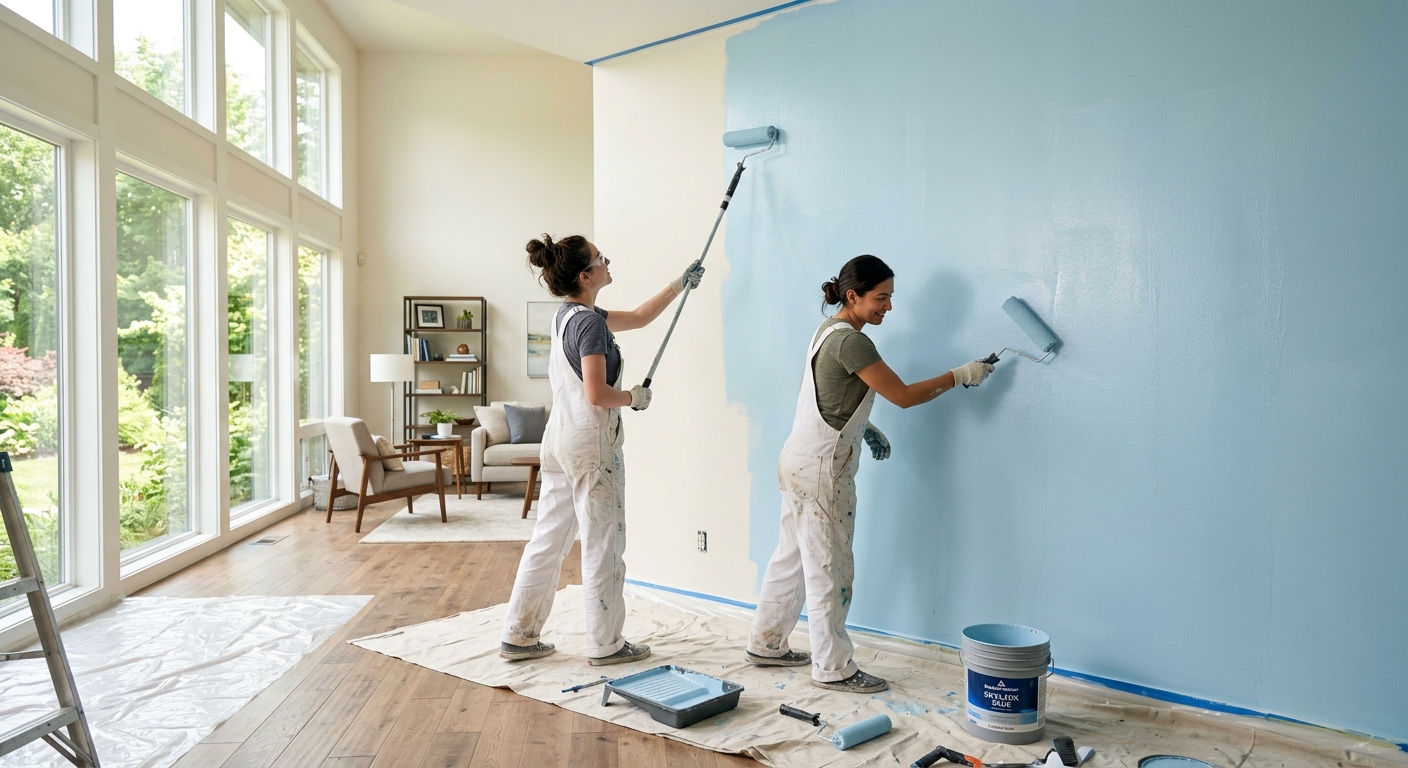
Painting options and costs in Cranston
Cranston homeowners usually ask for “the same paint job,” but the scope and prep level can change a lot from house to house. In the 2021 Census, Calgary’s profile shows a population of 20,850 for Cranston (Statistics Canada, 2021 Census), and that demand density is part of why scheduling can tighten during summer. Another driver is home age: across the Calgary region, a meaningful share of housing dates back before 1980, which often means more surface prep (scraping, patching, caulking, stain-blocking) before any top-coat goes on. For pre-1978 trim and siding, contractors commonly plan lead-safe work practices before sanding or scraping, even when homeowners are not legally required to do so.
In Cranston, the exterior pricing is especially sensitive to weather. Our workable season typically runs from about mid-May to late September, with daytime highs staying above 10°C and surfaces drying properly; when that window is busy, peak-season slots book fast and rates are firmer than shoulder months. Interiors are less weather-bound, but labour still rises with ceiling height, stair access, and how much repair work is needed after prior DIY touch-ups.
If you’re comparing budgets, start by matching your situation to a typical range. Use the table below to gauge whether you’re in a standard repaint or a prep-heavy job that pushes costs toward the upper end—then we can tighten it with a site visit and a clear scope.
| Service |
What's Included |
Typical Duration |
Price Range |
| Interior — whole home (walls, ceilings, trim) |
Protect floors/furnishings, patch & sand, caulk where needed, prime stained areas, paint walls/ceilings per room plan, paint interior trim/doors, cleanup and dust control |
5–10 days |
$1,500 – $6,500 |
| Interior — per room (standard bedroom or living room) |
Prep, patch & sand, spot prime as required, paint walls and one ceiling, optional simple trim touch-up (not full door/trim detailing unless noted) |
1–3 days |
$400 – $1,800 |
| Exterior — full house (siding, trim, soffits) |
Power washing/decontamination (as needed), scrape/sand loose paint, caulk exterior joints, prime bare/spot areas, paint siding with weather-ready acrylic system, paint trim/soffits, full cleanup |
2–4 weeks (weather-dependent) |
$2,500 – $9,000 |
| Exterior — trim and accent colours only |
Scrape/sand localized areas, spot prime, caulk where required, paint designated trim/accents, protect surrounding surfaces, cleanup |
4–10 days |
$900 – $4,200 |
| Kitchen cabinet painting (doors, frames, spray finish) |
Degrease/clean, light scuff prep, bonding primer where needed, spray/brush finish with proper cure, hardware protection, re-install, touch-up and final cleanup |
1–2 weeks (plus cure time) |
$800 – $7,000 |
| Specialty / faux finish (accent wall, texture) |
Surface prep, base coats, texture/faux process, multiple controlled coats, protective sealing (where required), cleanup |
1–7 days |
$600 – $6,000 |
Prices are estimates only and vary by project scope, site access and material selection.
What affects the price of painting in Cranston
Even when two homeowners describe the “same” repaint in Cranston, quotes can swing by 30–50% across the Calgary area because prep complexity is rarely identical. Labour pricing depends on how much time it takes to get surfaces acceptably sound—scraping loose paint, sanding edges, patching drywall or wood, caulking gaps, and priming stains or bare substrates. Materials can also change the total: a contractor-grade system versus a premium elastomeric/flexible exterior coating, plus the right primers for the substrate, will shift your top-end cost.
Exterior costs are tightly climate-bound in the Calgary region. We typically need mid-May to late September conditions: daytime highs above about 10°C and enough drying time after rain. In Ontario and Alberta, the workable exterior window is roughly late May to early October and projects must progress quickly when schedules open. Coastal BC can look busier on paper because the season is longer, but high humidity and frequent rain mean product selection and timing are more demanding; here in Cranston, freeze–thaw cycles, strong UV, and hail influence how we specify durable acrylics and flexible coatings—so the correct system matters.
Older homes throughout the region often require the kind of prep that makes up 50–70% of repaint labour. For example, filling and priming damaged drywall seams plus stain-blocking can move you from the interior “per room” range toward the “whole home” band because repairs tend to multiply when the walls are opened up. On the exterior, a house with widespread peeling or failed caulking can push toward the upper part of the $2,500 – $9,000 exterior band, whereas a trim-only refresh may stay closer to the lower end of the same market reality. If you’re dealing with wood/fibre cement and multi-storey access, those variables can add thousands even before the first can is opened.
| Price Factor |
Why It Matters |
Cost Impact |
| Surface prep — scraping, sanding, patching drywall or wood |
Prep determines adhesion and finish longevity; it’s usually the largest labour driver on repaints |
Can account for 50–70% of labour on repaint work |
| Number of coats — 2-coat system over primer vs. 1 coat over existing |
Coverage and durability depend on proper layering; 2 coats over primer reduces flashing and peeling risk |
Typically adds 10–25% versus a minimal-coat approach |
| Paint quality tier — contractor-grade vs. premium (Benjamin Moore, Sherwin) |
Premium systems often hide better and handle UV/flex better; exterior warranties may require specific systems |
Materials can shift 5–20% depending on product tier and sheen |
| Ceilings and trim — adds significant time vs. walls-only |
Ceilings increase masking and ladder time; trim adds edge work and extra cure time |
Commonly adds 15–35% to interior scope |
| Exterior season window — short season raises summer rates |
Weather limits exterior scheduling; peak season increases demand and crew utilization |
Can raise exterior pricing by 10–25% in busy weeks |
| Lead-safe precautions — required for pre-1978 homes with lead paint |
Professional methods add time and controls (containment, HEPA cleanup, disposal planning) |
Often adds 5–15% on prep-heavy projects |
| Surface material — drywall vs. plaster vs. wood vs. stucco |
Different substrates need different primers and patching approaches for bonding and absorption control |
Can swing 10–30% depending on what’s underneath |
| Height and access — multi-storey exterior requires scaffolding or lifts |
Access equipment, safety setup, and extra protection add both time and overhead |
Can add 15–40% to exterior labour on taller homes |
Permits & regulations in Alberta
In Alberta, painting typically does not require a permit for ordinary interior or exterior paint work. Where permits may come up is not usually “painting the wall,” but related scope such as structural modifications, significant building-envelope changes, or work requiring separate trade sign-offs. For standard repainting—prep, caulking, priming, and applying paint—no routine painting permit is typically needed.
That said, health guidelines matter for homes built before 1978. If lead paint is present, best practice is to test and then use lead-safe work practices before sanding or scraping: wet methods to reduce dust, HEPA vacuuming, proper bagging/disposal, and containment where feasible. For homeowners in Cranston, this isn’t legally mandated for you personally in the way it is for licensed contractors doing hazardous work; however, professional crews generally follow these methods as standard practice to protect occupants and workers.
When you hire, confirm the contractor carries liability insurance and has WSIB/WCB coverage for workers. Ask for written proof before work starts.
To verify step-by-step in Cranston, do the following: (1) check the contractor’s business information/licence using the appropriate Alberta directory or listing they provide, (2) request a certificate of insurance naming you correctly as the certificate holder if available, (3) confirm WCB/WSIB coverage documentation or account status, (4) get a written contract listing paint brand, sheen, number of coats, and exactly which prep steps are included, and (5) ensure your contract specifies cleanup/disposal scope so it’s not left vague.
Interior vs exterior painting — getting the best result in Cranston
In Cranston, the “best result” isn’t about picking the most expensive bucket—it’s about matching prep, coatings, and sheen choices to our climate and how the home is used. For interiors, premature failure is most often caused by inadequate surface prep: filling and sanding rough repairs, priming patched areas, and addressing stains or markers before top-coat. Sheen matters too. Flat or matte can look great on low-use ceiling surfaces, while eggshell is a common choice for bedrooms and living rooms because it balances washability with a soft finish. In higher-touch areas like hallways, satin or low-sheen eggshell holds up better.
For the exterior, Alberta performance hinges on caulking and substrate preparation. We caulk exterior joints before painting to prevent water ingress—because even a good top-coat can fail if moisture gets behind it. Primer choice is also critical: different substrates (new drywall-like patches, bare wood, or weathered masonry/fibre cement) require compatible primers to promote adhesion. In Calgary conditions (freeze–thaw, UV intensity, and occasional hail impacts), we specify durable acrylic systems and flexible/elastic coatings where the siding system calls for it, not just standard interior latex.
Cabinet painting is often a better budget alternative than replacement when the box is structurally sound. If you’re deciding between full cabinet replacement and cabinet painting, the price gap can be justified: a typical cabinet painting scope sits within $800 – $7,000. If your layout allows full painting without structural changes, that’s often materially less than replacement—especially when you factor in demolition, new cabinet lead times, and re-installation costs.
For pre-1978 homes, lead-safe precautions remain important for trim and doors. Getting prep right is what protects your finish—because the top-coat is only as durable as the surface it bonds to.
| Project Type |
Key Prep Step |
Recommended Coats |
Price Band |
| Interior — fresh drywall (new construction) |
Seal + prime new drywall to control absorption before finish paint |
1 primer coat + 2 top-coats |
$1,500 – $6,500 |
| Interior — repaint (good condition, no repairs) |
Clean/degloss, minor patching only, spot prime if needed |
1–2 coats top-coat (often 2 for uniform colour) |
$400 – $2,800 |
| Interior — repaint (patching and priming needed) |
Patch, sand, and prime repaired areas plus stain-blocking where required |
2 top-coats over spot primer (full 2-coat approach) |
$900 – $8,000 |
| Exterior siding (wood or fibre cement) |
Scrape/sand loose paint, prime bare areas, and caulk joints before top-coat |
1 primer system + 2 exterior top-coats (system-dependent) |
$2,500 – $9,000 |
| Exterior trim and accents only |
Spot prep and prime, then feather edges for colour uniformity |
1 primer spot + 2 coats to match finish |
$900 – $4,200 |
| Kitchen cabinets (spray finish) |
Degrease and use bonding primer where required for cabinet adhesion |
Bonding primer + 2 finish coats with proper cure |
$800 – $7,000 |
How to choose a painting contractor in Cranston
Start by confirming the contractor can legally and responsibly do the work. Ask for proof of liability insurance—then verify the coverage is current and that the certificate reflects your job address where possible. Next, request documentation of WSIB/WCB coverage for workers; if a contractor can’t provide it, that’s a major risk for you. Then, verify their business details/licence standing using the Alberta registry or the information they provide in writing, and match it to the quote paperwork so you know you’re dealing with the same entity that will show up on-site.
Get 2–3 itemised written quotes. You want a labour + materials breakdown, not just a single number. Ensure the scope is comparable: what’s included for prep, primer, caulking, cleanup, and disposal? Ask whether the quote includes a permit pull if one is required for your specific building situation (most paint work doesn’t need one in Alberta, but exclusions happen). Clarify staging: interior involves dust control and protection; exterior often requires scaffolding/lifts and weather monitoring.
Warranty should be in writing. Ask for the workmanship warranty length (and what it covers), the product/manufacturer warranty, and whether you’ll keep coverage after project completion. Payment schedule matters too: never pay more than 10–15% upfront. Hold back until the job is complete and walk through punch-list items. Finally, get a timeline with a start date and completion estimate in writing—especially for exterior painting, where rain and overnight temperatures can push dates.
- Ask for a detailed scope of work: prep steps, primer type, and caulking included or excluded
- Confirm the crew uses surface prep appropriate to the substrate (drywall, wood, fibre cement)
- Request paint brand and sheen listed by room/surface
- Check insurance certificate dates and the contractor name matches the quote
- Verify WSIB/WCB coverage documentation before work starts
- Get written disposal/cleanup details (drop-off, waste bagging, jobsite sweeping)
- Confirm whether trim work includes door hardware protection and fine edge cutting
- Ask about how they protect landscaping, driveways, and exterior windows
- Request a written colour plan and test patches for tricky lighting
- Ensure warranty is specific (workmanship vs. product) and stated in the contract
- Use a payment schedule with a holdback until completion/punch-list sign-off
- Get a weather plan for exterior work (what happens if rain/overnight lows delay coats)
Red flags in Cranston include: quotes with vague “includes prep” wording, refusals to provide insurance/WSIB/WCB proof, unusually low pricing that skips primer or caulking, no written warranty terms, and pressure to pay the full amount before any work starts.
Frequently asked questions — painting in Cranston
How do I prep walls before painting?
For most Cranston interior repaints, prep determines whether the finish looks smooth months later. First, remove dust and grease: wipe walls with a damp cloth and a mild degreaser for areas near kitchens or handprints. Patch holes and dents with proper filler, let it cure, then sand until it’s flush—feather edges so you don’t see repair lines under light. If there are stains (water marks, nicotine, or tannin bleed), spot prime those areas; otherwise, the stain can bleed through. If you’re dealing with peeling paint, plan for scraping down to sound edges and then priming. If you want a contractor-grade result, the best approach is often professional prep—especially on previously DIY-touched walls where adhesion problems are hidden.
Do I need to worry about lead paint in an older Cranston home?
If your Cranston home is pre-1978, you should be mindful of lead paint risks, particularly on trim, doors, and older siding where paint layers are thicker. Alberta doesn’t typically require homeowners to obtain permits for paintwork, but health guidelines recommend testing and using lead-safe methods if lead is present before sanding or scraping. For professionals, that means containment, wet methods to keep dust down, HEPA vacuuming, and proper disposal planning—so the work is safer for occupants and workers. If you’re getting quotes, ask whether lead-safe practices are included for pre-1978 components. It can affect labour time, and in some cases shift your project toward the upper end of interior or exterior ranges, because careful prep costs time.
How long does it take to paint a house?
In Cranston, interior timelines depend on repairs and access, while exterior timelines depend on weather. A whole-home interior project often takes about 5–10 days of labour, assuming surfaces are reasonably ready and repairs are straightforward; drying/cure times are built into the schedule. Exterior painting is weather-dependent and commonly takes 2–4 weeks overall because coats must dry and stay above workable temperatures (roughly mid-May to late September conditions with daytime highs above 10°C). If your exterior needs heavy scraping and caulking, prep can take longer than the actual spraying/rolling days. If you’re budgeting, remember timing can also affect cost: peak summer demand can tighten scheduling and push pricing toward the higher end of the $2,500 – $9,000 exterior band.
What's the difference between paint quality tiers?
Paint quality tiers generally differ in how well they cover, how smoothly they lay out, and how they resist fading and wear. Premium lines (often like those sold under brands such as Benjamin Moore or Sherwin) tend to provide better hide, more consistent sheen, and improved durability—especially important for exteriors under Alberta UV and freeze–thaw. Higher-quality coatings can also mean fewer “workarounds,” like additional spot-coats to correct uneven coverage. On interiors, quality impacts washability and touch-up friendliness, which matters in hallways and family rooms. The trade-off is cost: switching from a contractor-grade approach to a premium system may raise material costs, but it can keep your job from escalating into repeated patching and repainting. That’s why we tie product selection to the prep and substrate rather than pitching upgrades blindly.
How do I compare painting quotes?
When comparing quotes for Cranston homes, insist on itemised scopes so you can tell what’s actually included. Compare labour and materials separately, and make sure each quote lists paint brand and sheen, number of coats, and the prep steps (scraping, sanding, patching, caulking, and priming). Look for exclusions like “prep only where needed” or “no priming on minor repairs”—those can change the final outcome. Confirm cleanup and disposal are included. For exterior work, ask how they manage weather delays and whether they allocate time for rain/temperature setbacks during the short workable season. If one quote lands near the middle of the $400 – $8,000 interior band while others jump higher, the difference is usually prep complexity or trim/ceiling/detail work, not just the colour.
What paint sheen should I use in different rooms?
Sheen choice is part durability, part appearance. For ceilings, many homeowners choose flat or matte because it hides imperfections and keeps reflections low. For living rooms and bedrooms, eggshell or a soft low-sheen is a common balance: it’s easier to wipe than flat and still looks warm. Kitchens, bathrooms, and hallways typically benefit from satin or a slightly higher sheen because walls get more contact and require easier cleaning. For trim and doors, semi-gloss or gloss is often used because it stands up better to washing and highlights crisp edges. If your home has glossy surfaces from prior coats, correct prep and primer are still essential to prevent adhesion problems—even the best sheen won’t fix poor bonding.